
The Last Ballot Before the Fall
Electronic Games Magazine and the 1984 Arcade Awards
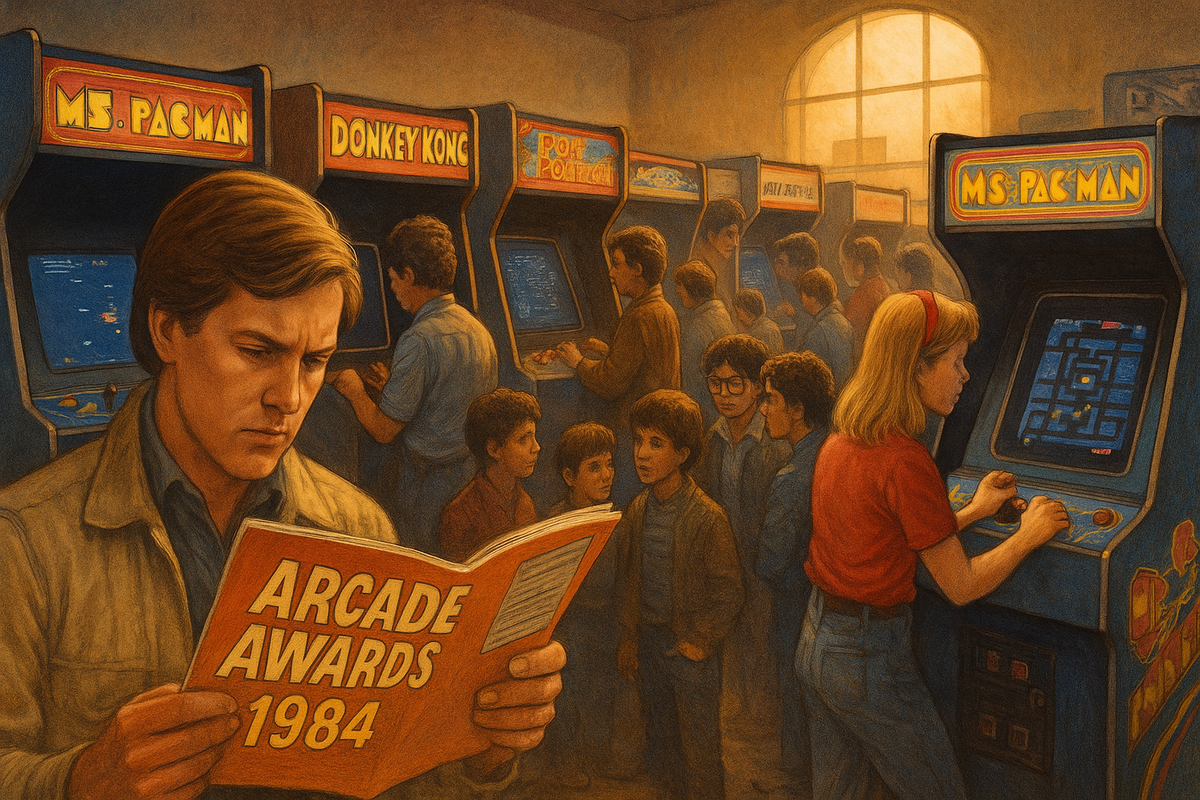
In September 1983, readers who plucked Electronic Games Magazine from the newsstand didn't know they were holding a eulogy.
The cover promised glory: a chrome-plated robotic knight gripping a staff like Excalibur, the headline blazing across his chest—"1984 Videogame of the Year?" Inside, the magazine's centerpiece feature laid out the contenders for the 1984 Arcade Awards with the gravity of an Oscar telecast. Ms. Pac-Man. Dragon's Lair. River Raid. Games that had become cultural touchstones, dissected across seventeen pages of vivid screenshots, critical analysis, and—most radical of all—an official reader ballot.
Mail it back. Make your voice count. Help crown the future.
Except the future was already collapsing.
By the time those ballots arrived at Electronic Games headquarters, the video game crash of 1983 had begun its silent detonation. Too many consoles. Too many cynical cash-grabs rushed to market. A consumer base that had finally stopped believing the hype. The industry wouldn't recover for years. But in this September issue—published at the exact moment the floor began to crack—the magazine's editors were still writing as if gaming's golden age would last forever.
That dissonance is what makes this issue unforgettable.
Archive Details
Publication: Electronic Games Magazine
Issue Date: September 1983
Feature: "Meet the 1984 Arcade Awards Contenders"
Historical Context: Published on the eve of the 1983 video game crash
The Cathedral Moment
By late 1983, Electronic Games had spent three years building something unprecedented: legitimacy. While other publications treated video games as either children's toys or suspicious fads, Electronic Games approached them with the analytical rigor of film criticism. Its writers didn't just describe gameplay—they argued for why it mattered. They tracked industry trends. They profiled developers as auteurs. They treated a 16K cartridge with the same intellectual seriousness Cahiers du Cinéma once gave Hitchcock.
The September issue was the apex of that mission. The 1984 Arcade Awards preview wasn't a marketing stunt. It was a structured, methodical evaluation of video games as a cultural medium—complete with defined categories, judging criteria, and democratic reader participation. For teenagers flipping pages at kitchen tables across America, this was the closest thing to attending the Oscars.
And it worked because Electronic Games understood what players intuited but couldn't yet articulate: these games weren't just entertainment. They were the birth of a new art form.
What the Ballot Revealed
The categories themselves were a manifesto. Each one clarified what the magazine—and by extension, its readers—valued in 1983:
1984 Videogame of the Year (16K or less ROM) went to Ms. Pac-Man for the Atari 2600, a technical marvel that proved home cartridges could replicate arcade magic without compromise. The yellow heroine wasn't just Pac-Man "with a bow"—she was proof that character, design, and tight gameplay could survive the journey from coin-op cabinet to living room.
Best Action Videogame pitted River Raid (Activision/Atari 2600) against Advanced Dungeons & Dragons (Intellivision). One offered breakneck reflex combat over an endless scrolling river. The other delivered dungeon-crawling strategy that felt imported from tabletop RPGs. Both thrived on immersion—the sensation that you weren't just playing a game but inhabiting your world.
Best Audiovisual Effects (16K or more ROM) belonged to Dragon's Lair (Cinematronics), the laserdisc phenomenon that stunned arcade-goers with hand-drawn animation rivaling Disney. It didn't matter that the gameplay was shallow—Dragon's Lair redefined what games could look like, and that visual ambition became a North Star for the next decade.
Coin-Op Game of the Year recognized Pole Position (Atari) and Front Line (Taito), arcade titans that pushed graphical fidelity and mechanical innovation to new heights. These were the games that kept quarters flowing, the benchmarks every developer studied.
Most Innovative Videogame Computer Game honored Happy Trails (Intellivision), a title that dared to inject humor and whimsy into a market dominated by shooters and racers. Innovation wasn't just technical—it was tonal.
Best Multiplayer Videogame Computer Game highlighted Dungeons of Daggorath (TRS-80) and Wizard of Wor (Atari/Commodore), early experiments in cooperative and competitive gaming on home computers. These were the seeds of LAN parties and online matchmaking, planted in an era when "multiplayer" meant crowding around a single monitor.
Each category was a statement. Each nominee, a thesis.
The Artifact Value
For collectors of vintage gaming ephemera, the September 1983 issue of Electronic Games occupies rare air. It's not just nostalgia bait. It's a primary source document from a cultural inflection point.
Historical Timing
Published mere weeks before the crash accelerated, this issue captures the industry at maximum altitude—creatively robust, financially vulnerable, blissfully unaware. It's the last photograph before the avalanche.
Iconic Cover
That robotic knight remains one of the most striking visuals in Electronic Games' entire print run, a sci-fi talisman that feels both futuristic and medieval, perfectly encapsulating gaming's hybrid identity.
Cultural Significance
The 1984 Arcade Awards represent one of the first systematic attempts to evaluate video games as a medium worthy of critical structure. This wasn't Entertainment Weekly covering games as a sidebar—this was a publication arguing that games deserved their own Cannes.
Collector Demand
Early Electronic Games issues—especially those tied to awards, milestones, or landmark releases—command premium prices in archival markets. This September issue checks every box.
Holding it now is like holding a Civil War letter written on the eve of Gettysburg. The writer doesn't know what's coming. That ignorance is what makes it sacred.
Why Print Still Matters
In 2025, gaming news vaporizes the moment it's published. Reviews drop on YouTube and disappear into algorithmic oblivion. Wikis edit themselves into collective amnesia. Nothing is permanent because nothing needs to be.
But Electronic Games was permanent. Readers studied every screenshot. They debated every review at lunch tables. They tore out the ballot, filled it in with ballpoint pen, and mailed it to New York because their opinion mattered. The magazine became a shared artifact—a physical witness to a cultural revolution.
That's the irreplaceable value of vintage print. It can't be patched. It can't be updated. It can't be memory-holed. It simply is, frozen in the moment of its creation, stubbornly refusing to forget.
The Collection
Thousands of original Electronic Games magazines—from the early 1980s through the 1990s—are available for study, acquisition, and preservation. Each issue traces the evolution of gaming culture, technology, and critical thought across two transformative decades.
Collector Significance
Historical Artifact
The September 1983 issue documents the exact moment when video games achieved cultural legitimacy—just before the industry's greatest crisis. This temporal positioning makes it invaluable for understanding the medium's evolution.
Primary Source
Contemporary game history relies on digital archives and secondhand accounts. Original magazines offer unmediated access to how the culture understood itself in real time—no retroactive editing, no revisionist narratives.
Physical Permanence
Unlike digital content that can vanish with a server failure or corporate decision, these magazines exist independent of infrastructure. They are self-contained, archival-quality artifacts that require no electricity to preserve their testimony.
Investment Value
Early Electronic Games issues appreciate steadily in archival markets, particularly milestone editions tied to awards, industry events, or technological shifts. Condition matters—intact issues with original inserts command premiums.
Explore the Archive
Browse thousands of original Electronic Games magazines and witness the evolution of gaming culture from its golden age through the 1990s.
Browse Electronic Games Magazine CollectionCoda
The September 1983 issue of Electronic Games Magazine remains significant not despite the crash that followed, but because of it. This was the moment when video games were celebrated with the gravity of cinema, analyzed with the rigor of literature, and honored with the ceremony of any legitimate art form.
The industry would collapse. Electronic Games itself would shutter in 1994. But this issue—this specific artifact—captured a truth that survived: video games were never just toys. They were the story of a generation learning to dream in pixels.
For anyone who values that story, vintage magazines like this aren't collectibles.
They're evidence.