
The Rebel Christ: How Time Magazine Captured America's Holiest Counterculture
Inside the June 21, 1971 issue that documented the Jesus Movement at its most radical
On June 21, 1971, millions of Americans opened their mailboxes to find Jesus Christ staring back at them—not from a church bulletin, but from the cover of Time Magazine.
Not quite. But close enough to shake the establishment.
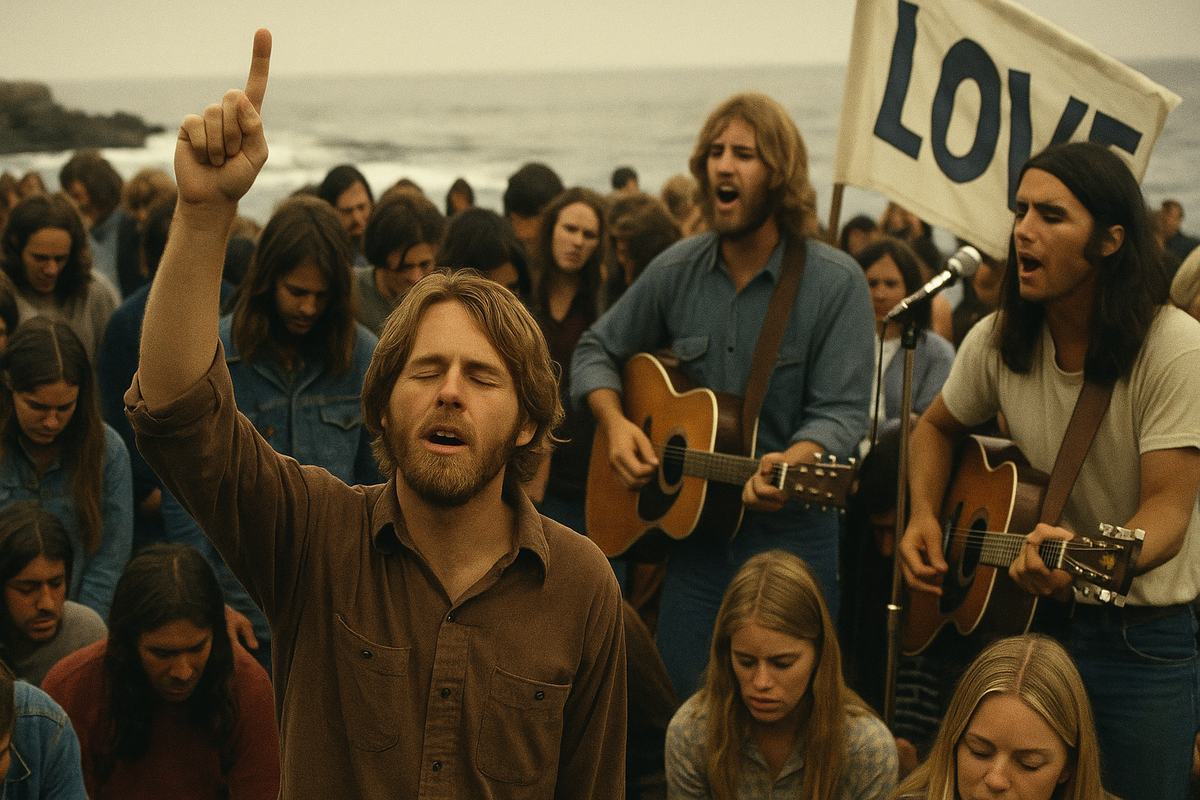
Inside that week's issue, a sprawling photo essay declared what middle America could no longer ignore: the same longhaired youth who had marched against Vietnam, dropped acid at Woodstock, and proclaimed the death of God were now wading into the Pacific Ocean for mass baptisms. They were speaking in tongues in storefront churches. They were raising one finger to heaven and shouting that Jesus—not revolution, not free love—was the answer.
Time called it "The New Rebel Cry: Jesus Is Coming!" It remains one of the most vivid documents of the Jesus Movement ever published.
America at the Breaking Point
The summer of 1971 was a hinge moment. Nixon sat in the White House, besieged by protests and paranoia. The war in Southeast Asia ground on, hemorrhaging lives and credibility. The utopian promises of the 1960s had curdled into overdoses, bad trips, and communes collapsing under their own contradictions.
Into that void stepped the Jesus People—scraggly, sincere, and startlingly devout. They kept the long hair and the guitars, but traded LSD for the Gospel of John. They rejected materialism and the military-industrial complex, but did so in the name of Christ, not Chairman Mao.
For Time's readership—educated, anxious, desperate to understand what their children were doing—the story was both alien and oddly familiar. Rebellion hadn't died. It had simply found a new Lord.
Archive Details
Publication: Time Magazine
Issue Date: June 21, 1971
Feature Title: "The New Rebel Cry: Jesus Is Coming!"
Historical Context: Published six months before Time's iconic "Jesus Revolution" cover of December 1971
Archive Source: Original Magazines Collection
Time's Masterstroke: The Outlaw Messiah
Time opened with a stroke of editorial genius: a mock "wanted poster" for Jesus Christ.
Alias: The Messiah, Son of God, Prince of Peace.
Appearance: Long hair, robe, sandals, hangs with the poor.
Warning: Extremely dangerous. Still at large.
It was cheeky, provocative, and theologically sharper than it had any right to be. To the magazine's writers, Jesus wasn't just a religious figure—he was the ultimate countercultural icon, the original radical whose followers now threatened the status quo as surely as any Black Panther or Yippie.
But the real power of the issue lay in its photography. Across multiple spreads, readers encountered:
Hundreds of young people streaming into the surf at Corona del Mar for open-air baptisms. Prayer circles on football fields, hands clasped, eyes closed. Worship services in converted garages and warehouses, arms raised in ecstatic praise. Antiwar protesters holding signs that asked, "Would Jesus Carry a Draft Card?" The ubiquitous "One Way" symbol—index finger thrust skyward, proclaiming one path to salvation.
The images did what text alone could not: they made the Jesus Movement real. This wasn't theology. It was bodies in motion, faces lit with conviction, a generation finding something worth believing in.
Why This Issue Mattered
Time didn't just report the Jesus Movement. It legitimized it.
Visual Storytelling at Scale
No other newsweekly devoted this much photographic real estate to a religious revival. Full-page color images transformed what could have been dismissed as West Coast eccentricity into a national phenomenon.
Cultural Memory
Time situated the Jesus People within the long arc of American awakenings, drawing lines back to Jonathan Edwards and Charles Finney. The movement wasn't a fluke—it was the latest chapter in the nation's restless spiritual history.
Mainstream Validation
Once Time declared it news, pastors, parents, and politicians had to reckon with it. The Jesus Movement was no longer fringe. It was front and center in the American conversation.
A Prelude to Icon Status
This June 1971 issue served as a prelude. Six months later, Time would publish its iconic "Jesus Revolution" cover, cementing the movement's place in cultural memory. But this earlier feature caught the wave as it was still building—raw, unpolished, and impossibly alive.
What Time Saw on the Ground
The magazine's reporters fanned out across California and beyond, returning with dispatches that read like anthropological fieldwork:
The Hippie Converts – Young people leaving Haight-Ashbury crash pads for Christian communes, where Bible study replaced bong hits and communal discipline replaced chaos.
Solid Rock House and Others – Communes in California that offered food, prayer, and a shared life centered on Jesus. Strict rules, joyful faces.
The Soundtrack of Revival – Christian rock and folk bands writing anthems like "Put Your Hand in the Hand" and "I Wish We'd All Been Ready," giving the movement a sound as distinct as its message.
Faith Meets Politics – Signs that blurred the line between worship and protest: "Would Jesus Carry a Draft Card?" The question was pacifist, prophetic, and impossible to ignore.
A Revival Without Borders – Catholic Pentecostals speaking in tongues. Jewish converts embracing Christ. The Jesus Movement cut across denominational lines, ethnic lines, even the sacred boundary between church and street.
Every vignette pointed to the same conclusion: Jesus had become the banner of a new counterculture, one that rejected the establishment on its own terms.
The Collector's Perspective
A Moment Before the Icon
Published months before the December 1971 "Jesus Revolution" cover, this issue captures the movement in its ascent, before it became a cultural cliché.
Firsthand Documentation
The photographs of beach baptisms, prayer huddles, and ecstatic worship are among the most recognizable images of the era. Owning the original is owning the source.
Cultural Crossroads
This issue sits at the intersection of religion, politics, youth culture, and media history. It's essential reading for anyone studying the 1970s.
Collector Demand
Religious historians, cultural archivists, and families preserving the memory of the Jesus Movement all seek this issue. Clean copies are increasingly hard to find.
The Rebel Cry, Preserved
The June 21, 1971 issue of Time captured something fleeting and powerful: a generation in motion, a culture in flux, a moment when the counterculture looked up instead of out. The photographs, the reporting, the sheer audacity of framing Jesus as an outlaw—all of it endures.
For collectors, it's a piece of history. For historians, it's a primary source. For anyone who lived through the 1970s or wants to understand them, it's indispensable.
To hold this magazine is to hold a question America was asking itself: What happens when the rebels find God?
Explore the Archive
Discover this issue and thousands more from the 20th century's most influential publications.
Browse Time Magazine Collection