
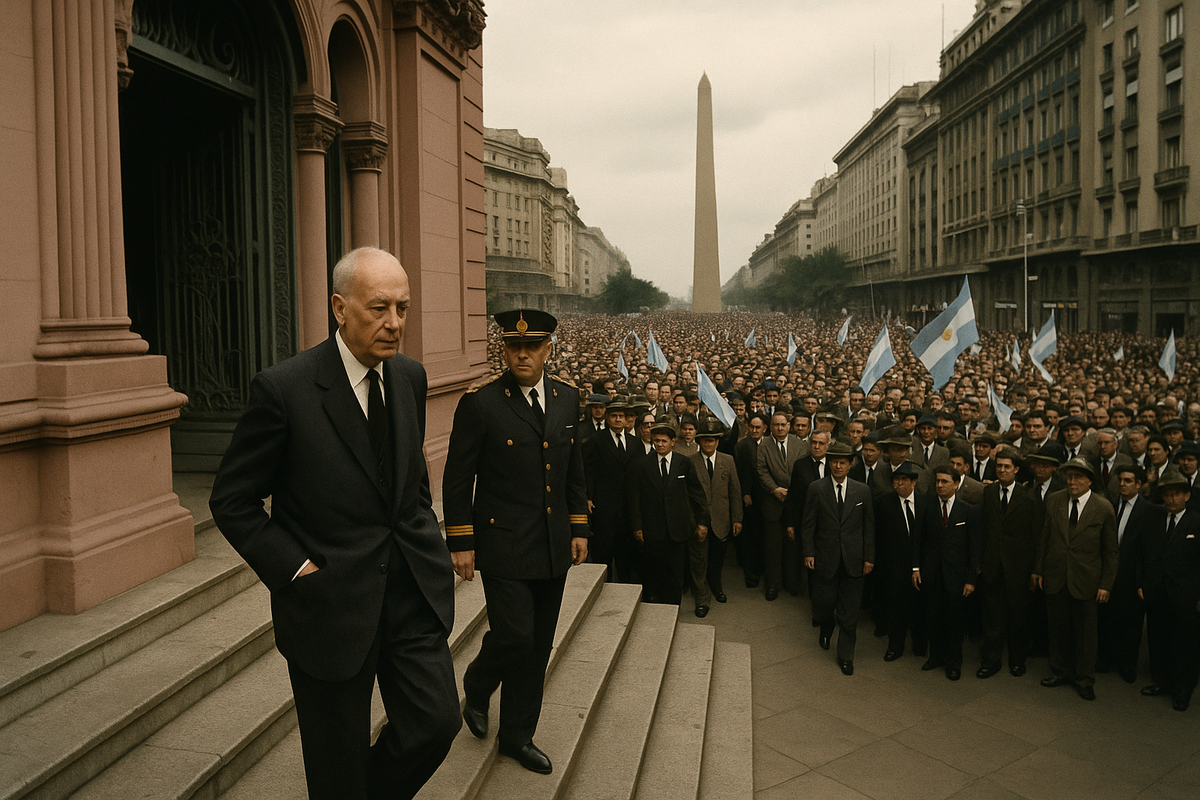
The Ghost That Wouldn't Die
When Time Magazine Captured Argentina's 1962 Collapse
On March 30, 1962, American breakfast tables received an omen they didn't know how to read.
That morning's Time Magazine carried a feature that should have been a warning shot—not just about Argentina, but about the fragility of democracy itself when populism refuses to stay buried. The article, "Ghost from the Past," documented President Arturo Frondizi's final days in power. Within weeks, he would be gone. But the ghost Time wrote about—Juan Perón and his movement—would haunt Argentina for another generation.
For readers sipping coffee in Kansas City or commuting through Grand Central, this wasn't idle foreign correspondence. This was Cold War cartography. Castro had already claimed Cuba. The Bay of Pigs had failed spectacularly just one year earlier. And now Argentina, the most European, most "stable" nation in South America, was tearing itself apart over a man who hadn't set foot in the country for seven years.
Time didn't just report the crisis. It mapped it, photographed it, and framed it as a parable Americans needed to understand.
Issue Archive
Publication: Time Magazine
Issue Date: March 30, 1962
Featured Article: "Ghost from the Past"
Historical Context: President Arturo Frondizi's Final Days
Cold War Era: Between Bay of Pigs (1961) and Cuban Missile Crisis (1962)
The Impossible President
Arturo Frondizi never stood a chance.
Elected in 1958, he attempted what political scientists now recognize as a doomed compromise: modernize Argentina's economy while tolerating the Peronist movement that still commanded the loyalty of unions, workers, and vast swaths of the countryside. To the military, this made him a collaborator. To Peronists, he was an imposter blocking their rightful return.
By March 1962, the equation had become simple: Peronist candidates, though technically banned, swept provincial elections. The military issued its ultimatum. Frondizi, bookish and conciliatory, tried to negotiate. The generals were done negotiating.
Time captured him in ceremonial dress, presiding over parades he no longer controlled. The magazine's language was clinical but damning: "unlikely leader," a man caught between forces he could neither master nor escape. The accompanying photographs told the real story—governor-elects celebrating victories that violated every rule, Buenos Aires' Ninth of July Avenue gleaming with the promise of a modernity Argentina couldn't seem to reach.
The Map That Told the Truth
The most striking element of Time's coverage wasn't text—it was a bold, shaded map titled "Peronistas' Power."
Province by province, the graphic revealed what words struggled to convey: Peronism wasn't a movement. It was the political geology of Argentina itself. The shaded regions formed an unbroken territory of loyalty, a shadow government waiting to reclaim substance.
For American readers accustomed to clean electoral maps and peaceful transfers of power, this was unsettling visual evidence. Democracy, it turned out, could win elections and still lose the country.
Why Washington Watched
Time's hemispheres section didn't treat Argentina as exotic spectacle. It treated it as strategic crisis.
The framing was explicit: what happened in Buenos Aires mattered in Washington. The magazine positioned Frondizi's fall within the binary logic of 1962—either nations aligned with the West and embraced liberal democracy, or instability opened doors for radical alternatives. There was no third option, no room for the messy reality of a populist movement that defied Cold War categories.
Peronism was neither communist nor capitalist, neither democratic nor fascist in the clean sense Americans understood. It was Argentine, which meant it resisted the very frameworks Time's readers used to make sense of the world. The article struggled with this, falling back on the language of "strongmen" and "demagogues" because the alternative—acknowledging that millions of Argentines genuinely wanted Perón back—complicated the narrative too much.
Frondizi's Fragile Presidency
Portrayed as bookish, cautious, and out of step with military demands, his downfall seemed inevitable from the moment Time went to press.
Peronist Resurgence
Despite being banned, Peronist candidates swept provincial elections, proving the movement's resilience and revealing democracy's paradox.
Military Pressure
Generals, long hostile to Peronism, viewed Frondizi as dangerously lenient and began pressing for his immediate removal.
Cold War Lens
Time framed the struggle within U.S.-Soviet rivalry, highlighting Washington's fears of instability spreading south from Cuba.
The Argentine Dilemma
How to modernize a nation while reconciling with a populist legacy that refused to fade—a question that remains unanswered.
Visual Documentation
The "Peronistas' Power" map remains one of the era's sharpest political graphics, visualizing power with striking clarity.
The Artifact Worth Keeping
Timing
Published days before Frondizi's actual removal, it caught history at the breaking point—analysis as prophecy.
Visual Documentation
The "Peronistas' Power" map remains one of the sharpest pieces of political graphics from early 1960s Time, a snapshot of how mid-century journalism visualized power.
Cold War Context
Positioned between the Bay of Pigs (April 1961) and the Cuban Missile Crisis (October 1962), this issue captures American anxiety at its peak—the moment when Latin America felt like the next domino.
Editorial Voice
Time in 1962 wrote with an authority modern journalism has largely abandoned. There's no hedging, no "some observers say." The prose declares, judges, frames. Reading it now is like handling a fossil from an extinct species of certainty.
Why Vintage Magazines Matter
A history book will tell you Frondizi fell in March 1962. This magazine shows you how Americans understood it as it happened—with all the bias, urgency, and Cold War paranoia intact.
That's the difference between retrospective analysis and primary evidence. One explains what occurred. The other preserves how it felt.
These magazines don't just report the past. They are the past—ink, paper, advertisements for products that no longer exist, letters to the editor from readers long dead. They capture the texture of a moment: what people feared, what they ignored, what they got wrong, and what they saw with surprising clarity.
In an age when news evaporates within hours, these physical objects endure. They connect us to grandparents who read them over breakfast, to a world where a magazine arrived weekly and shaped opinion for days, not seconds.
Explore the Archive
The March 30, 1962 issue—and thousands of other original Time magazines—are available in our curated collection.
Browse Time Magazine CollectionEach magazine is an original artifact, not a reproduction. Together, they form a library of the 20th century as it unfolded: politics, culture, science, war, and the slow recognition that the future wouldn't look like anyone expected.
The ghost Frondizi faced in 1962 never disappeared. Perón himself returned to Argentina in 1973, won the presidency again, and died in office the following year. His widow succeeded him. The movement fractured into factions that still shape Argentine politics today. Time's "Ghost from the Past" turned out to be a permanent resident—a reminder that in politics, nothing stays buried unless the soil itself changes.
This magazine documented the moment Argentina learned that lesson. It remains worth reading for the moment we might need to learn it again.