
The Photograph That Predicted History
Ernie Davis and the December 1961 Ebony That Captured a Heisman Winner Before the World Knew His Name
In December 1961, newsstands across America displayed an issue of Ebony Magazine that would become a time capsule of a nation on the edge of transformation. Actress La Bonita Bianchi graced the cover, but inside, a sprawling photo-essay told a different story—one that would reverberate through sports history, civil rights, and American culture for generations.
"Ernie Davis: Everybody's All America" arrived in readers' hands just weeks before the Syracuse halfback would shatter college football's most stubborn racial barrier. The feature captured Davis at the apex of his athletic power, yet still in the quiet moment before immortality. By month's end, he would become the first African American to win the Heisman Trophy. But this Ebony spread remains singular precisely because it documented him before that threshold—a young man whose greatness was undeniable, whose achievement was imminent, whose story was still being written in real time.
For collectors and historians today, this issue represents something rarer than prescience. It is evidence of a Black publication asserting what the mainstream sports press had not yet fully acknowledged: that Ernie Davis was not just talented. He was transcendent.
Archive Details
Historical Figure: Ernie Davis, Syracuse University halfback and first African American Heisman Trophy winner
Issue Date: December 1961
Archive Source: Ebony Magazine, founded 1945 by John H. Johnson
Feature Title: "Ernie Davis: Everybody's All America"
Historical Context: Published during the Freedom Rides and weeks before Davis won the Heisman Trophy
The America That Opened This Magazine
The readers who pulled this issue from mailboxes or magazine racks in late 1961 inhabited a country splitting at its seams. The Greensboro sit-ins had ignited student activism across the South the previous year. The Freedom Rides were testing—and often bleeding for—the promise of desegregated interstate travel. Martin Luther King Jr. and a young President Kennedy were circling each other in a cautious dance around the question of federal power and racial justice.
Sports offered no sanctuary from these tensions. It amplified them.
When Ernie Davis took the field for Syracuse, he carried more than a football. He carried the weight of representation in a sport that had only recently begun to integrate its upper echelons. He followed in the considerable shadow of Jim Brown, Syracuse's previous star and the most dominant Black athlete in professional football. But Davis was forging his own path—2,000 yards, 27 touchdowns, and a statistical demolition of the records Brown had left behind.
What made Davis dangerous to the status quo was not merely his athleticism. It was his refusal to fit the caricature. He was a B-minus economics major. He listened to jazz in his dorm room. He signed autographs with genuine warmth. He spoke with intelligence and carried himself with dignity that no stereotype could contain.
Ebony understood the assignment. This was not a sports profile. This was a manifesto in photo-essay form.
What Ebony Saw That Others Missed
Founded in 1945 by John H. Johnson, Ebony had spent sixteen years building an editorial philosophy that mainstream publications could not—or would not—replicate. Where Life and Look might feature a Black athlete as an exotic curiosity, Ebony showed the fullness of the person. Where sports pages reduced men to statistics and muscle, Ebony insisted on context, humanity, and cultural significance.
The Ernie Davis feature exemplified this approach with surgical precision:
On the Field
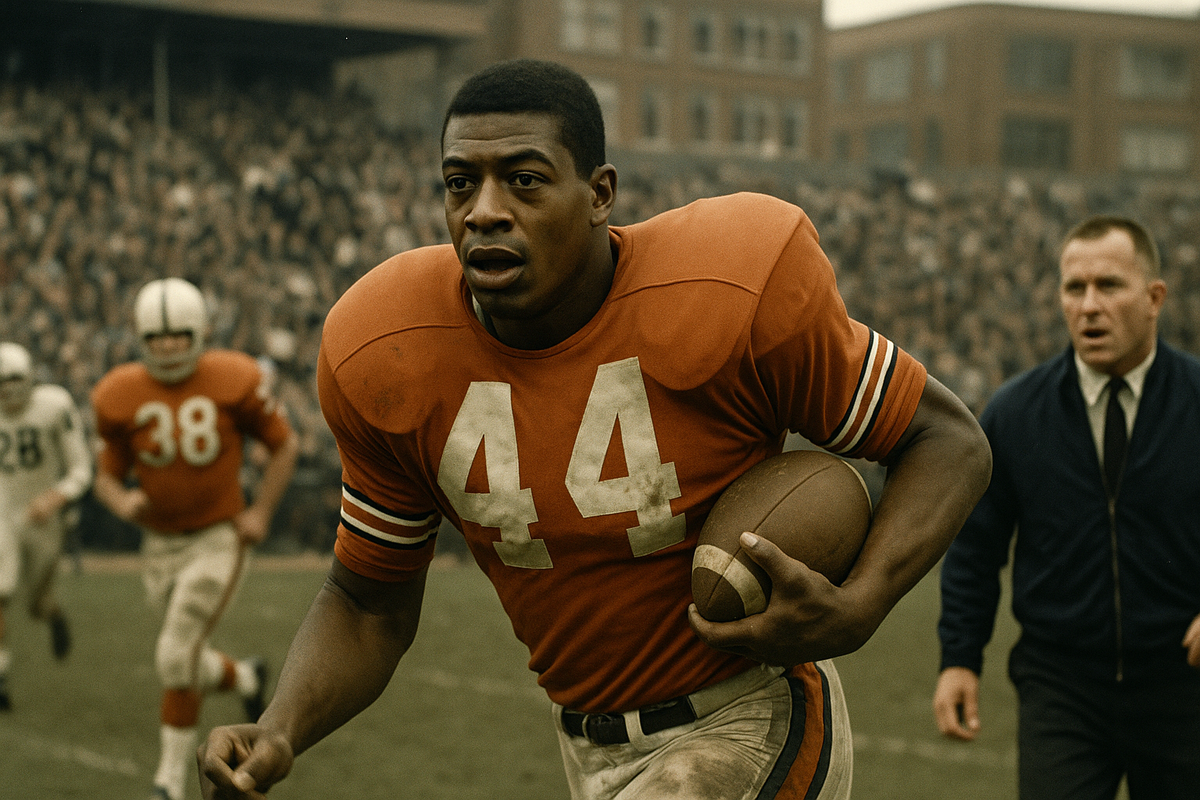
Photographers captured Davis in motion—number 44 blurring past defenders, muscles coiled in midair, the kinetic poetry of an athlete operating at the outer limits of human capability. The images vibrated with action, backgrounds smeared by speed, contrasts sharpened to emphasize his dominance.
On the Sidelines
Readers saw a different Davis—kneeling alongside white teammates, absorbed in a coach's instructions, towel draped over his shoulders in a moment of post-play exhaustion. These frames communicated discipline, teamwork, and the quiet authority of a man who did not need to perform his leadership.
On Campus
The photo-essay followed Davis across the Syracuse quad, books under arm, blending into the flow of student life. The message was deliberate: he was not a mercenary athlete parachuted in to win games. He was a student. An economics major. A young intellectual navigating the same dormitories and dining halls as his peers.
In Intimate Spaces
The lens turned softer. Davis in his room at Sadler Hall, surrounded by jazz records. Davis leaning against his 1957 Oldsmobile. Davis laughing with friends. These were not trophy shots. They were invitations into a life lived beyond the stadium lights—a life textured by music, friendship, and the ordinary pleasures of young adulthood.
This layered portraiture achieved something radical: it presented a Black athlete as a complete human being. Not raw talent awaiting cultivation. Not a symbol requiring explanation. A man. Complex. Thoughtful. Worthy of admiration on multiple planes.
The Gentle Giant Who Rewrote the Playbook
Coaches and sportswriters had taken to calling Davis "the nation's No. 1 back," and the statistics bore out the superlative. He had eclipsed Jim Brown's Syracuse records with ruthless efficiency. But those who knew him spoke less about yards and more about character.
Davis was powerful enough to flatten linebackers. Yet he was remembered for his humility. He could have leveraged his fame into swagger and endorsements. Instead, he remained gracious, soft-spoken, uninterested in personal mythology. In an era when Black athletes were often expected to perform gratitude for the opportunity to compete, Davis offered something more subversive: quiet self-possession.
He refused to be spectacular in the ways white America found comfortable. He was not the "natural athlete" whose gifts required no intellect. He studied economics. He maintained academic standards while carrying the physical burden of being the most targeted player on every field he entered. He demonstrated that excellence and humility were not contradictions but complements.
For Ebony's readers, this mattered profoundly. Davis was not succeeding despite his Blackness or by suppressing it. He was succeeding as a fully realized person who happened to be Black—and that distinction, in 1961, was revolutionary.
The Issue That Became an Artifact
Decades later, the December 1961 Ebony has ascended from magazine to historical document. Its value to collectors stems from a confluence of factors that rarely align:
Historical timing—The issue arrived in the narrow window between Davis's dominance and his coronation. It captured the inflection point, the moment before the world caught up to what Ebony already knew.
Civil rights context—Published during the Freedom Rides and in the year of executive orders aimed at desegregating federal employment, the Davis profile existed within a larger narrative of African American advancement. It was part of the proof that progress, however incomplete, was tangible.
Tragic truncation—After being drafted first overall by the Cleveland Browns in 1962, Davis was diagnosed with leukemia. He died in May 1963 at age 23, never playing a single professional game. This Ebony feature is one of the few major profiles published while he was alive and healthy—a document of potential rather than elegy.
Photographic excellence—The combination of action photography and intimate portraiture created a visual record that transcends sports journalism. These images are studied in courses on media representation, civil rights history, and the evolution of American magazine culture.
Cultural stewardship—Ebony served as the visual archive of Black life in the twentieth century. For families who saved and passed down issues like this one, the magazine was not disposable media. It was heritage.
To acquire this issue now is to hold a fragment of that archive—a moment when representation, excellence, and possibility converged on glossy pages that smelled of ink and ambition.
The Bittersweet Afterimage
Ernie Davis's story ended before it should have. The leukemia diagnosis came swiftly. The decline was cruel. The death, at 23, was a theft of decades.
But this Ebony issue preserves him otherwise. Here, he is strong. He is smiling. He is full of the future. The tragedy has not yet written itself across his narrative. To encounter these pages is to see Davis as his teammates saw him, as his coaches saw him, as Ebony's editors saw him—not through the haze of what was lost, but in the sharp focus of what was achieved.
This is the power of archival journalism. It arrests time. It refuses to let the ending rewrite the middle.
Why Ebony Was Indispensable
The Davis profile illuminates a larger truth about Ebony's cultural role. In an era when mainstream media offered Black Americans only sporadic, often demeaning visibility, Ebony provided consistent, dignified representation. It covered the breadth of Black life—from entertainers to educators, from athletes to activists, from triumph to everyday grace.
For readers, Ebony was both mirror and aspiration. It reflected the world they inhabited and modeled the world they were building. It treated its subjects with the editorial sophistication that white publications reserved for white subjects. And it created a visual and textual record that would allow future generations to understand not just what happened, but how it felt to live through history as it unfolded.
Families saved these issues. They passed them down. They treated them not as ephemera but as evidence—that we were here, that we mattered, that we told our own stories.
For Collectors: Why This Issue Matters
Historic First
Documents the first African American Heisman Trophy winner, captured in the decisive moment before the award was announced.
Civil Rights Milestone
A civil rights era landmark in media representation, published during the Freedom Rides.
Athletic Legacy
One of the most important athletes of the twentieth century, preserved during his brief prime.
Editorial Vision
The editorial vision of Ebony at the height of its cultural influence and journalistic power.
This is not a common issue. It is a cornerstone.
Explore the Archive
From athletes to artists, from movement leaders to everyday families navigating a transforming nation, Ebony chronicled Black American life with unmatched depth and care.
Browse Ebony Magazine CollectionThe Legacy in Your Hands
To hold the December 1961 Ebony is to hold a question and its answer. The question: Could a young Black man from Elmira, New York, rise to the pinnacle of American sports while maintaining his dignity, his intellect, and his humanity intact? The answer: Ernie Davis, in full color and motion, smiling from the pages of a magazine that believed in him before the trophy made belief obligatory.
His life was too short. But the record remains—not tragedy, but triumph. Not what was taken, but what was given. Not the silence of absence, but the roar of a crowd that, for one golden season, could not deny greatness when it wore number 44.
This is why we preserve these pages. This is why we return to them. Because history is not just what happened. It is how we chose to remember—and who we trusted to tell the story.