
Atari's Last Bet: When Electronic Games Magazine Witnessed the Future—Before It Collapsed
Inside the January 1983 issue that captured Atari's boldest gamble at gaming's most precarious moment
Hold this magazine in your hands. January 1983. The pages still smell faintly of newsprint and optimism. Donkey Kong snarls from the cover, barrel cocked, while Mario braces for impact. Inside, Electronic Games Magazine asks the question that would haunt Atari for decades: "Is This the Videogame of the 1980s?"
They were talking about the Atari 5200 SuperSystem. And they had no idea they were documenting a requiem.
For families standing in electronics stores that winter, this wasn't just another console review. This was the debate—printed, photographed, analyzed with the kind of seriousness that video games had only recently earned. Do we bet on Atari's future? Or do we stick with the 2600, the ColecoVision, the Intellivision? Electronic Games didn't just cover the 5200. It made the machine real. It made the choice urgent.
And then, by Christmas, the industry began to collapse.
Archive Details
Publication: Electronic Games Magazine
Issue Date: January 1983
Featured System: Atari 5200 SuperSystem
Cover Feature: Donkey Kong vs. Mario barrel-throwing illustration
Historical Context: Published months before the 1983 video game industry crash
The Console Wars at Peak Velocity
By late 1982, the home gaming market was a gladiatorial arena. ColecoVision had landed a knockout punch with arcade-perfect Donkey Kong. Mattel's Intellivision promised "smarter" play with voice synthesis and sports simulations that felt closer to ESPN than Pong. Even Magnavox's aging Odyssey² still commanded shelf space through sheer inertia.
Atari had ruled this world since 1977. The 2600 was the de facto console—the standard, the monolith, the machine everyone owned. But by 1982, its graphics looked primitive. Its library, while massive, couldn't compete with the shimmer and complexity pouring out of arcades. If Atari wanted to survive the 1980s, it needed to evolve.
Enter the 5200 SuperSystem: a machine built on the bones of Atari's 400/800 computers, promising arcade-grade animation, expanded memory, and controllers so advanced they bordered on experimental. This wasn't an incremental upgrade. This was Atari betting everything on reinvention.
Electronic Games Magazine was there to chronicle the gamble.
When Game Journalism Meant Something You Could Hold
Founded in 1981, Electronic Games was the first publication to treat video games as culture, not just commerce. No toy-catalog fluff. No reprinted press releases. This was journalism—reviews, strategies, technical breakdowns, and market analysis written for readers who wanted to understand not just what to buy, but why it mattered.
The January 1983 issue exemplified that mission. The cover balanced irreverence (Donkey Kong's cartoon menace) with gravitas (the promise of serious reporting inside). Flip past that cover, and you encountered something rare: evidence. Side-by-side screenshots of Missile Command, Galaxian, and Super Breakout. Close-ups of the 5200's futuristic analog controllers. Game-by-game evaluations that didn't pull punches.
This wasn't hype. This was testimony.
For families trying to navigate the console wars, this issue became a compass. Parents who couldn't tell a joystick from a paddle trusted Electronic Games to translate the technical into the tangible. Kids who saved allowances for months studied these pages like scripture. To hold this magazine in 1983 was to hold the future—or at least, the version of the future Atari wanted you to believe in.
The 5200: Ambition Meets Reality
The Electronic Games feature dissected the 5200 with surgical precision, and what it revealed was both impressive and troubling.
Design: The Aesthetic Gambit
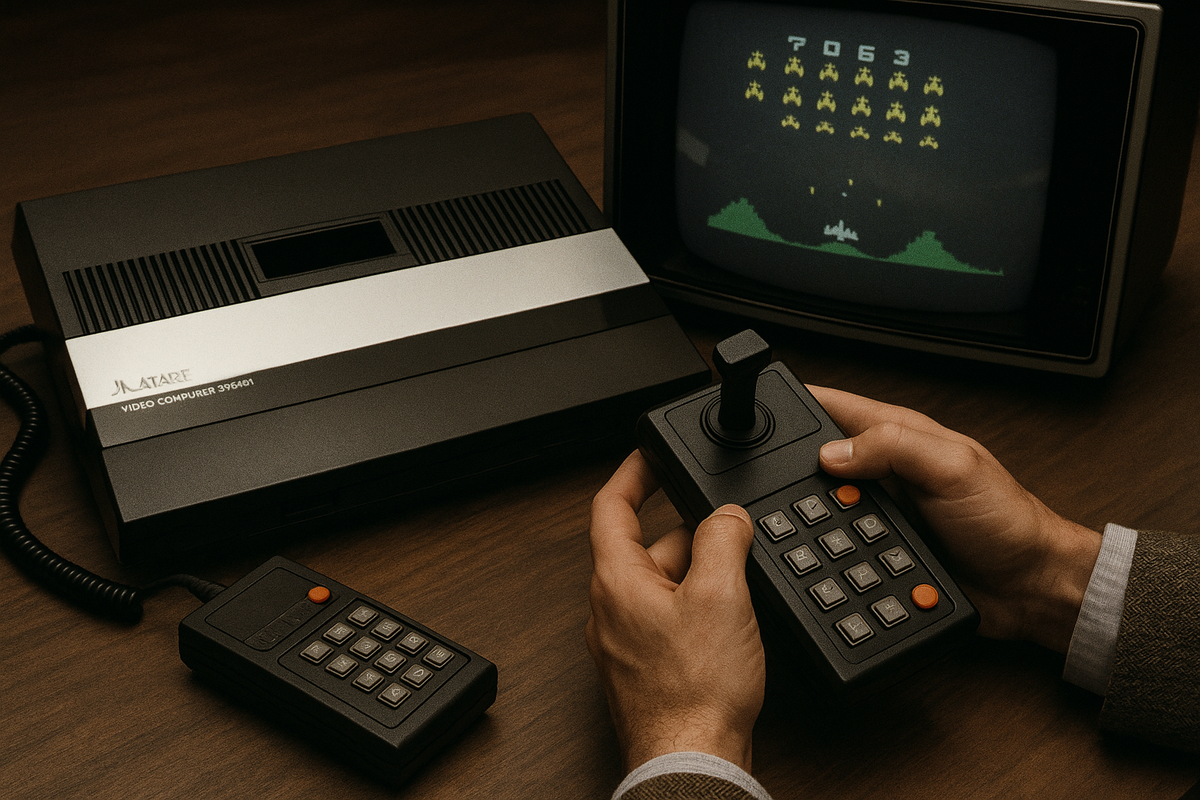
Visually, the 5200 was a statement piece. Sleek, wide-bodied, with a top-loading cartridge slot that felt more like a VCR than a toy. With 64K RAM cartridge capability and graphics engines borrowed from Atari's computer line, it promised a decade of runway.
Controllers: Revolutionary or Reckless?
The 5200's analog joystick offered 360-degree movement and variable speed. But the controllers lacked self-centering, turning precision games into frustration. The built-in numeric keypads added bulk and complexity many players didn't want.
The Launch Library: Remixes, Not Revolutions
The magazine reviewed the 5200's initial lineup with clear eyes:
Missile Command – Faster, smoother, and arguably the system's strongest debut. This was the 5200 firing on all cylinders.
Space Invaders – Faithful, competent, but not revelatory. A safe port that didn't justify the hardware leap.
Galaxian – New to Atari's home ecosystem and impressively arcade-accurate. A genuine win.
Super Breakout – Solid, but hardly transformative. The game looked better, but didn't feel different.
Star Raiders – Positioned as the killer app. This space combat simulator, borrowed from Atari's computers, showcased the 5200's power and ambition. But it also revealed the system's strategic flaw: heavy reliance on existing Atari franchises.
The subtext was damning. The 5200 wasn't innovating—it was upgrading. And for a console meant to define the decade, that distinction mattered.
The Compatibility Crisis
Then came the issue's most critical observation: the 5200 could not play 2600 games.
ColecoVision offered backward compatibility with the 2600 via an adapter, making it a safe choice for families with existing libraries. The 5200 demanded you start over. For households that had spent years building cartridge collections, this wasn't just inconvenient—it was a betrayal. Atari was asking loyalists to abandon the ecosystem that made Atari dominant in the first place.
Electronic Games didn't miss the irony. And neither did consumers.
Physical History in a Digital Age
Online reviews vanish. Blogs get deleted. Digital archives corrupt. But these magazines—printed, bound, archived in attics and collections—survived. They are witnesses.
Electronic Games chronicled gaming's most volatile decade with rigor and passion. Every page is a timestamp: what we believed, what we hoped for, what we got wrong. In an era where the past is rewritten constantly, these physical artifacts are anchors. They remind us that history was once captured slowly, carefully, and saved.
That permanence is why collectors prize them. That permanence is why they matter.
Why This Issue Endures
Forty-two years later, the January 1983 issue of Electronic Games remains one of the most collectible magazines in gaming history. Here's why:
Historical Timing
This issue captured Atari's peak confidence mere months before the 1983 crash decimated the industry. It's optimism fossilized in newsprint.
Iconic Cover Art
Donkey Kong's barrel-throwing grimace became one of gaming journalism's most recognizable images. It perfectly encapsulates the arcade-to-home migration of the era.
Definitive 5200 Coverage
One of the earliest and most comprehensive examinations of the 5200 in print. For collectors, it's the primary source.
Cultural Artifact
To own this issue is to own the debate. Should families upgrade? Was Atari still king? This magazine made those questions tangible.
When you hold this issue today, you're not just reading a review. You're holding the moment when the future was still unwritten—and when one of gaming's giants reached for glory, only to find the ground giving way beneath them.
Explore the Archive
Our collection includes dozens of original Electronic Games magazines spanning the 1980s and 1990s—from the arcade boom through the console wars, from Atari's dominance to Nintendo's resurrection. Each issue is a window into gaming's evolution, preserved as it was first reported.
Whether you're a serious collector, a cultural historian, or someone honoring the memory of a console that defined your childhood, these magazines offer something irreplaceable: the chance to see history as it happened.
Browse Electronic Games Magazine CollectionThe Last Word
The January 1983 issue of Electronic Games Magazine documented Atari's boldest move at its most precarious moment. The 5200 SuperSystem promised to secure the company's dominance for a decade. Instead, it became a monument to overreach—a machine that asked too much and delivered too late.
But the magazine endures. And in its pages, we see not just what Atari built, but what we believed was possible. That belief—frozen in ink and photographs—is what makes this issue essential.
For collectors, historians, and anyone who understands that the past is only as real as the artifacts we preserve, this magazine is more than paper. It's proof that we were there. That we cared. That the future once looked very different than what arrived.
Hold it. Read it. Remember.