
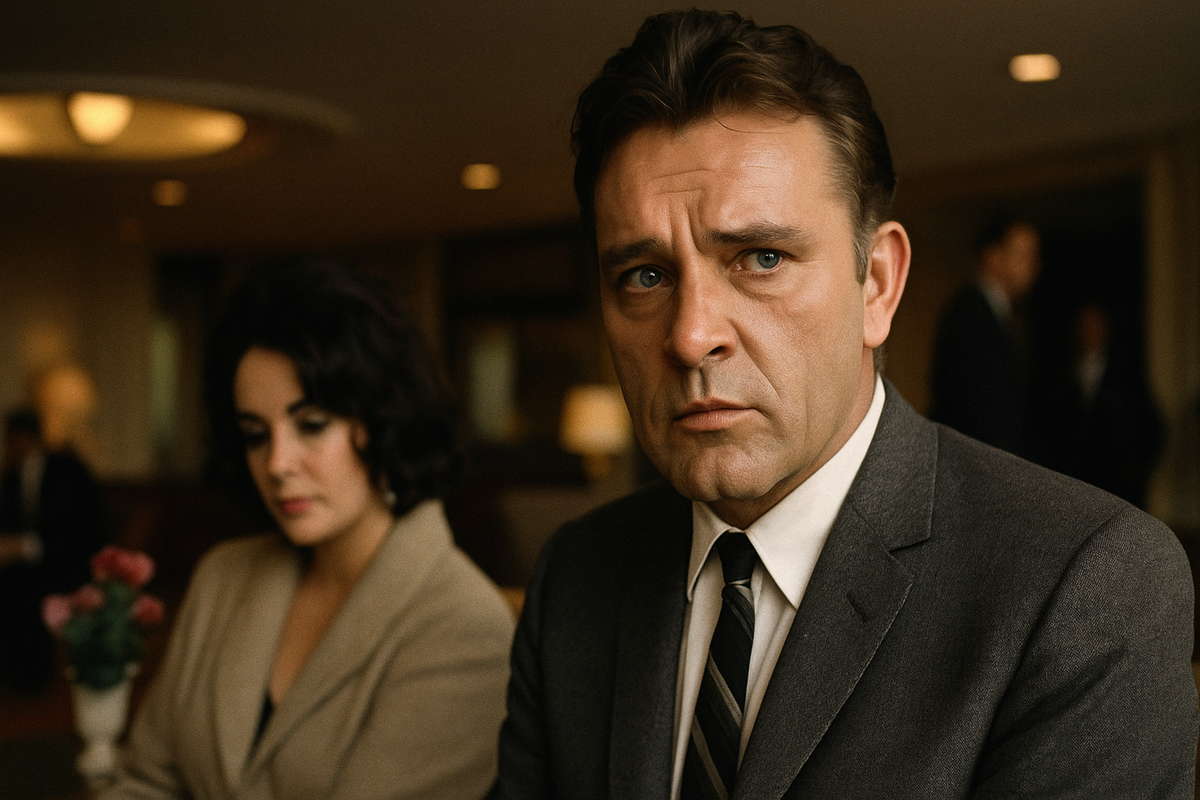
When Richard Burton Owned America
The Time Magazine Cover That Changed Celebrity Forever
April 26, 1963. A Welsh coal miner's son stared out from newsstands across America with eyes that could ignite a stage—or a scandal. That morning, Time Magazine didn't just profile an actor. It documented the exact moment celebrity transformed from studio-manufactured glamour into something rawer, more dangerous, and infinitely more fascinating.
Richard Burton had arrived.
Archive Details
Historical Figure: Richard Burton
Issue Date: April 26, 1963
Archive Source: Time Magazine
Cultural Context: The transformation of celebrity during Hollywood's transition from the Golden Age studio system to the era of global, tabloid-driven stardom
The Collision of High Art and Low Gossip
For American readers in 1963, Burton represented an irresistible contradiction. Here was a man who could deliver Hamlet with Shakespearean thunder one night and dominate tabloid headlines the next. His affair with Elizabeth Taylor during the filming of Cleopatra—both married to others, the press ravenous—had become the decade's defining scandal. Yet his Welsh working-class roots and Oxford-trained gravitas kept him from dissolving into mere gossip-column fodder.
Time understood what it was witnessing: the birth of modern celebrity, where artistic credibility and personal chaos fed each other in an endless, magnetic loop.
The early 1960s were pivoting hard. The Golden Age studio system was crumbling. Television had invaded living rooms. Tabloids were multiplying. And international press coverage meant that a romance in Rome could electrify readers in Des Moines by breakfast. Burton stood at the eye of this storm—classical actor turned global phenomenon, his face on Broadway billboards while his personal life detonated across continents.
Time's Surgical Portrait
By 1963, Time had mastered the art of cultural anatomy. The magazine didn't simply report Burton's career—it dissected why he mattered to a nation navigating Cold War anxieties and seismic cultural shifts.
The article excavated Burton's origins in Pontrhydyfen, a Welsh coal-mining village shadowed by a railway viaduct. It traced his unlikely journey from Oxford scholarship student to the commanding presence in Hamlet and Coriolanus that earned him comparisons to Laurence Olivier. And it refused to sanitize: Burton emerged as moody, magnetic, brilliant, and self-destructive—a man who drank too much, loved too hard, and burned too bright.
What elevated Time's coverage was its visual architecture. Readers didn't just read about Burton—they encountered him across multiple registers:
On stage: Powerful photographs of his Shakespearean performances, capturing the theatrical intensity that made him a legend before Hollywood ever touched him.
At home: A portrait of his parents, anchoring him in working-class Welsh tradition—a reminder that stardom hadn't erased his origins.
In scandal: A candid shot with Elizabeth Taylor at London's Dorchester Hotel, glamour and controversy fused into a single frame.
As father: Burton with his daughter Jessica, a rare glimpse of the private man behind the public inferno.
This wasn't fan magazine puffery. It was cultural journalism as portraiture.
The Cover That Defined an Era
Time's April 26, 1963 cover stripped away Hollywood gloss. Shot in dramatic black-and-white, Burton's face commanded attention—piercing gaze, theatrical intensity, no softening filters. This was an artist at full power, not a matinee idol packaged for easy consumption.
The editorial voice matched the visual severity. Time's writers didn't fawn. They acknowledged Burton's demons—the drinking, the volcanic temperament—while celebrating his undeniable charisma and talent. The balance was surgical: admiration without worship, critique without dismissal. Time positioned itself not as starry-eyed fan but as cultural arbiter, explaining why this complicated, contradictory figure mattered.
Why This Issue Endures
"The Man on the Billboard"
Burton's image looming over Broadway, embodying the shift from stage respectability to mass-market celebrity.
Welsh Roots vs. Hollywood Excess
The coal-mining town contrasted against Cleopatra's notorious budget overruns and on-set chaos.
Stage to Screen
The tension between theatrical legitimacy and Hollywood spectacle, a debate Burton embodied but never resolved.
The Taylor Factor
How their relationship didn't just fuel his fame but redefined what the public expected from celebrity romance: drama, danger, destruction.
Flawed Genius
Burton as the prototype for modern celebrity: talented enough to earn respect, troubled enough to dominate headlines.
Collector Significance
Cultural Milestone
It captures Burton at the precise moment of global ascension, before his career trajectory became complicated by the very fame this issue helped cement.
Hollywood Archaeology
Its Cleopatra coverage situates it within one of cinema's most infamous productions, a film that nearly bankrupted 20th Century Fox and redefined Hollywood excess.
Visual Archive
The interior photographs make this one of the most striking Time issues of the decade—a masterclass in mid-century magazine design and celebrity portraiture.
Cross-Disciplinary Appeal
Theater historians, film scholars, and celebrity culture researchers all find distinct value in this single issue, making it a cornerstone piece for serious collections.
Why Original Magazines Matter
Vintage issues endure because they are immediacy frozen in print. They show how the world first experienced these moments—not through hindsight or revision, but in real time, with all the period assumptions, anxieties, and enthusiasms intact.
Unlike digital reproductions, the physical magazine carries its era in every element: the typography, the advertisements for products long extinct, the editorial framing that reveals what a culture valued and feared. To hold the April 26, 1963 issue is to hold 1963 itself—the moment when Richard Burton became both icon and cautionary tale.
Explore the Archive
If Burton's transformation fascinates you—or if you're drawn to the machinery of fame in the 1960s—this issue is essential. But it represents just one artifact in a vast collection of 20th-century cultural history preserved in original form.
Browse Time Magazine CollectionEach issue is an original artifact, capturing the headlines, personalities, and turning points that shaped the modern world.
The April 26, 1963 issue of Time Magazine remains a landmark—not just in Burton's story, but in the evolution of celebrity itself. It documented a man who was simultaneously Shakespearean titan and tabloid sensation, whose talent justified his chaos until it didn't, whose love affair with Elizabeth Taylor became the template for every celebrity romance-as-public-spectacle that followed.
For collectors, historians, and anyone who recognizes that fame is a story we tell ourselves about the extraordinary, this magazine isn't just reading material. It's evidence of the moment when the modern celebrity was born, flawed and fascinating, on the cover of America's most influential newsweekly.