
When Ebony Crowned B.B. King — And Dared America to Respect the Blues
How the April 1962 issue transformed a Delta bluesman into a cultural ambassador and declared an entire art form worthy of honor
The cover date read April 1962. Inside, between advertisements for hair pomade and life insurance, Ebony magazine made a declaration that would have been unthinkable in most American publications: the blues were not America's shame. They were America's genius.
The man at the center of this editorial gambit was Riley "Blues Boy" King — a guitarist from the Mississippi Delta who had spent fifteen years playing 364 nights a year in venues that ranged from Chicago's Regal Theater to roadhouses where the stage was a plywood platform. Ebony titled its feature "Why I'll Always Sing the Blues," and in doing so, drew a line in the cultural sand. This was not an apology. This was a manifesto.
For readers navigating the early 1960s — a moment when Freedom Riders were being beaten in Alabama and the civil rights movement was forcing America to confront its deepest hypocrisies — the article offered something radical: pride in an art form many Black leaders had spent decades trying to distance themselves from.
The blues, after all, carried baggage. It was the music of sharecroppers and juke joints, of Saturday night sin and Sunday morning regret. Respectable society wanted gospel. It wanted jazz. It wanted anything but the raw, unvarnished sound of struggle that B.B. King played every night on his Gibson guitar.
Ebony said: enough.
Historical Record
Featured Subject: Riley "B.B." King, Blues Musician
Publication: Ebony Magazine, April 1962
Article Title: "Why I'll Always Sing the Blues"
Historical Context: Height of the American Civil Rights Movement
Archive Source: Original Ebony Magazine Collection
The Magazine That Refused to Apologize
By 1962, Ebony had become the most influential African American publication in the country, reaching over a million readers monthly. Its editorial formula was distinctive — hard news, lifestyle features, and celebrity profiles woven into a single narrative of Black achievement and aspiration. The magazine didn't just report on African American life; it shaped how that life was understood, both within the community and beyond it.
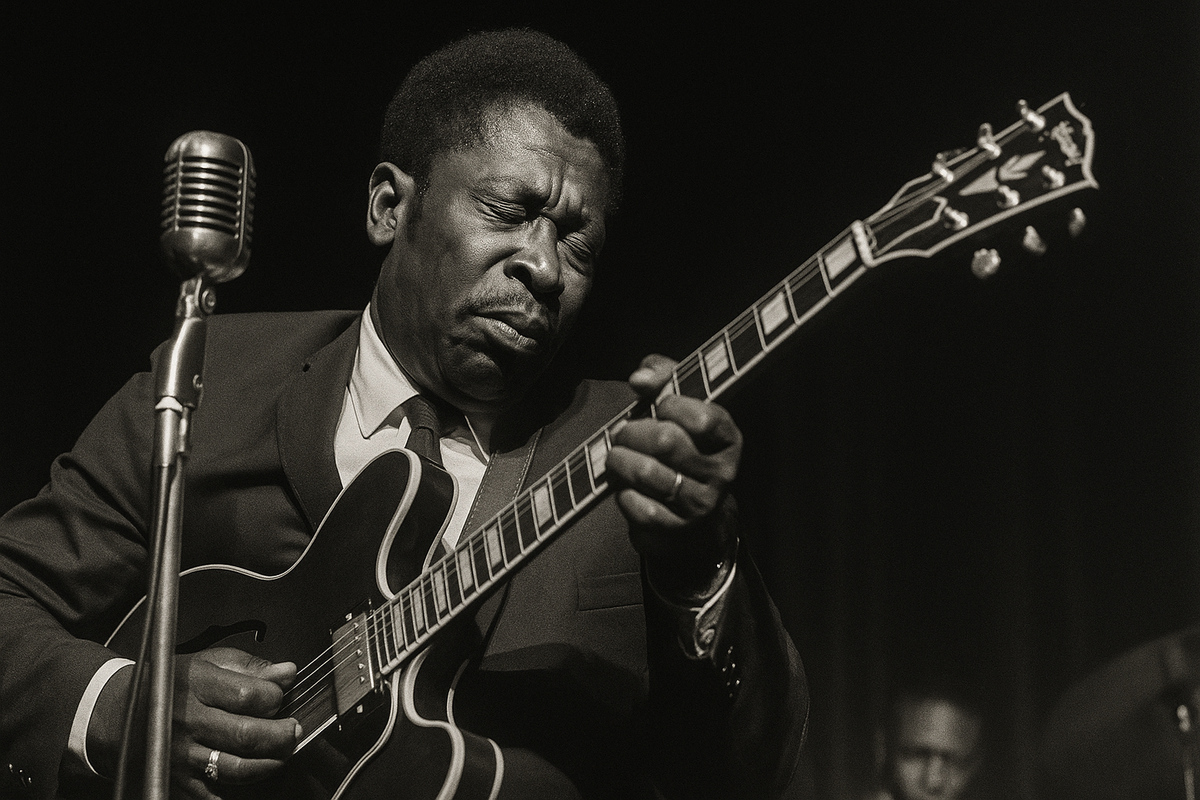
The B.B. King feature exemplified this approach. Across multiple pages, Ebony constructed a portrait that was part performance analysis, part social commentary, part business profile. King appeared on stage, guitar in hand, captured in the physical intensity of his craft. He appeared in a Toledo hotel room, staring out a window — the loneliness of the road made visible. He appeared with his wife Sue and their young son Timothy, reading together, a deliberate counter-image to the stereotype of the itinerant bluesman who lived fast and died young.
And in one striking photograph, he appeared alongside Elvis Presley — a visual argument that the genealogy of American popular music ran directly through the blues, whether mainstream audiences wanted to acknowledge it or not.
What King Said — And What It Meant
Throughout the article, King's voice came through with clarity and purpose. He rejected the notion that blues was somehow illegitimate or immoral: "The blues are not dirty songs, but good, soulful music which helps you when you are down and out."
He pushed back against the caricatures that plagued blues musicians: "They don't realize we can be gentlemen too and have families and want respect."
And he insisted on the permanence of his art: "As long as we got troubles, we got the blues."
These were not the words of a man seeking permission. King understood that the blues were forged in conditions most Americans preferred to ignore — poverty, racial terror, economic exploitation. But he also understood that those conditions had produced something extraordinary: a musical language that spoke to human experience at its most fundamental level.
Ebony amplified this message by framing King as a professional, not a primitive. The article detailed his punishing tour schedule, his custom $32,000 touring bus equipped with television and telephone, his habit of making long-distance business calls himself. This was a man who understood the music industry as both art and commerce, who navigated a racist entertainment system with discipline and savvy.
The Cultural Battlefield of 1962
To understand the stakes of this article, you have to understand the moment. In 1962, the civil rights movement was everywhere — in headlines, in churches, in streets. Martin Luther King Jr. (no relation) was organizing in Albany, Georgia. James Meredith was preparing to integrate the University of Mississippi. The Student Nonviolent Coordinating Committee was registering Black voters across the Deep South despite threats and violence.
In this context, culture was contested terrain. What music should represent African American achievement? What art forms deserved respect? Gospel had the church's blessing. Jazz had intellectual credibility. But the blues? The blues were complicated.
Many Black activists and intellectuals saw the blues as a reminder of the past they were fighting to transcend — sharecropping, segregation, second-class citizenship. Some argued that embracing the blues meant accepting stereotypes that white America had used to justify discrimination.
Ebony took the opposite position. The magazine argued that the blues were not a symbol of defeat but a testament to survival. They were proof that African Americans had taken the worst conditions imaginable and created art that would reshape global music. This was not accommodation. This was alchemy.
And B.B. King was the living embodiment of that transformation — a man who had emerged from the cotton fields of Mississippi to become one of the most respected musicians in America, all while refusing to soften or sanitize his sound.
The Photographs That Made the Argument
The images accompanying the article were as important as the words. Ebony had always understood that photography was rhetoric, and the pictures of B.B. King built a case in purely visual terms.
On Stage
King was power and precision — his body leaning into the music, his face a study in concentration.
Backstage
Surrounded by admirers, signing autographs, receiving the recognition that segregated America too often denied.
On the Bus
Both success story and working musician, a man who had made it but still logged hundreds of miles between gigs.
With Elvis Presley
The image made the cultural debt explicit. There was no rock and roll without the blues. There was no Elvis without B.B. King.
The Permanence of Print
In an era of digital archives and streaming everything, there's something profound about holding an original magazine from 1962. The weight of the paper, the quality of the photography, the advertisements that reveal the economics and aesthetics of the time — these details cannot be fully replicated on a screen.
Vintage Ebony magazines endure because they were designed to endure. They were meant to be kept, reread, passed down. Families saved them as records of achievement and progress. Barbershops and beauty salons displayed them as statements of pride. They were objects that mattered, not just content to be consumed and discarded.
That permanence makes them valuable today. They are not reproductions or commemorations. They are the original documents, printed when the outcomes were still uncertain, when B.B. King was still fighting for the respect that would eventually become his legacy.
Why This Issue Still Matters
Cultural Milestone
One of the first major national publications to profile a blues musician with the seriousness and respect typically reserved for jazz artists or classical composers.
Historical Intersection
Captures a specific moment in the relationship between African American culture and the civil rights movement — when claiming the blues meant claiming the right to define Black identity on one's own terms.
Primary Source
Physical artifacts that documented African American life in real time, with editorial authority and visual sophistication. Each issue is a time capsule preserving debates, aspirations, and tensions of its moment.
Triple Intersection
Sits at the crucial convergence of music history, civil rights history, and media history — making it valuable not just as a collectible but as a primary source for understanding 1960s America.
The Declaration That Endures
When Ebony published its feature on B.B. King in April 1962, it made a bet on the future. It argued that the blues were not a relic to be outgrown but a foundation to be honored. It insisted that a man from the Mississippi Delta deserved the same respect as any artist in America.
Six decades later, that bet looks prescient. B.B. King would go on to win fifteen Grammy Awards, play for presidents, and be inducted into the Rock and Roll Hall of Fame. The blues would be recognized by UNESCO as an intangible cultural heritage of humanity.
But in 1962, none of that was certain. What was certain was that Ebony magazine was willing to make the case, to publish the photographs, to amplify B.B. King's voice when much of America still wasn't ready to listen.
Holding an original copy of that issue today means holding a piece of that declaration — a moment when a magazine, a musician, and a movement all insisted that the blues were not just America's music. They were America's soul.
Explore the Archive
Thousands of original Ebony magazines spanning the 1940s through the 1990s are available, documenting entire decades of music, politics, civil rights struggles, and cultural transformation as they unfolded in real time.
Browse Ebony Magazine Collection