
The Magazine That Sold America a War
Time's August 14, 1964 Gulf of Tonkin Issue and the Week America Committed to Vietnam
On the morning of August 14, 1964, millions of Americans sat down to breakfast with a magazine that would help seal their country's fate. They didn't know it yet—couldn't have known—but the issue of Time they held in their hands was not merely reporting history. It was manufacturing consent for a war that would devour 58,000 American lives and fracture the nation's soul.
The cover was almost casual: F-102 interceptors on a Saigon tarmac, looking more like a travel photograph than a declaration of intent. Inside, the headline read simply: "Action in Tonkin Gulf." No dramatics. No hysteria. Just the brisk, authoritative voice of America's most trusted newsweekly explaining why U.S. destroyers had been attacked in Southeast Asian waters—and why President Lyndon B. Johnson had no choice but to strike back.
What made this issue extraordinary was not what it reported, but when it reported it. This was the first major American media account of the Gulf of Tonkin Incident to reach the public—published in the exact week Congress passed the Gulf of Tonkin Resolution, handing Johnson a blank check for war. Readers weren't reflecting on history. They were living it, one paragraph at a time.
For collectors of 20th-century journalism, this issue is not memorabilia. It is evidence.
Historical Archive
Publication: Time Magazine
Issue Date: August 14, 1964
Cover Story: "Action in Tonkin Gulf"
Historical Context: First major media coverage of the Gulf of Tonkin Incident, published as Congress passed the Gulf of Tonkin Resolution
Significance: Primary source documenting America's escalation into the Vietnam War
The Week America Crossed the Rubicon
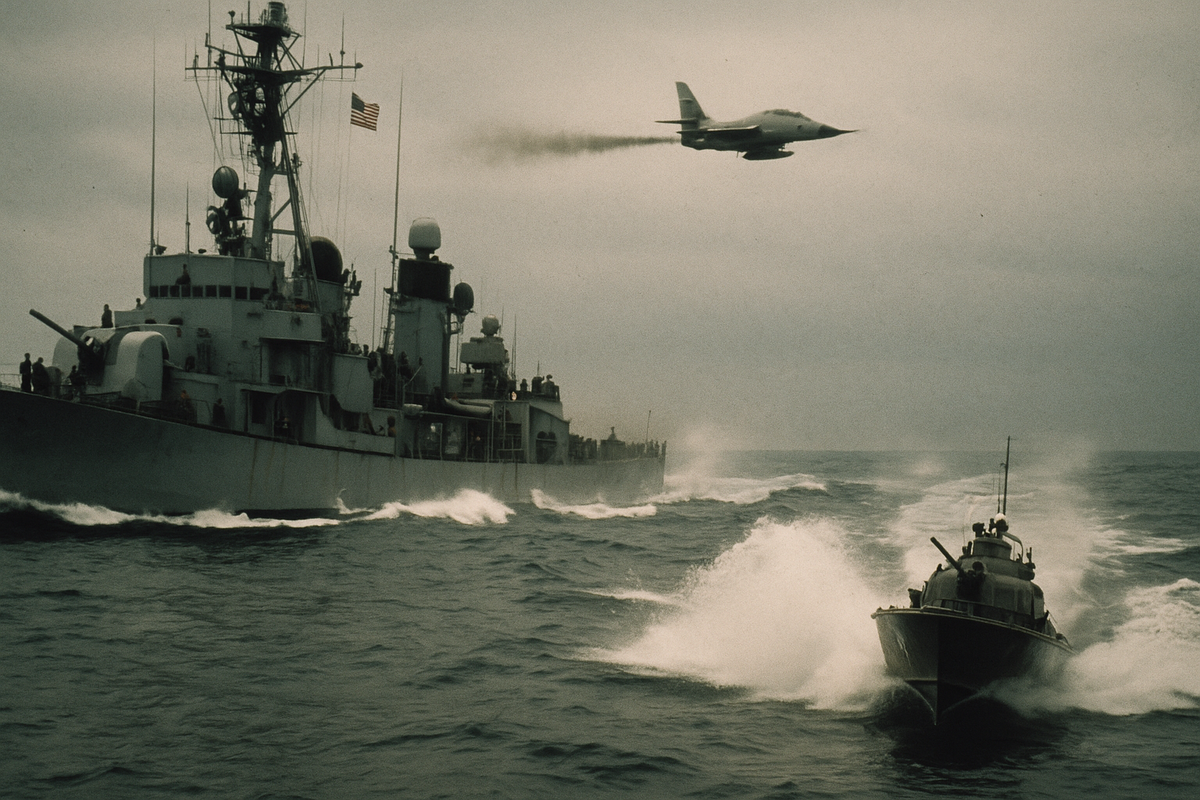
August 1964 was already a pressure cooker. Cold War anxiety had Americans scanning headlines for the next flashpoint—Berlin, Cuba, now Vietnam. U.S. naval vessels had been running covert surveillance missions off North Vietnam's coast for months, part of the DESOTO patrol program. On August 2, the destroyer USS Maddox reported an attack by North Vietnamese torpedo boats in the Gulf of Tonkin. Two days later, on August 4, another alleged attack—later mired in controversy and doubt—gave Washington the justification it needed.
Johnson moved with surgical speed. Airstrikes against North Vietnamese bases were launched within hours. The Gulf of Tonkin Resolution was introduced in Congress and passed with near-unanimity—only two Senators dissented. The President now possessed sweeping authority to wage war in Southeast Asia without a formal declaration.
Time's August 14 issue arrived as this machinery of escalation was already in motion. Its readers were not passive observers. They were participants, being handed the narrative that would justify years of bloodshed.
How Time Framed the Unframeable
The magazine's "Nation" section delivered the story with the cool precision Time had perfected over four decades. The prose was sharp, the facts laid out like a military briefing:
- The USS Maddox's defensive fire against torpedo boats.
- Navy jets arriving to strafe attackers with 20-mm cannon rounds.
- Johnson's order for retaliation, framed as both punishment and signal.
What distinguished Time's coverage was its fusion of military reportage and political theater. The article walked readers through the battle itself—complete with maps showing the "Area of Action," North Vietnamese coastline, and U.S. Seventh Fleet positioning—then pivoted to Washington war rooms, where Johnson weighed responses with his advisors.
The magazine captured Johnson's televised address, in which he vowed the U.S. "seeks no wider war" but promised consequences for aggression. It presented the Gulf of Tonkin Resolution as a near-unanimous expression of national will. It framed the incident not merely as a naval skirmish, but as a Cold War litmus test—a message to Moscow, Beijing, and America's allies that U.S. resolve was non-negotiable.
Yet even Time, for all its establishment bona fides, could not ignore the fog surrounding the second attack. The article noted "conflicting reports" and ambiguities that would, in time, become the incident's defining characteristic. This tension—between certainty and doubt, between what was reported and what actually happened—makes the issue a historical artifact of uncommon weight.
The Visual Architecture of Escalation
Time understood that wars are sold as much through imagery as through words. The August 14 issue deployed visuals with calculated effect:
The Cover
F-102 interceptors in Saigon, silent and menacing on the tarmac—a promise of force held in reserve.
The Battle Map
North Vietnamese torpedo boat routes, U.S. fleet maneuvers, targeted bases—war rendered as geometry.
The Power Portraits
Johnson with his advisors at the White House. Admiral U.S. Grant Sharp in Pacific command centers.
The Fleet
The USS Constellation and USS Ticonderoga, floating fortresses bristling with firepower.
These were not decorative. They were didactic. Time was teaching Americans how to see the conflict—not as a quagmire in the making, but as a necessary assertion of strength. The magazine transformed policy into narrative, and narrative into consensus.
For a reader in 1964, this was history happening now, delivered with the authority of glossy paper and expert layout. For a collector today, these pages are a window into how America talked itself into Vietnam.
The Permanence of Paper in a Digital Age
We live in an era where news evaporates the moment it's published. A headline flashes across a screen, lingers for hours, then vanishes into the algorithmic ether. There is no object to hold, no artifact to preserve.
The August 14, 1964 Time is the opposite. It is durable, physical, permanent. It captures not just facts, but the emotional texture of its moment—the urgency in the prose, the confidence in the maps, the unspoken assumptions about American power. It is history you can touch.
These magazines endure because they are more than journalism. They are time capsules. They preserve the exact week the future changed, before anyone knew how badly it would end. That is what makes them invaluable to collectors and educators alike.
Why This Issue Commands Collector Attention
Historical Synchronicity
This was not retrospective analysis. It was real-time reporting of the moment Congress authorized expanded military action in Vietnam. Readers held this issue in the same week the war's legal framework was constructed.
The Inflection Point
Before this week, U.S. involvement in Vietnam was largely advisory—military "advisors" and covert operations. After this week, it became an open-ended commitment to ground combat and aerial bombardment. This issue captures that hinge.
Visual Power
The combination of battle maps, presidential war councils, and carrier photographs makes this one of Time's most visually arresting Cold War issues. It doesn't just describe escalation—it shows it.
Cultural Weight
To own this magazine is to own a piece of the machinery that built consensus for Vietnam. It is a primary source, yes, but also a cultural artifact—proof of how media, government, and public opinion intertwined in the 1960s.
Add This Artifact to Your Collection
If you study the Cold War, the Vietnam era, or the evolution of American foreign policy, the August 14, 1964 issue of Time belongs in your archive.
Browse Time Magazine CollectionFrom the Great Depression through Watergate, from World War II to the Space Race, trace America's trajectory through the pages that reported it first. These are not reprints or digital facsimiles—they are the original artifacts, ink on paper, history in hand.
Final Word
The August 14, 1964 Time is not just a magazine. It is a historical document that captured the precise moment America committed to a war it would spend a decade fighting and generations understanding. Its maps, photographs, and reporting made distant naval encounters vivid for millions of readers. Its editorial framing helped construct the consensus that would carry the nation into Vietnam.
For those who value primary sources, who understand that history is not just what happened but how it was told, this issue is indispensable. It is the week America crossed the threshold—preserved in glossy pages, waiting to be studied, debated, and remembered.