
Babies for Sale: When America's Most Beloved Magazine Exposed the Black Market in Children
The Saturday Evening Post's shocking 1951 Christmas exposé that forced a nation to confront its most uncomfortable contradictions
On December 22, 1951, American families opened their mailboxes expecting Christmas cheer. What arrived instead would shatter the season's illusions.
The cover of The Saturday Evening Post showed everything readers wanted to believe about their country: Stevan Dohanos had painted a little girl adjusting her holiday tree while a puppy tugged playfully at her skirt. Inside, the contrast was brutal. "Babies for Sale," an investigative feature by Henry F. and Katharine Pringle, documented a thriving black market where infants were bought and sold for as much as $10,000—while 75,000 children were legally adopted each year through proper channels.
This wasn't sensationalism. It was the Post doing what it did best: holding a mirror to American life and forcing readers to confront what they saw reflected back.
Archive Details
Publication: The Saturday Evening Post
Issue Date: December 22, 1951
Feature Article: "Babies for Sale" by Henry F. and Katharine Pringle
Cover Artist: Stevan Dohanos
Photographer: Harry Saltzman
Historical Context: Published during the postwar baby boom, documenting America's underground adoption crisis
The Perfect Storm of Postwar Desperation
The early 1950s created ideal conditions for an underground baby trade. The nation had emerged from depression and war into unprecedented prosperity. The baby boom symbolized renewal, and the nuclear family—working father, homemaker mother, biological children—became the unquestioned ideal of American life.
But biology didn't cooperate with ideology. Infertile couples faced a cultural mandate to build families they couldn't create. Simultaneously, unwed mothers confronted crushing social stigma. Secrecy surrounded their pregnancies. Pressure mounted to surrender their babies discreetly. Supply met demand in the shadows, and the black market flourished.
The contradiction was stark: in a society that worshipped the family, children had become commodities.
When Holiday Cheer Meets Hard Truth
The Saturday Evening Post understood its cultural power. As one of the most influential magazines in America, it reached millions of households with its mix of fiction, humor, art, and investigative journalism. The editors' decision to publish "Babies for Sale" during Christmas week was calculated and devastating.
That Dohanos cover—so warm, so innocent—made the exposé inside hit harder. Just as Life magazine had used photography to bring war into American living rooms, the Post deployed images and narrative to make the adoption scandal impossible to ignore.
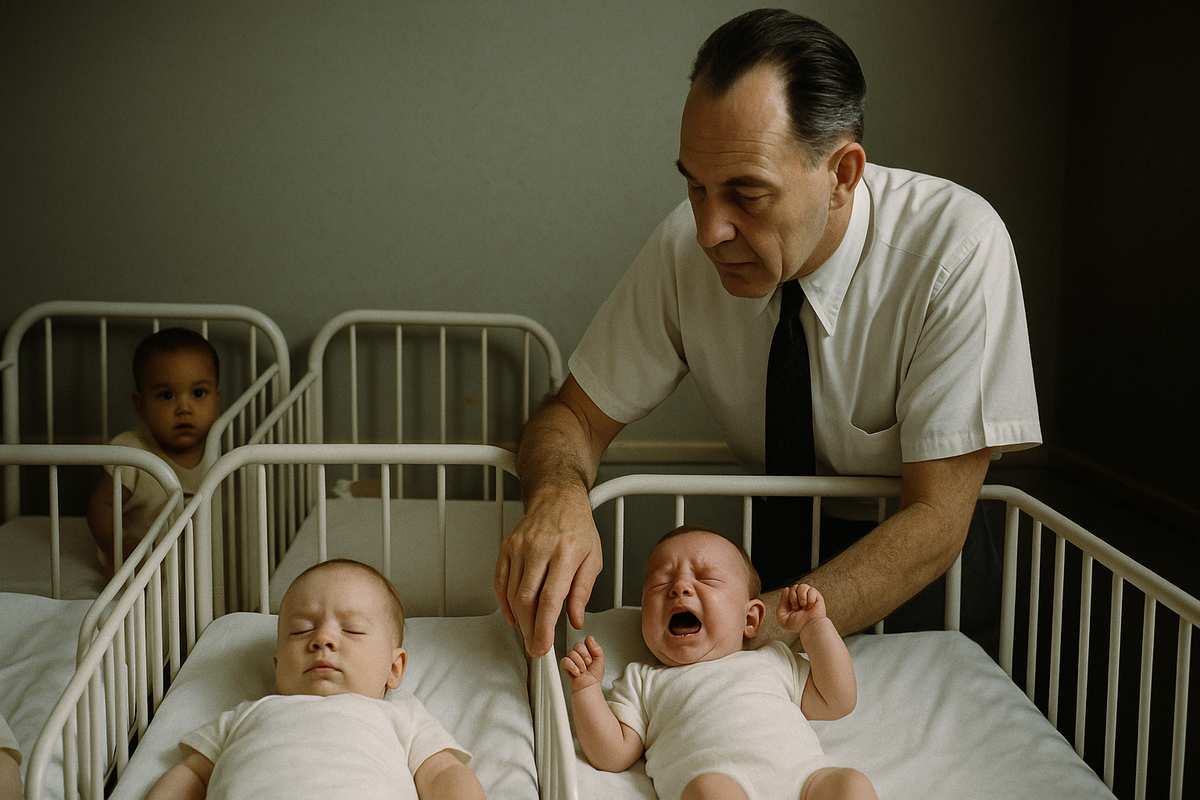
Harry Saltzman's stark photographs punctuated the Pringles' reporting:
Three infants in cribs at the Spence-Chapin Adoption Service, captioned to assure readers these children were "not for sale." A doctor examining a crying baby, illustrating the health safeguards legitimate agencies provided. A couple holding two adopted children, proof that legal channels worked. A mother with her young son outdoors, contrasted against warnings about black-market risks.
The visual strategy forced readers to see these children not as abstractions but as real lives hanging in the balance.
The Human Toll, Case by Case
The Pringles built their investigation around actual stories, each one revealing a different pressure point in the system.
Betty's Tragedy
Her fiancé was killed in Korea. Alone and pregnant, she gave birth in secrecy. A nurse quietly arranged an adoption outside official channels. Her case wasn't about greed—it was about shame, isolation, and a society that offered no legitimate options for women in her position.
Nick's Transformation
Once labeled a "problem child," he thrived after adoption through proper channels that included screening, preparation, and structured placement. The difference wasn't the child—it was the system supporting him.
The Role of Clergy
Some ministers, believing it their Christian duty, connected babies with waiting parents. Their intentions were compassionate. Their impact fueled the black market.
Doctors and Lawyers as Middlemen
Professionals enabled the trade, facilitating adoptions for fees ranging from $1,500 to $10,000—a fortune in 1951. Some rationalized it as helping desperate people. The line between service and profiteering blurred.
The Medical Risks
Babies obtained outside agencies often lacked proper health examinations. Some carried congenital illnesses, including syphilis. Adoptive families who had paid thousands of dollars found themselves heartbroken, caring for sick children they weren't prepared to help.
The Safeguards of Agencies
Organizations like Spence-Chapin offered health checks, background reviews, interviews. The process was slower, more bureaucratic, more frustrating for desperate couples. It was also far safer for everyone involved.
The Cultural Reckoning
"Babies for Sale" wasn't ultimately about adoption procedure. It was about American values colliding with American reality.
The desperation for children reflected a society that had elevated family to sacred status. The stigma against unwed mothers created a hidden supply of infants whose fates were decided in whispered conversations, not courtrooms. Even well-meaning people—ministers easing congregants' suffering, doctors streamlining paperwork, lawyers connecting parties—contributed to a system where compassion and commerce became indistinguishable.
The Post didn't offer easy solutions. It offered something more valuable: clear-eyed documentation of how a social problem actually worked, who it affected, and why it persisted.
The Magazine That Mattered
The Saturday Evening Post endures in collectors' hands and historians' research because it was never merely a magazine. It was a chronicle of American life—capturing the art, fiction, humor, and scandal that shaped the nation's culture as events happened.
Investigations like "Babies for Sale" function as time capsules of social struggle. They remind us that behind every idealized image of American life, hidden stories demanded telling. In an age when digital content vanishes overnight, these printed magazines represent something increasingly rare: history read slowly, studied at kitchen tables, saved in family collections, and passed down as artifacts of what we were.
Why Collectors Prize This Issue
The December 22, 1951 Saturday Evening Post commands attention in vintage magazine markets for reasons that transcend nostalgia.
Historical Timing
Published during the baby boom's height, the issue documented one of the era's most pressing—and uncomfortable—social crises as it was unfolding.
The Dohanos Cover
Captures the holiday nostalgia that made Post covers iconic. Christmas scenes by the magazine's great illustrators remain consistently sought-after.
Cultural Juxtaposition
Holiday cheer on the cover, child welfare crisis inside—the contrast encapsulates America's contradictions in a single artifact.
Investigative Significance
Issues featuring major exposés or social reform debates represent journalism that changed public conversation. This wasn't entertainment; it was intervention.
Holding this issue means holding a moment when America confronted the cost of its own ideals—when the desire for family collided with secrecy and stigma, and a magazine forced the nation to watch.
Explore the Archive
Thousands of original Saturday Evening Post magazines spanning the 1930s through the 1970s are available in our collection. You can trace decades of American history, culture, and art as they unfolded in real time—seen through the eyes of the journalists, illustrators, and editors who documented each era as it happened.
Whether you're a collector, historian, or someone honoring family memory, these magazines offer something irreplaceable: America as it was first reported, preserved in the pages where those stories originally appeared.
Browse The Saturday Evening Post Magazine CollectionThe December 22, 1951 issue stands as one of mid-century journalism's most important publications. Its coverage of the black-market baby trade delivered not only facts but also moral reckoning to American readers when they needed it most. More than 70 years later, those struggles remain preserved—waiting to be rediscovered by anyone willing to turn the pages and confront what the Post forced its original audience to see.