
The Last Champions of a Dying Territory
How a 1986 Magazine Captured Two Futures of Wrestling
The photograph stops you cold.
Two young men, barely into their twenties, stand shoulder to shoulder with championship gold around their waists. One radiates technical precision—lean, focused, the son of a wrestling legend learning to exceed his father's shadow. The other towers beside him, movie-star handsome with a mustache that belonged on a 1940s leading man, raw power barely contained in his frame.
The year was 1986. Their names were Curt Hennig and Scott Hall. And Pro Wrestling Illustrated was documenting them at the exact moment before everything changed—for them, for their promotion, and for professional wrestling itself.
Within five years, one would become Mr. Perfect, redefining technical wrestling for a generation. The other would birth Razor Ramon, then help detonate the biggest angle in wrestling history with the New World Order. But in July 1986, they were simply the AWA Tag Team Champions, fighting to prove that their dying promotion could still create stars in an industry being swallowed whole by Vince McMahon's national machine.
Pro Wrestling Illustrated gave them twelve pages. Those pages would become a historical document.
Archive Details
Featured Athletes: Curt Hennig & Scott Hall
Issue Date: July 1986
Publication: Pro Wrestling Illustrated
Article Title: "A Perfect Blend of Style & Substance"
Championship: AWA Tag Team Champions
The Promotion That Refused to Die Quietly
By 1986, the American Wrestling Association was bleeding out. Verne Gagne's Minneapolis-based empire—once a peer to the WWWF and NWA—had watched Hulk Hogan walk away to New York. Its television footprint was shrinking. The WWF's cable expansion and pay-per-view ambitions were rendering the old territorial system obsolete, one market at a time.
Yet the AWA still possessed something McMahon couldn't manufacture overnight: a developmental system that built legitimate workers. Curt Hennig represented that tradition perfectly. His father, Larry "The Axe" Hennig, had been one of Gagne's most reliable draws. Curt absorbed the AWA style—mat-based, psychology-driven, brutally real in its execution—from childhood.
Scott Hall was the opposite: a natural athlete who looked like he'd been designed in a lab to be a professional wrestler, but who needed seasoning. His partnership with Hennig wasn't just creative matchmaking. It was institutional knowledge being passed to explosive potential.
When they captured the AWA Tag Team Championship, they carried more than leather and gold. They carried the promotion's last argument for relevance.
Why Pro Wrestling Illustrated Mattered
In 1986, if you wanted to understand wrestling beyond your local territory, you bought Pro Wrestling Illustrated.
The magazine operated outside promotional control, covering the WWF, NWA, AWA, and regional territories with equal weight. Its rankings sparked debates. Its photographers captured wrestlers in ways television never could—part sports journalism, part mythology-building. While promotions lied to protect kayfabe, PWI threaded a needle: it respected the business's worked nature while treating its athletes as legitimate performers worthy of serious coverage.
The article on Hennig and Hall—"A Perfect Blend of Style & Substance"—exemplified that approach.
The cover that month belonged to the Rock 'n' Roll Express, the pretty-boy tag team driving the NWA's business. But inside, the Hennig-Hall feature commanded attention through pure photographic authority. The opening shot presented them as champions, not prospects: belts visible, postures confident, the camera treating them as equals to anyone in the sport.
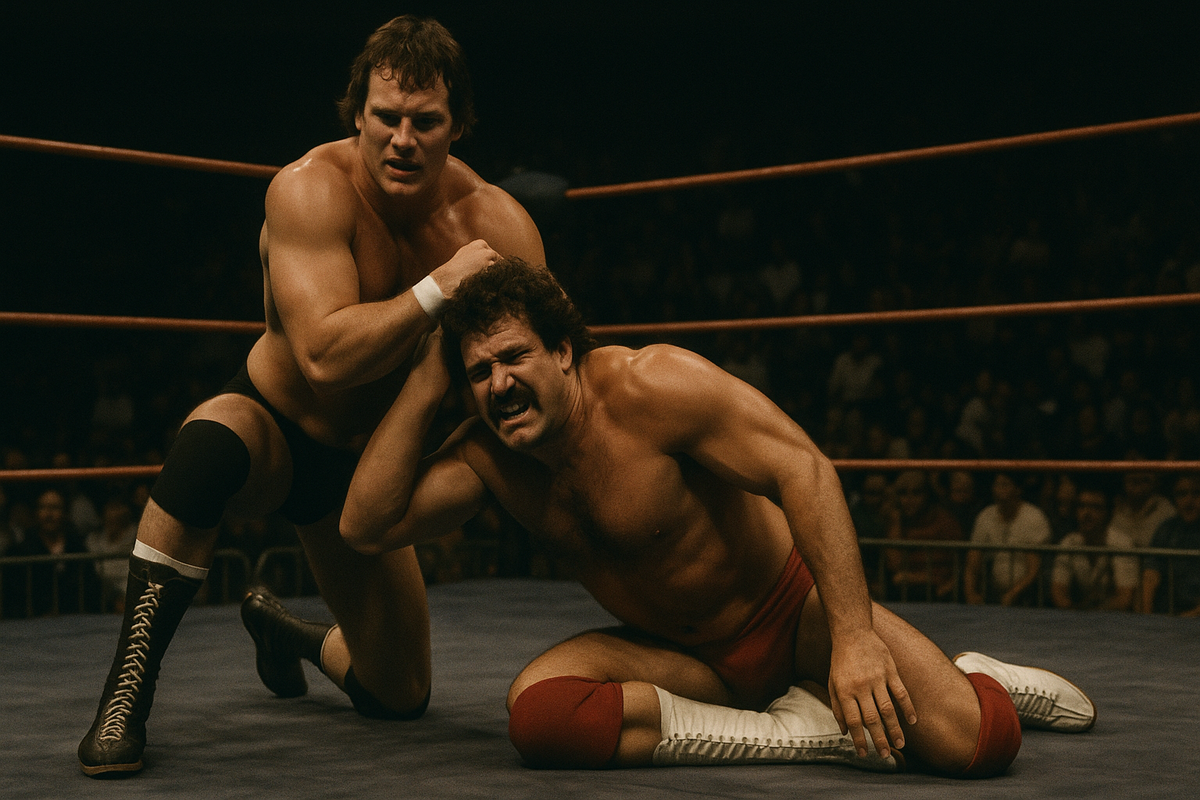
The action photography told a technical story. Scott Hall delivering a picture-perfect backdrop to Bill Irwin, his height advantage turning a basic move into spectacle. Curt Hennig demonstrating headlocks and wristlocks with textbook precision, making fundamental holds look like high art. Sequential shots showing them working as a unit, anticipating each other's movements, filling "each other's gaps" as the article phrased it.
That phrase—filling each other's gaps—wasn't throwaway copy. PWI was documenting something real: Hall needed discipline and ring psychology; Hennig needed someone who could match his intensity and provide raw power. The article drew an unlikely comparison to Rocky and Adrian from the film series, two incomplete people who became whole through partnership.
It was wrestling journalism as character study, and it worked because the magazine understood something essential: fans wanted to believe these men were as good as they looked.
What the Article Revealed
PWI's profile built its narrative around contrasts and synthesis. Hennig was the strategist, calling matches with veteran instincts despite his youth. Hall was the enforcer, learning to channel his natural aggression into controlled violence. Together, they represented what tag team wrestling could be when psychology mattered more than spectacle.
The magazine included anecdotes that blurred worked storyline with legitimate relationship. Hennig pushing Hall to train when exhaustion beckoned. Hall crediting his partner with teaching him how to think three moves ahead. Whether these stories were true or carefully constructed narrative didn't matter—PWI was preserving the bond between them as historical record.
The subtext was impossible to miss: these championships were a beginning, not a peak. The article suggested both men would eventually pursue singles glory, a prediction that proved almost comically understated. But in 1986, that future remained theoretical. What existed was two young men carrying the credibility of a struggling promotion, documented by the only magazine that treated all territories as equally worthy of preservation.
The Champions' Contrast
Hennig brought technical mastery and ring psychology; Hall provided raw power and movie-star presence. Their partnership balanced strategy with spectacle.
Photographic Authority
PWI's action shots captured Hall's devastating backdrop to Bill Irwin and Hennig's textbook technical work, creating visual proof of their legitimacy.
Narrative Depth
The Rocky and Adrian comparison elevated the story beyond simple sports coverage into character study—two incomplete individuals becoming whole as partners.
Prophecy in Print
The article predicted their eventual singles success, preserving the exact moment before Hennig and Hall transformed into Mr. Perfect and Razor Ramon.
The Magazine That Defined an Era
Pro Wrestling Illustrated's influence on wrestling culture cannot be overstated. Its annual PWI 500 rankings became canon. Its championship recognition gave legitimacy to titles that might otherwise have been dismissed. Its writers—Bill Apter chief among them—understood that wrestling existed in the space between sport and theater, and that covering it required respecting both elements.
The Hennig-Hall feature demonstrated that editorial philosophy perfectly. It treated them as athletes worthy of technical analysis while building narrative drama around their partnership. It preserved their moment in time with photographic precision while contextualizing them within the industry's broader transformation.
That approach made PWI essential. And it makes issues like July 1986 historical artifacts, not just collectibles.
Legacy in Twelve Pages
Within three years of this article, Curt Hennig would sign with the WWF and become Mr. Perfect, his "Perfect-Plex" finishing move and undefeated streak establishing him as one of the most technically gifted performers in wrestling history. He made excellence look effortless, a trait visible in those 1986 photographs if you knew what to watch for.
Scott Hall's path took longer but cut deeper. As Razor Ramon, he helped define the WWF's "New Generation" era with his coolness and legitimate toughness. Later, alongside Kevin Nash, he would form the core of the New World Order, the storyline that nearly destroyed the WWF by making WCW appointment viewing. Hall's charisma and in-ring intelligence—hinted at in PWI's coverage—became industry-altering forces.
But in July 1986, they were simply two young men with tag team gold and a magazine willing to document their potential. Pro Wrestling Illustrated recognized what they were building and preserved it. That preservation is why these pages matter.
Why Collectors Covet This Issue
Historical Timing
Captures Hennig and Hall before fame transformed them into untouchable icons—the moment before Mr. Perfect and Razor Ramon existed.
Primary Source Documentation
One of the final documents proving the AWA's relevance as a major promotion, published by wrestling's most authoritative voice.
Photographic Rarity
Mid-1980s action photography and posed portraits that defined the era's visual style, featuring lighting and composition found nowhere else.
Cultural Artifact
Physical evidence of wrestling's territorial era and the exact moment of industry transformation, captured by the magazine that chronicled it all.
Explore the Archive
For collectors and historians, these issues represent more than reading material. They are primary sources—physical evidence of wrestling's territorial era, captured by the magazine that understood the sport well enough to chronicle its transformation.
Browse Pro Wrestling Illustrated Magazine Collection