
The Day Forbes Exposed the Greatest Teenage Con Artist Wall Street Ever Believed
How the October 2, 1989 issue documented Barry Minkow's $200 million fraud and changed business journalism forever
On October 2, 1989, Forbes Magazine published a financial autopsy that would haunt auditors for decades.
The cover story wasn't about another junk bond king or savings-and-loan collapse. It was about a 21-year-old who had convinced Ernst & Whinney, major banks, and Wall Street analysts that his carpet cleaning company was worth over $200 million. The only problem? Nearly every dollar of revenue was imaginary.
Daniel Akst's investigation, "How Barry Minkow Fooled the Auditors," didn't just chronicle a fraud. It dissected the anatomy of belief itself—how seasoned professionals could be led through fake construction sites, shown fabricated contracts, and still sign off on financial statements that existed only in the mind of a charismatic teenager from Los Angeles.
For readers still shaken by the 1987 crash and watching the unraveling of Michael Milken's empire, the ZZZZ Best scandal delivered an uncomfortable truth: the gatekeepers could be deceived. And if they could be fooled by a kid operating out of his parents' garage, what else had Wall Street missed?
Archive Details
Historical Figure: Barry Minkow, Founder of ZZZZ Best
Issue Date: October 2, 1989
Archive Source: Forbes Magazine
Feature Article: "How Barry Minkow Fooled the Auditors" by Daniel Akst
Market Context: Post-1987 crash, savings-and-loan crisis era
The Teenager Who Built an Empire on Air
Barry Minkow founded ZZZZ Best at sixteen in a San Fernando Valley garage, pitching it as nothing less than "the General Motors of carpet cleaning." The audacity wasn't in starting a service business—it was in the scale of his ambition and the speed of his execution.
Within five years, Minkow had orchestrated a public offering, secured millions in bank financing, and reported $50 million in annual sales. Wall Street analysts wrote glowing reports. The press called him a wunderkind. His market valuation exceeded $200 million.
But there were no restoration contracts. No insurance jobs. No actual revenue stream beyond the Ponzi scheme mechanics that kept the illusion inflated. Every dollar raised went to pay off earlier investors and fund an increasingly elaborate theater of legitimacy.
This wasn't a teenager cooking books in his bedroom. This was a full-scale production involving rented buildings, bribed security guards, staged work sites, and a rotating cast of accomplices who maintained the facade long enough to fool firms whose entire purpose was detecting exactly this kind of deception.
How Forbes Pulled Back the Curtain
What distinguished Akst's reporting from the breathless profiles that had preceded it was forensic precision. Forbes didn't just report that ZZZZ Best was a fraud—it reconstructed exactly how the con worked.
The centerpiece was Larry Gray, the Ernst & Whinney auditor assigned to verify ZZZZ Best's crown jewels: massive insurance restoration contracts in Sacramento and San Diego. Gray's story became a case study in manufactured reality. Minkow's team rented empty buildings, furnished them with desks and signage, created fake tenant rosters, and hired security to "restrict access" during carefully choreographed site visits. Gray was shown exactly what Minkow wanted him to see—and nothing more.
The article included three photographs that captured the human drama behind the numbers:
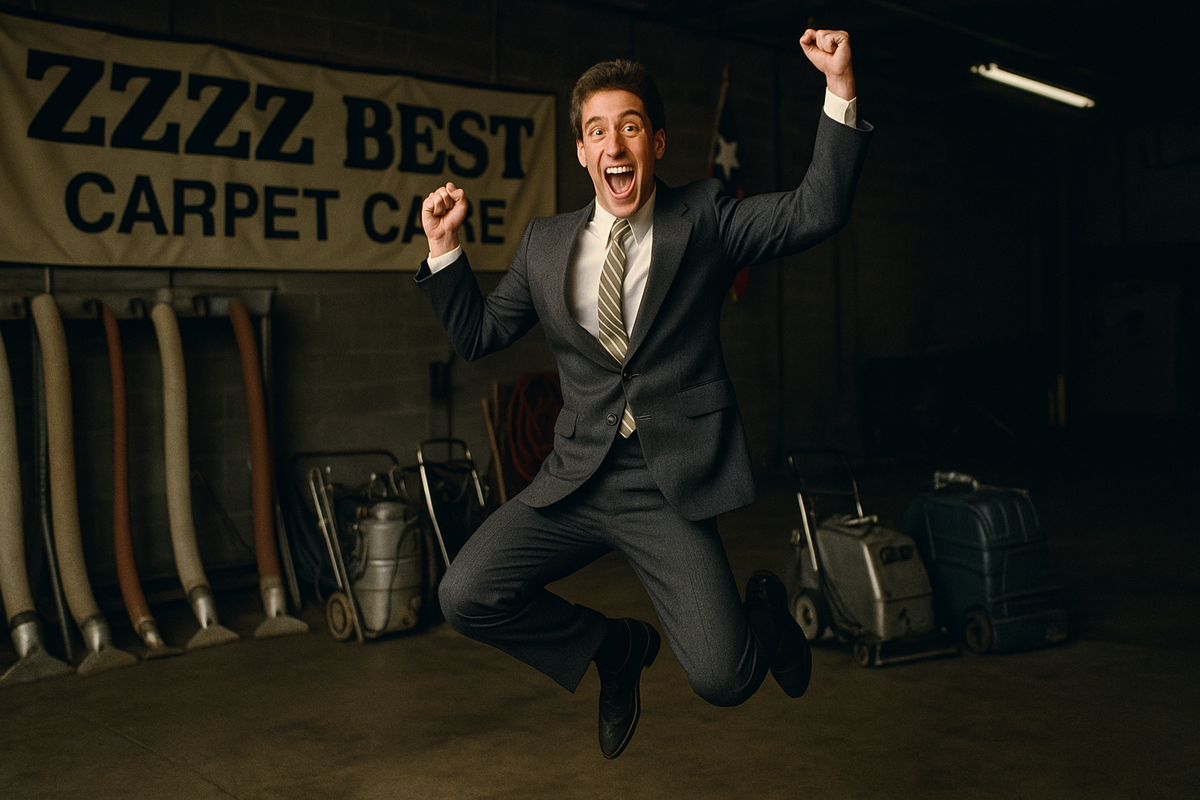
Barry Minkow frozen mid-jump, grinning with the confidence of someone who believed his own mythology. The caption: "A remarkable combination of genius and illiteracy." Youth and bravado crystallized in a single image.
Larry Gray shaking hands with Minkow, a moment of trust that would later symbolize professional catastrophe. The caption: "It could have happened to any of us." A devastating acknowledgment that competence was no defense against a sufficiently committed fraud.
Minkow's inner circle posing together, a reminder that ZZZZ Best wasn't a solo act but a conspiracy that required coordination, loyalty, and shared delusion.
Forbes understood that fraud isn't just financial—it's theatrical. And the magazine documented both the performance and the moment the curtain fell.
The Mechanics of Belief
The details Forbes unearthed read like a heist film:
Staged Construction Sites
Empty buildings transformed into active restoration projects for auditor visits, complete with equipment rentals and temporary signage.
Controlled Access
Auditors were restricted to weekend tours with handlers present, always under time pressure, never allowed to speak freely with supposed clients or contractors.
Phantom Revenue
In a single day in December 1986, ZZZZ Best raised $21 million through stock sales and bank loans—all predicated on contracts that didn't exist.
Lifestyle Theater
Lavish company parties with hundreds of guests created the impression of success, masking the reality that every dollar spent was borrowed or stolen.
By mid-1987, the contradictions became impossible to manage. Journalists began asking questions Minkow couldn't answer. Investors who visited job sites found empty buildings. The collapse was swift and total, leaving over $100 million in losses and a trail of prosecutions.
Minkow received a 25-year prison sentence. His accomplices followed him behind bars. And Ernst & Whinney faced questions about how their systems had failed so completely.
Why This Issue Still Matters
Forbes in 1989 was fighting a perception problem. Business journalism had spent much of the decade celebrating wealth creation without adequately scrutinizing its sources. The magazine risked being seen as a cheerleader for excess rather than an arbiter of truth.
"How Barry Minkow Fooled the Auditors" was Forbes reclaiming its investigative authority. It signaled that the publication would document not just success but failure, not just ambition but fraud, not just what executives claimed but what the evidence revealed.
This wasn't soft reporting with anonymous sources and hedged conclusions. This was named individuals, specific locations, documented deceptions, and uncomfortable questions about professional oversight. It was journalism that mattered because it challenged institutions, not just individuals.
For readers navigating an era of financial scandal—Ivan Boesky's insider trading, the savings-and-loan crisis, Michael Milken's junk bond empire—the ZZZZ Best story offered a different kind of cautionary tale. Minkow wasn't a corrupt Wall Street titan. He was a teenager who understood that the system ran on trust, and that trust could be manufactured.
The Enduring Questions
More than three decades later, the ZZZZ Best scandal still generates interest because it raises questions without easy answers:
How do you design systems that catch sophisticated fraud without paralyzing legitimate business?
What responsibility do auditors bear when they follow protocol but miss the truth?
Why are charismatic young founders granted more trust than their track records warrant?
The October 2, 1989 Forbes didn't answer these questions definitively. But it documented them with enough clarity that subsequent frauds—from Enron to Theranos—would be measured against Barry Minkow's template.
This issue isn't just a magazine. It's evidence that American capitalism has always struggled to distinguish between vision and delusion, between ambition and fraud, between trust and gullibility.
And it's a reminder that sometimes the most important journalism isn't about celebrating success—it's about explaining why we believed the story in the first place.
The Collector's Perspective
Historical Timing
Published at the tail end of the 1980s scandal era, it captures a moment when American faith in financial institutions was already fragile. The article arrived as confirmation, not revelation.
Scandal Documentation
Issues covering landmark frauds hold value because they preserve the contemporary understanding of events before revisionism sets in. This is how America learned about ZZZZ Best in real time.
Cultural Crossover
The Minkow story transcends finance. It's true crime, it's generational commentary, it's a study in charisma and manipulation. That breadth gives it staying power.
Archival Integrity
Holding the original issue means possessing the photographs, the layout choices, the advertisements that ran alongside the exposé. Context that digital scans can't fully replicate.
Explore This Issue and More
From the scandals of the 1980s to the dot-com frenzy and beyond, these aren't just publications—they're artifacts of the moments when America had to reckon with the cost of believing too easily.
Browse Forbes Magazine Collection