
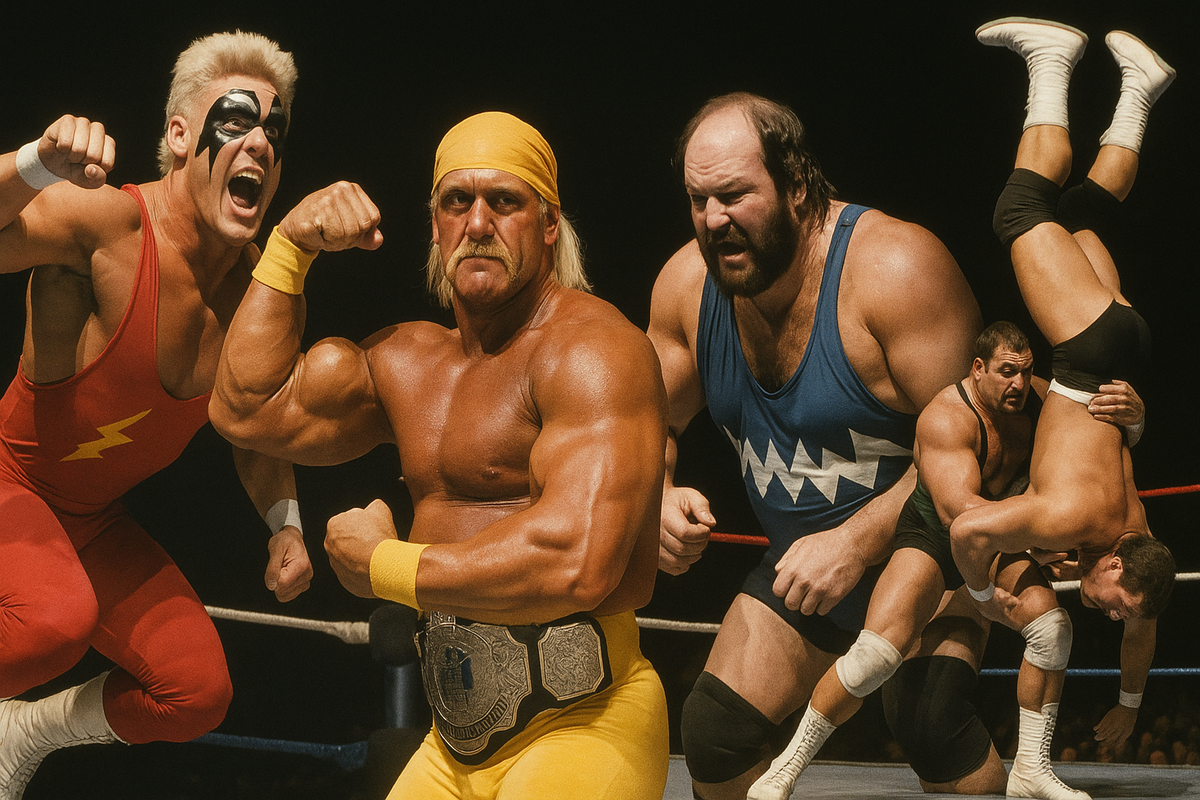
The Night 70,000 Fans Crowned a New Era
Inside Pro Wrestling Illustrated's 1990 Awards Issue and the Seismic Shift That Changed Wrestling Forever
The ballots came by mail. Thousands of them. By early 1991, Pro Wrestling Illustrated had counted nearly 70,000 handwritten votes—fans from every corner of North America casting their verdict on the year that split professional wrestling into before and after.
When the March 1991 issue hit newsstands, it didn't just announce winners. It documented a seismic shift in the sport's power structure, captured in full-color photography and the unfiltered voice of the audience that paid to see it.
Sting had dethroned Ric Flair. Hulk Hogan had fallen to The Ultimate Warrior. A young Texas wrestler named Steve Austin earned his first national recognition. And for one issue, PWI became more than a magazine—it became the official record of wrestling's generational handoff.
This wasn't fan service. It was historiography in real time.
Archive Details
Publication: Pro Wrestling Illustrated
Issue Date: March 1991
Coverage Period: 1990 Achievement Awards
Fan Ballots Counted: Nearly 70,000
Historical Significance: Documents wrestling's generational transition from Hogan-era dominance to the rise of Sting, Warrior, and the early recognition of Steve Austin
1990: The Year the Territories Died and the Icons Stumbled
By the time WrestleMania VI opened in Toronto's SkyDome, the wrestling map had been redrawn. The regional territories that once sustained the sport—Mid-South, World Class, the AWA—had collapsed or been absorbed. Only two empires remained: Vince McMahon's WWF, riding the pay-per-view boom into mainstream ubiquity, and Ted Turner's WCW, desperately seeking a post-Flair identity.
Then the unthinkable: Hulk Hogan lost clean.
The Ultimate Warrior pinned him in the main event, unified the WWF and Intercontinental Championships, and became the company's anointed heir. For fans raised on Hogan's immortality, it was disorienting. The man who had body-slammed Andre, who had carried wrestling into Saturday morning cartoons, had been defeated by his own protégé.
Three months later, at the Great American Bash in Baltimore, Sting—face painted, blonde flattop gleaming—defeated Ric Flair to capture the NWA World Heavyweight Championship. It wasn't just a title change. It was WCW betting its future on youth, athleticism, and a new kind of hero who didn't need a 20-minute promo to connect.
Elsewhere, the sport's future was quietly taking shape. In Memphis and Dallas, a 25-year-old named Steve Austin was learning his craft in USWA rings, earning Rookie of the Year recognition from PWI voters who wouldn't see "Stone Cold" for another six years. Cactus Jack was throwing himself through barbed wire. The Steiner Brothers were redefining what tag team wrestling could be with suplexes that defied physics.
When PWI tallied its fan ballots for 1990, it wasn't just counting votes. It was measuring the tremors of an industry reinventing itself.
Why PWI's Authority Mattered in the Pre-Internet Era
Before dirt sheets, before WWE Network, before Reddit threads dissecting every angle, there was Pro Wrestling Illustrated.
For millions of fans in 1990, PWI was the only bridge between promotions. If you lived in Philadelphia, you saw WWF programming. If you were lucky enough to have TBS, you caught WCW. But PWI covered everything—WWF, WCW, USWA, New Japan, AAA. It treated wrestling with the seriousness of Sports Illustrated covering the NBA, maintaining kayfabe while offering cross-promotional analysis no television broadcast could provide.
The annual Achievement Awards carried unique weight because they were genuinely democratic. Unlike promotional magazines controlled by McMahon or Turner, PWI's results came from tens of thousands of mailed ballots. Fans didn't just consume wrestling—they adjudicated it. When Sting won Wrestler of the Year, it wasn't a corporate decree. It was a verdict.
The March 1991 issue presented those verdicts with the gravitas they deserved: full-page action shots, detailed explanations of each winner's achievements, and the kind of archival photography that made you feel like you'd witnessed every major match of the year. Sting mid-leap against Flair. Hogan rallying a crowd that would soon turn on him. Earthquake's crushing legdrop on Hogan's ribs. The Steiners executing a Frankensteiner that looked like it violated the laws of momentum.
This wasn't entertainment journalism. This was sports documentation for a sport that officially didn't exist.
The 1990 Achievement Awards: A Roster of the Inevitable and the Prophetic
The victory over Flair at the Great American Bash sealed it, but voters also rewarded Sting's resilience—his return from injury, his refusal to adopt the Horsemen's cynicism, his embodiment of WCW's gamble on the next generation.
The rare match where the outcome felt genuinely uncertain. Two champions, two philosophies, one torch being passed in front of 67,000 fans. Warrior's victory wasn't just an upset—it was a coronation.
Before Scott's transformation into "Big Poppa Pump," the Steiners were rewriting tag team mechanics with German suplexes, Frankensteiners, and a level of technical innovation that made them stand out even in a stacked division.
Even in defeat, even in transition, the Hulkster remained wrestling's gravitational center. Fans could sense the era ending, but they weren't ready to let go.
When John Tenta crushed Hogan's ribs with a series of seated splashes, he didn't just injure the champion—he committed an act of narrative violence so effective that it earned him villainy's highest honor.
While Sting captured the title, it was Flair's rivalry with Luger—the betrayals, the Horsemen drama, the corporate maneuvering—that gave WCW its dramatic spine throughout 1990.
Long before the bald head, the goatee, and the Stone Cold Stunner, Austin was a talented mid-card worker in Memphis and Dallas, earning respect for his fundamentals. PWI voters saw something in him. They had no idea what they were seeing.
A second honor for his comeback from injury, proof that the fanbase valued resilience as much as championship gold.
Once dismissed as generic enhancement talent, Roma found new relevance as half of Power & Glory with Hercules. It was the kind of mid-card success story PWI voters loved to recognize.
As the guiding force behind Doom (Ron Simmons and Butch Reed), Long proved he could elevate talent through strategy and presence, not just ringside theatrics.
Together, these awards tell a story: wrestling's old guard was yielding, its future was arriving ahead of schedule, and the fans were paying close enough attention to recognize both.
The Permanence of Print in an Instant-Everything World
In 1991, wrestling history moved at the speed of mail and monthly publication schedules. Fans studied these pages over kitchen tables, debated the results with friends, and saved the issue because they understood instinctively that what they were witnessing mattered.
Today, when every match is archived online and every rumor spreads in seconds, these magazines offer something the internet cannot: fixed perspective. They show us what fans thought at the time, unrevised by hindsight or corporate revisionism. They preserve the moment before we knew Stone Cold would become Stone Cold, before Sting would face Hogan at Starrcade '97, before the Monday Night Wars would consume everything.
That's what makes Pro Wrestling Illustrated's achievement issues more valuable with each passing year. They're not just nostalgia. They're primary sources.
Why the March 1991 Issue Remains Essential for Collectors
Documentary Precision
This is the only fan-driven, cross-promotional record of 1990's wrestling landscape. No other publication captured the year with this level of democratic legitimacy.
Photographic Iconography
The full-color spreads—Sting's painted face at the moment of victory, Hogan and Warrior staring each other down, the Steiners mid-suplex—are among the definitive images of early '90s wrestling.
Prophetic Recognition
Steve Austin's first national award appears here, years before anyone could have predicted his transformation into the biggest draw in wrestling history. Collectors value these early sightings of future legends.
Cultural Timestamp
This issue exists at the exact inflection point between wrestling's territorial past and its corporate future. It documents the moment when the industry's center of gravity shifted permanently.
Physical Scarcity
Unlike digital media, which can be infinitely reproduced, original copies of this issue are finite. As fewer survive in collectible condition, demand among serious archivists and pop culture historians continues to rise.
Historical Evidence
When you hold this magazine, you're not holding a relic. You're holding the ballots, the photography, and the editorial judgment that defined wrestling's most volatile year for the people who lived through it.
Explore the Full Archive
Our collection includes original Pro Wrestling Illustrated issues spanning the 1970s through the 1990s—complete runs of award issues, key storyline documentation, and the photographic record of wrestling's most transformative decades.
Browse PWI Magazine CollectionFinal Bell
The March 1991 issue of Pro Wrestling Illustrated stands as one of the sport's most important archival documents. Its coverage of the 1990 Achievement Awards didn't just recognize winners—it captured the precise moment when wrestling's center of gravity shifted from the Hogan era to whatever came next.
Sting's championship. Warrior's coronation. Austin's emergence. The Steiners' innovation. All of it documented through fan consensus, preserved in full-color photography, and presented with the editorial authority that made PWI the sport's paper of record.
For anyone serious about wrestling history, this isn't just a magazine. It's evidence of the night 70,000 fans decided the future—and got it right.