
The Last Summer of Certainty
When Esquire Crowned Baseball's Royalty in June 1963
June 1963. John Kennedy still presided over Camelot. America hadn't yet watched its innocence die in Dallas. And on newsstands across the country, Esquire magazine delivered something that would become unthinkable in modern sports media: an essay that treated five baseball players not as athletes, but as American aristocracy.
Robert Riger's "Baseball's Power Elite" wasn't sports journalism. It was coronation.
The feature arrived at the precise moment when baseball still owned the nation's imagination—before the NFL's rise, before the fracturing of monoculture, before statistics could be weaponized to flatten mystery into spreadsheets. Riger understood what Esquire's sophisticated readership demanded: not another recitation of batting averages, but an exploration of what made certain men mythic.
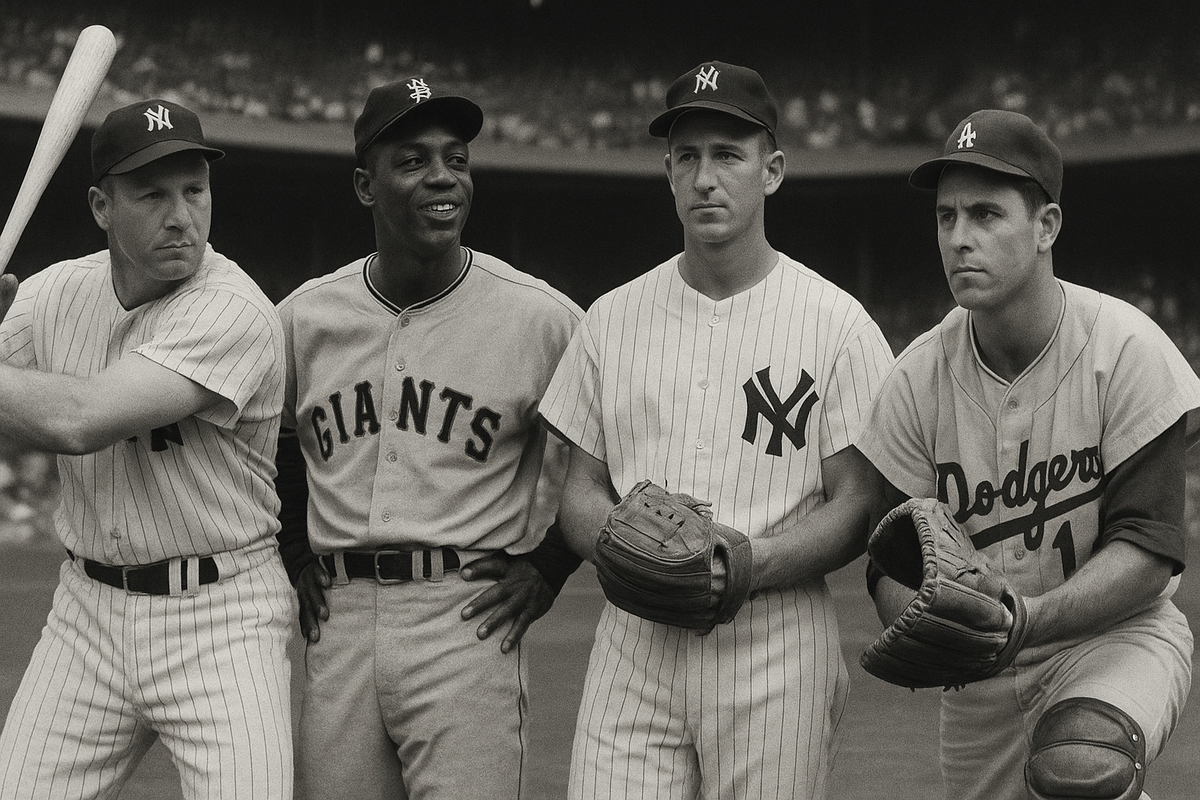
His subjects were Mickey Mantle, Willie Mays, Whitey Ford, Maury Wills, and Tom Haller. Three of these names would echo through history. Two would fade. But in 1963, Riger saw them all as exemplars of something larger than wins and losses.
Historical Archive
Publication: Esquire Magazine
Issue Date: June 1963
Featured Article: "Baseball's Power Elite" by Robert Riger
Featured Players: Mickey Mantle, Willie Mays, Whitey Ford, Maury Wills, Tom Haller
Historical Context: Published months before JFK's assassination
The Dynasty and the Maverick
Mickey Mantle carried an impossible burden in 1963. He was the heir to Babe Ruth's throne, the center of the Yankees' seemingly eternal dynasty, and a man whose body was already betraying him at thirty-one. Every swing contained both raw power and visible pain. Riger captured this duality—the way Mantle embodied American strength while privately crumbling under its weight.
Willie Mays was his opposite: pure kinetic joy. While Mantle grimaced through heroics, Mays made transcendence look effortless. His speed, his glove work, his impossible catches—everything about Mays suggested that greatness shouldn't cost you anything. He played as if the game loved him back.
Whitey Ford offered a third model entirely: mastery through control. No wasted motion. No flash. Just surgical precision repeated over twenty seasons. Ford proved that excellence could be quiet, methodical, almost bureaucratic in its consistency. In an era that worshipped power, Ford was the accountant who somehow became essential.
The Revolutionary and the Prospect
Maury Wills had rewritten baseball's tactical playbook a year earlier. His 104 stolen bases in 1962 didn't just break a record—they reminded every manager in the league that speed could terrorize pitchers as effectively as home runs. Wills turned the stolen base from a gamble into a weapon, forcing a strategic recalibration across the sport.
And then there was Tom Haller—the anomaly in Riger's pantheon. While the others were established legends or proven revolutionaries, Haller represented something different: the promise of the next wave. A young catcher with the Giants, Haller embodied grit and potential. His inclusion in "Baseball's Power Elite" now reads as either prescient or optimistic, depending on how generously you grade a solid career against immortality.
Esquire as Curator of Masculinity
By 1963, Esquire had spent three decades defining what sophisticated American manhood looked like. The magazine didn't merely cover sports—it positioned them within a larger conversation about identity, style, and cultural authority. Placing Riger's baseball essay alongside literary criticism, political commentary, and fashion spreads sent an unmistakable message: understanding these athletes was essential to understanding America itself.
The feature's visual presentation reinforced this elevation. Black-and-white photography captured Mantle frozen mid-swing, Mays suspended in graceful motion, Ford's economical delivery, Wills exploding toward second base, Haller crouched in tense anticipation. Each image was composed like a portrait of nobility. The accompanying illustrations—including a droll cartoon of a convertible stalled on train tracks—reminded readers that Esquire could balance gravitas with wit, seriousness with knowing humor.
Riger's prose matched the magazine's sophistication. He wrote about "aura" and "mystique," qualities that defied quantification. His essay argued that true greatness lived in intangibles—the way a player could alter the emotional temperature of a stadium simply by stepping into the batter's box. This wasn't the language of box scores. It was the language of literature applied to sport.
A Nation on the Edge
The timing makes this issue almost unbearably poignant. Published mere months before Kennedy's assassination would shatter America's self-image, "Baseball's Power Elite" captures a country that still believed in uncomplicated heroism. The Civil Rights Movement was dismantling Jim Crow, the Cold War continued its nuclear standoff, and cultural upheaval simmered beneath the surface—but baseball remained steady, a stage where excellence could still be celebrated without irony or complication.
For readers in 1963, Mantle and Mays weren't just talented athletes. They were proof that American systems produced greatness. Ford's consistency suggested reliability in uncertain times. Wills's innovation demonstrated that tradition could evolve without collapsing. Even Haller's youth promised continuity—that the next generation would uphold the standards established by their predecessors.
The article functioned as reassurance disguised as sports writing.
Why This Issue Endures
For collectors, the June 1963 Esquire represents a convergence of historical forces. It's simultaneously a sports document, a cultural artifact, and a design masterpiece from the magazine's golden age.
The photography and layout exemplify mid-century editorial excellence—clean, dramatic, purposeful. Every element serves the larger argument that these men deserve to be treated as significant. Few publications ever profiled Mantle, Mays, and Ford together with such seriousness and literary ambition.
But the issue's deeper value lies in what it preserves: a specific moment when baseball still functioned as national mythology, when a mainstream magazine could treat athletes as philosophers treated ideas, and when Americans could look at their sports heroes without irony corroding admiration.
Design Excellence
Black-and-white photography captures each player as American nobility, with clean layouts and dramatic composition that elevate sport into art.
Literary Ambition
Riger wrote about "aura" and "mystique"—qualities that defied statistics—treating greatness as a subject worthy of sophisticated analysis.
Cultural Authority
Esquire positioned baseball alongside literature and politics, arguing that understanding these athletes was essential to understanding America.
Historical Timing
Published months before JFK's assassination, it captures the last moment of American innocence—when heroes could be celebrated without irony.
The Artifact as Time Machine
Holding this issue now means holding 1963 itself. Every page offers evidence: of how American men saw themselves, of which values they celebrated, of what "excellence" meant before cynicism and deconstruction became default modes of analysis.
You can trace cultural shifts through the advertisements alone. The products, the models, the aspirations—all frozen in amber.
But Riger's essay remains the centerpiece. It's a document from the last moment when sportswriters could write about athletes as if they were Homeric figures without seeming ridiculous. Within a decade, the Vietnam War and Watergate would make that kind of uncomplicated hero-worship nearly impossible. The ironic distance of postmodernism would insist on deconstructing rather than celebrating.
"Baseball's Power Elite" exists on the far side of that divide. It's earnest, elevated, unashamed of its reverence. That's precisely what makes it valuable.
Collector Significance
Historic Timing
Published months before JFK's assassination, capturing a nation on the edge of profound change and the last summer of American innocence.
Sports Significance
Few magazines profiled Mantle, Mays, and Ford together with such literary authority and sophisticated cultural analysis.
Design Quality
Exemplifies Esquire's golden era with masterful photography, clean layouts, and the seamless integration of text and image.
Cross-Appeal
Attracts baseball historians, mid-century design collectors, and cultural scholars—a convergence of multiple collecting categories.
Increasing Rarity
Well-preserved copies grow scarcer each year as mid-century magazines deteriorate or are discarded, driving collector demand.
Cultural Record
Documents how Americans constructed identity through sport and media before irony became the default mode of cultural analysis.
For the Serious Collector
If you're building a library of 20th-century cultural history, this issue belongs in it. From the 1930s through the 1970s, Esquire didn't just document American culture—it helped define what was worth documenting.
Browse Esquire Magazine Collection