
The Woman Who Wouldn't Be Silenced
Ruby Hurley, the October 6, 1955 Issue of Jet Magazine, and the Dangerous Work of Freedom
The telephone rang at all hours. Sometimes the voices were specific: "We're going to sprinkle you with gunshot."
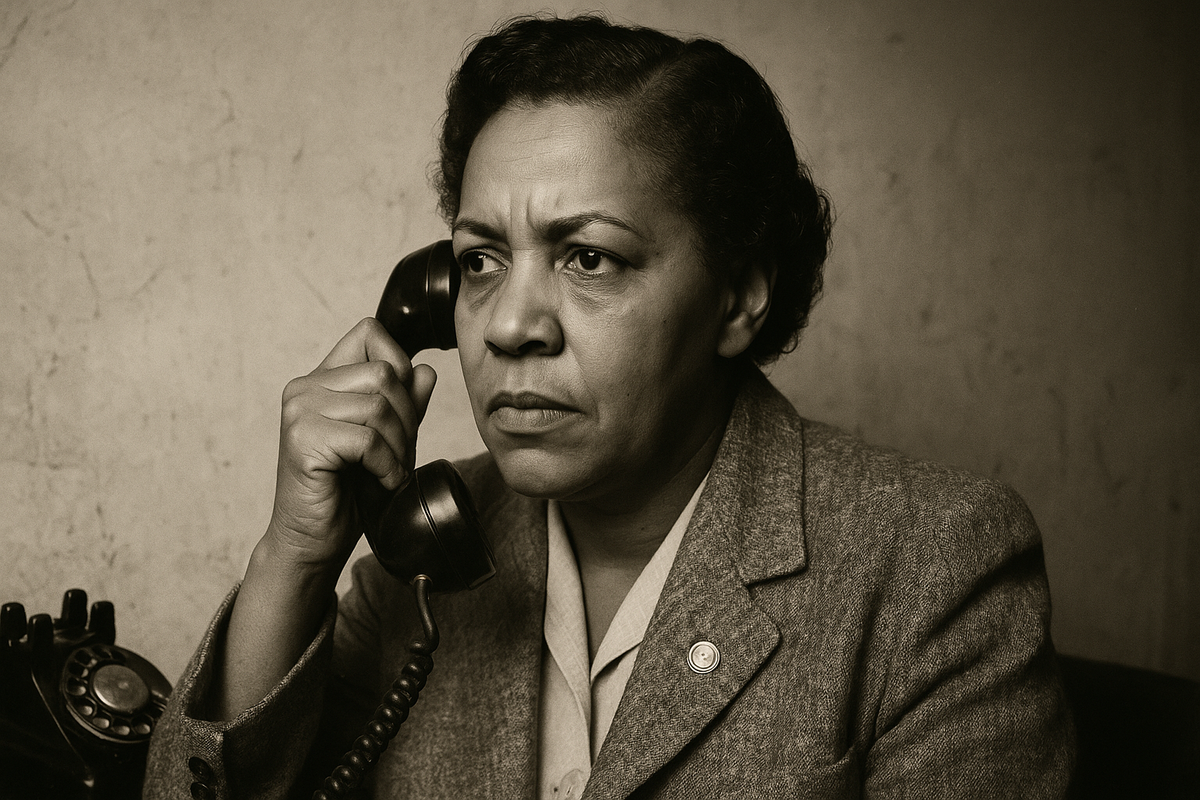
Other times, the callers simply promised to bomb her Birmingham office. Ruby Hurley—the NAACP's Southern Regional Director supervising operations across seven states—received these threats nearly every day. Yet when Jet Magazine photographed her for its October 6, 1955 cover, they captured her exactly as she worked: receiver in hand, unflinching, coordinating the movement's response to terror.
The cover line didn't equivocate: "Most Militant Negro Woman in the South."
Archive Details
- Historical Figure
- Ruby Hurley, NAACP Southern Regional Director
- Issue Date
- October 6, 1955
- Archive Source
- Jet Magazine
- Historical Context
- Published weeks after Emmett Till's murder and trial verdict
October 1955: The Moment Democracy Fractured
The timing of this issue was no accident. Just weeks earlier, two white men had tortured and murdered fourteen-year-old Emmett Till in Mississippi. Their trial concluded September 23—acquittal after sixty-seven minutes of jury deliberation. Jet's previous issue had already shaken the nation by publishing Mamie Till-Mobley's decision to show her son's mutilated body in an open casket. Now, in early October, as readers processed the killers walking free, Jet pivoted its lens to those fighting back.
This was the landscape:
Brown v. Board of Education had landed the previous year, declaring school segregation unconstitutional. White Citizens' Councils were forming in response—organized resistance cloaked in civic language. Violence wasn't aberrant; it was policy enforcement. Black activists investigating murders, registering voters, or challenging Jim Crow could expect surveillance, beatings, bombings, or worse.
Ruby Hurley was doing all of it.
The Architecture of Resistance
From her Birmingham base, Hurley coordinated what amounted to a shadow government of justice. Her territory: Alabama, Florida, Georgia, Mississippi, North Carolina, South Carolina, Tennessee. Her responsibilities: investigating lynchings, coordinating legal defense, recruiting members, delivering speeches, supporting local organizers facing down the Klan.
Jet documented her staggering workload: over 2,000 speeches delivered. Twenty thousand miles traveled each year by car, bus, train, and plane. She met with sharecroppers in Delta farmhouses. She inspected bombed-out homes where families had dared to register to vote. She listened to ministers whose churches had been firebombed for hosting voter registration drives.
And every night, the phone calls came. Anonymous. Specific. Constant.
What Mainstream Media Wouldn't Print
In 1955, the national press treated civil rights activism as a curiosity or a disruption. Heroism was reserved for soldiers and politicians, not Black women dodging death threats in the segregated South. Jet Magazine operated under different principles.
Founded in 1951, Jet was pocket-sized but fearless—a weekly digest that circulated through Black barbershops, beauty salons, and living rooms across America. Where white-owned publications minimized or ignored Black achievement and suffering, Jet amplified both with equal intensity.
The October 6, 1955 issue exemplified this mission. While other outlets focused narrowly on the Till verdict's sensational elements, Jet asked a different question: Who is organizing the response? Who is protecting the next family? Who is building the infrastructure of resistance?
The answer, pictured on a bright yellow cover, was Ruby Hurley.
The Cover That Refused to Look Away
The visual language was deliberate. Against that arresting yellow backdrop, Hurley holds a telephone—the instrument of her constant coordination and the channel for her daily threats. She's not posing. She's working. The headline doesn't soften or qualify: "Most Militant Negro Woman in the South." In 1955, militant wasn't the compliment it might sound like today—it was provocative, even dangerous. Jet knew this. They used it anyway.
Inside, the magazine paired photographs with narrative reporting that refused to sanitize the stakes. Readers saw Hurley inspecting bombed houses. They saw her meeting with families whose loved ones had been lynched. They saw her composure under conditions designed to break anyone.
This was Jet's genius: combining visual documentation with context, ensuring readers understood not just what happened, but what it cost the people making it happen.
What This Issue Documents
Daily Courage Under Existential Threat
Hurley operated knowing any trip could be her last, any phone call could bring real consequences. She kept working.
Logistics as Activism
The movement didn't run on speeches alone. It required someone coordinating legal defense, investigating murders, recruiting members, and maintaining networks across hostile territory. Hurley built and maintained this infrastructure.
Women's Leadership Before It Was Acknowledged
In 1955, civil rights leadership was publicly coded male. Jet recognized what mainstream accounts missed: women like Hurley were running operations, not supporting them.
Grassroots Networks Matter
Hurley's twenty-thousand-mile annual circuit meant meeting directly with sharecroppers, domestic workers, small-town ministers—the people most vulnerable to retaliation and most essential to the movement's survival.
Documentation as Defiance
Jet's decision to feature Hurley wasn't neutral journalism—it was a statement that this work deserved national attention, regardless of who found it threatening.
What Hurley's Story Still Teaches
Movements don't succeed on rhetoric alone. They require logistics, coordination, courage, and someone willing to answer the phone when threats arrive. Ruby Hurley did this work knowing it could kill her. She did it anyway, not because she was extraordinary—though she was—but because the alternative was accepting a system designed to destroy Black life and dignity.
Jet Magazine's coverage preserved what mainstream outlets dismissed or ignored. In doing so, it created a parallel historical record: one that centered Black achievement, documented Black suffering, and refused to pretend either was acceptable to overlook.
That record matters now because memory is selective. The names everyone knows—King, Parks, Lewis—earned their prominence. But the infrastructure that made their work possible depended on hundreds of others: regional directors, local organizers, volunteers who canvassed and coordinated and kept showing up despite the cost.
Ruby Hurley was one of those people. Jet made sure we'd remember.
Why This Issue Commands Attention
The October 6, 1955 issue of Jet Magazine is increasingly scarce in collectible condition. Historians, archivists, and serious collectors seek it for several converging reasons:
Historical Proximity
Published immediately after the Emmett Till verdict, it captures the movement's response while events were still unfolding—not retrospective analysis, but real-time documentation.
Underrecognized Leadership
Ruby Hurley remains less famous than male contemporaries despite equivalent or greater operational responsibility. This issue provides rare contemporary documentation of her work.
Visual Distinction
The bold yellow cover and striking portrait make this issue immediately recognizable—a standout in any collection of civil rights ephemera.
Preservation Challenges
Mid-1950s Jet issues were printed on newsprint, circulated widely, and rarely preserved. Surviving copies in good condition are genuinely rare.
Institutional Demand
Libraries, museums, and research institutions actively seek complete runs of Jet from this era for their civil rights collections.
Building a Collection That Matters
Original issues of Jet Magazine from the 1950s aren't casual acquisitions. They're primary sources—artifacts that documented history as it happened, distributed to readers who were living it.
Whether you're researching civil rights history, building an archival collection, or honoring family members who subscribed to Jet during this era, these magazines offer something digital archives can't: the physical experience of holding what someone held in October 1955.
Browse Jet Magazine CollectionA Document Worth Preserving
The October 6, 1955 issue of Jet Magazine freezes a moment when American democracy was fracturing and a generation of activists refused to let it break completely. Ruby Hurley's presence on that cover—telephone in hand, threats incoming, work continuing—stands as testimony to what sustained resistance actually looked like.
Not speeches. Not marches alone. But someone coordinating, investigating, traveling, listening, and answering the phone day after day after day, even when the voices on the other end promised death.
That's the history this magazine preserved. That's why it matters.