
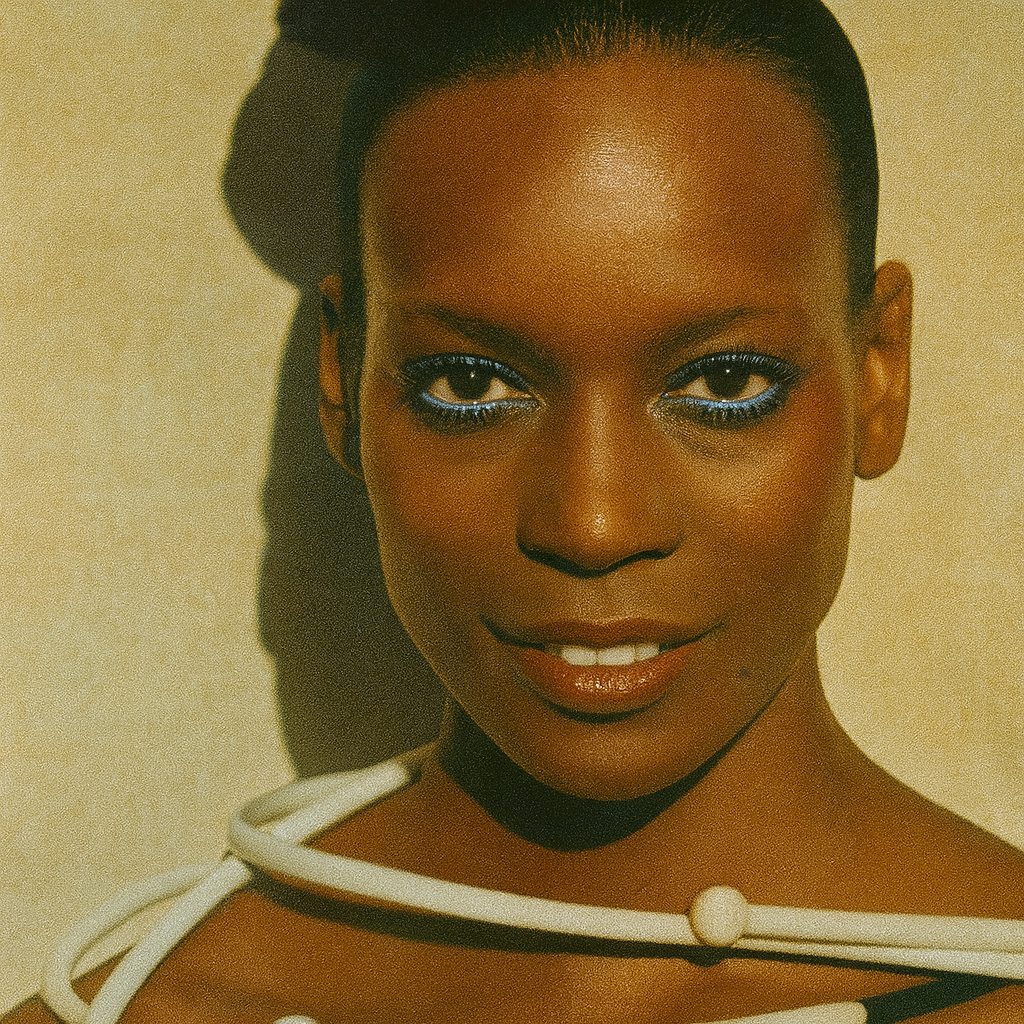
Beauty Surpasses Prejudice
Naomi Sims, American Pride, and the Changing Face of Fashion
A Black woman in a billowing cape strides across a Manhattan street, her smile turned back toward the camera—confident, radiant, unstoppable. The year is 1972. The magazine is Vogue. And for millions of American readers opening their June 1st issue, this image of Naomi Sims wasn't just fashion photography. It was a declaration.
This was the moment the world's first Black supermodel claimed her place at the center of American style—not as a novelty, not as a token, but as the embodiment of where beauty was heading. What readers held in their hands that summer wasn't merely a glossy fashion spread. It was evidence that the face of America was changing, and Vogue was documenting it in real time.
Archive Details
Historical Figure: Naomi Sims, World's First Black Supermodel
Issue Date: June 1, 1972
Archive Source: Vogue Magazine
Editor: Grace Mirabella
A Nation in Flux, A Magazine in Transition
The early 1970s offered no easy answers. The Vietnam War ground on. The women's movement challenged every assumption about power and domesticity. Racial justice remained an urgent, unfinished battle. Yet progress was undeniable: Black Americans were claiming space in politics, culture, and media once barred to them. Women were breaking into professions that had excluded them for generations.
Fashion has always been a mirror—sometimes flattering, often distorted, but always reflective. For decades, American magazines had worshipped a single aesthetic: blonde hair, pale skin, Eurocentric features. That narrow definition had calcified into doctrine. By 1972, the ground was shifting beneath it.
Naomi Sims was the earthquake.
Born in Mississippi in 1948 and raised in Pittsburgh, she had stormed New York's fashion scene in the late 1960s with a combination of striking beauty and fierce determination. By the time Vogue profiled her, she was only twenty-three—yet already a trailblazer. She'd walked major runways, anchored advertising campaigns, and published beauty advice for Black women navigating an industry that had long ignored them.
Her presence in the June 1972 Vogue was both timely and inevitable. And her words cut through every careful equivocation: "Beauty surpasses prejudice."
Vogue as Cultural Barometer
Under editor Grace Mirabella, Vogue had evolved beyond couture catalogs. It became a cultural instrument—one that didn't just show readers what to wear, but invited them into larger conversations about women's roles, shifting beauty ideals, and the politics of who gets seen.
The Naomi Sims feature exemplified this vision. The magazine didn't simply parade her through fashion shots. It built a narrative, integrating photography with substantial text, allowing Sims to speak in her own voice while readers absorbed her visual command.
The images told their own story:
Sims striding across a busy New York street, that cape flowing behind her, confidence radiating from every angle.
A striking close-up, her face framed with almost futuristic styling, her gaze direct and powerful—beauty as force, not ornament.
Quieter black-and-white photographs showing her reading to a child, evidence of her community service work.
For many households, this was their introduction to Sims. For countless young Black women, seeing her in Vogue was revolutionary—proof that elegance, power, and beauty were theirs to claim.
The Architecture of the Feature
The June 1, 1972 cover was understated, modern, typical of Mirabella's editorial restraint. No theatrical excess. Just clean sophistication.
Inside, the Sims feature commanded prime real estate. It wasn't tucked away as curiosity or tokenism. Long narrative passages ran alongside large-scale photographs, creating a portrait of Sims as multidimensional: model, thinker, volunteer, proud American. Vogue wasn't just showcasing fashion. It was shaping cultural aspiration.
The blend of word and image was deliberate. This was how the magazine wielded influence—by insisting that beauty could carry ideas, that style could intersect with substance, that representation mattered.
What the Feature Revealed
Why Collectors Prize This Issue
Serious collectors understand these aren't disposable magazines. They're cultural artifacts—physical evidence of moments when society redefined itself.
The Endurance of Print
Vogue issues from the 1970s remain relevant because they fused style with substance. They weren't just guides to trends but documents of what it meant to live, work, and dream in that era.
The June 1972 Naomi Sims issue is a time capsule. In an age before digital media, these magazines were how Americans understood beauty. Their physical permanence gives them continuing power.
For Collectors and Historians
If you value fashion history, civil rights documentation, or cultural evolution, the June 1, 1972 Vogue belongs in your collection. It's not just about glamorous photography—it's about progress, representation, and the redefinition of beauty in America.
Browse Vogue Magazine CollectionFrom the 1930s through the 1970s, each issue offers a window into its cultural moment. Together, they form a living archive of how fashion and society evolved.
Conclusion
The June 1, 1972 Vogue remains one of the most significant magazine issues of its decade. The Naomi Sims feature wasn't merely a fashion spread—it was a cultural milestone. With her words—"Beauty surpasses prejudice"—Sims stood as proof that America's face was changing.
To hold this issue today is to hold a moment when fashion met activism, when representation began reshaping an industry, and when a Black supermodel claimed her rightful place at the center of American style.
For those who value history, these vintage magazines aren't simply artifacts. They're voices from the past, reminding us that beauty and culture never stop evolving.