
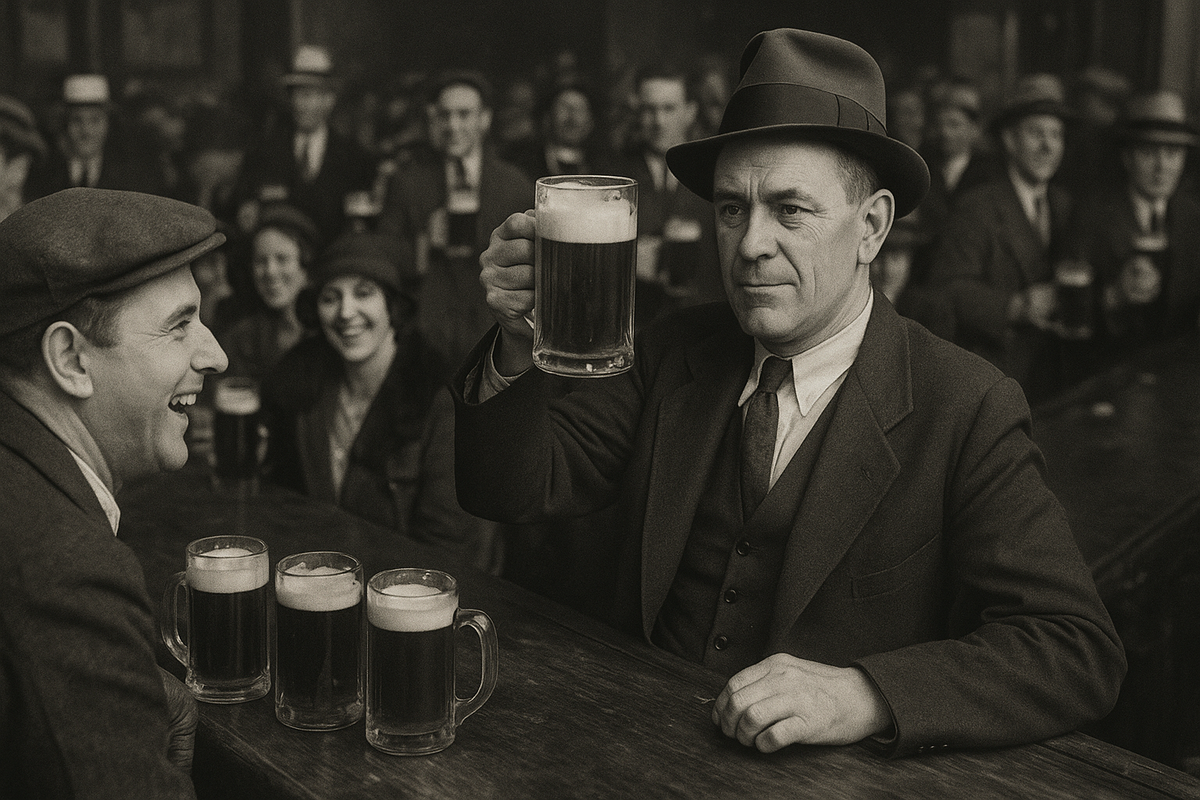
Beer, Prohibition, and American Culture in 1933
The New Yorker's Witty Take on a Nation in Transition
On April 15, 1933, readers who cracked open their copies of The New Yorker weren't just getting their weekly dose of cartoons and urbane commentary. They were witnessing a magazine perform an autopsy on Prohibition—while the patient was still warm.
The lead feature, "A Reporter at Large: Now That There's Beer," arrived precisely two weeks after Franklin D. Roosevelt signed the Cullen–Harrison Act into law, making 3.2% beer legal again after thirteen bone-dry years. Writer Morris Markey didn't waste time on celebrations. Instead, he dissected the economics, social hierarchies, and sheer absurdity of a city scrambling to figure out what legal drinking would mean for speakeasies, restaurants, and the entire architecture of New York nightlife.
This wasn't journalism. It was cultural taxidermy—capturing a moment of national transition with the magazine's signature blend of irony, precision, and withering observation.
Archive Details
Publication: The New Yorker
Issue Date: April 15, 1933
Featured Article: "A Reporter at Large: Now That There's Beer" by Morris Markey
Cover Artist: William Steig
Historical Context: Published two weeks after the Cullen–Harrison Act legalized 3.2% beer
A Nation Exhales
By April 1933, America was drowning. The Great Depression had gutted banks, vaporized savings, and left one in four workers unemployed. Into this wreckage stepped Roosevelt, inaugurated just weeks earlier with his promise of a New Deal. Loosening Prohibition was among his first acts—not out of sentimentality, but pragmatism. The country could no longer afford to enforce a law millions ignored, and the government desperately needed the tax revenue legal beer would generate.
When beer returned, Americans didn't just drink. They erupted. Parades clogged city streets. Taverns ran dry within hours. Impromptu block parties turned into raucous celebrations of a moral experiment finally, mercifully dead.
The New Yorker understood what others missed: this wasn't just about alcohol. It was about the collapse of American paternalism, the triumph of urban skepticism over rural moralism, and the quiet admission that government had spectacularly overreached. Markey's reportage captured all of it—the economic Darwinism about to cull speakeasies, the class warfare playing out in who could afford to survive the transition, and the Depression-weary public grabbing at any excuse to laugh again.
The Magazine That Mastered the Moment
By 1933, The New Yorker had already carved out its territory. Where daily newspapers reported facts, Harold Ross's magazine offered something rarer: interpretation laced with contempt for sentimentality. It didn't announce "beer is back" like a wire service bulletin. It asked the questions that mattered: What happens to the speakeasies? Who profits? Who fails? What does this reveal about who we are?
Markey's piece became a sociological map of urban nightlife's future. He predicted that speakeasies would fracture into two species: the glamorous clubs backed by wealthy patrons, which would simply rebrand as respectable establishments, and the filthy dives that had survived on secrecy alone—now exposed and doomed. The middle-class speakeasy, that hybrid creature of Prohibition, would go extinct.
Restaurants would dominate. By offering food and drink under one roof, they held every advantage. Beer halls would thrive as Depression-era entertainment—cheap, noisy, theatrical spaces where ordinary people could dance, flirt, and forget their bank statements for an evening.
But Markey's sharpest insight was darker: most saloon-keepers would fail anyway. Legality changed nothing about the brutality of commerce. Only the smartest, best-capitalized operators would survive the transition.
The magazine's cartoons amplified this sensibility. Every illustration carried the same sardonic edge—New York as a stage where American contradictions played out in real time, observed by artists who refused to look away or simplify what they saw.
A Cover That Knew the Joke
William Steig's cover for the April 15, 1933 issue is a masterclass in visual irony. A rotund man in evening dress sprawls on a sofa, slack with exhaustion or excess. A woman in a yellow gown collapses against him. Scattered across the table: pearls, gloves, a telephone—the debris of urban leisure.
Nothing about the image celebrates. Instead, it presents indulgence as both comic and slightly pathetic, capturing the mood of a city that had spent thirteen years drinking illegally and was now permitted to drink legally—and wasn't entirely sure the difference mattered.
Steig, who would later become one of The New Yorker's most beloved illustrators, understood what the moment required: not triumph, but a knowing smirk. The cover suggested that America was ready to lean back into pleasure again, but with eyes wide open about what that pleasure cost.
What Markey Saw That Others Missed
The genius of "Now That There's Beer" lies in its refusal to moralize. Markey didn't champion Prohibition's end or mourn its passing. He simply mapped the wreckage and predicted the future with cold-eyed accuracy:
The Speakeasy's Split Personality
Glamour clubs would endure by shedding their criminal origins; basement dives would vanish once legality stripped away their mystique.
Restaurants as the Real Winners
Combining food and alcohol gave them structural advantages no standalone bar could match.
The Illusion of Survival
Most operators still lacked the capital, location, or business acumen to succeed. Beer's return would trigger a culling, not a renaissance.
Beer Halls as Depression Theater
Like movie houses, they offered music, noise, spectacle, and the possibility of romance at prices the unemployed could almost afford.
This was reportage disguised as cultural criticism, an X-ray of Depression-era social dynamics that remains startlingly relevant.
Why These Magazines Endure
Vintage New Yorker issues survive because Harold Ross built a publication that refused to be merely timely. Every issue operated as cultural criticism disguised as journalism, capturing not just what happened, but what it meant—and doing so with prose sharp enough to remain relevant decades later.
The April 15, 1933 issue exemplifies this approach. Even during the Depression's darkest days, the magazine offered its readers something beyond escape: the pleasure of understanding their moment with precision and wit. That combination of intelligence and style is why these issues remain as collectible today as they were influential in their time.
Why This Issue Commands Collector Attention
Historical Timing
Published within days of beer's legalization, it captures the immediate cultural response rather than retrospective analysis.
Early Steig Cover
Acquiring his work from this period means owning a piece of his artistic evolution before he became synonymous with the magazine's visual identity.
Primary Source Value
Historians studying Prohibition's collapse, Depression-era urban culture, or the economics of nightlife treat this issue as essential documentation.
Scarcity
1930s issues survive in far smaller numbers than postwar New Yorkers, and milestone issues tied to legislative change carry premium valuations.
Cultural Artifact Status
This isn't a magazine reporting on a moment. It is the moment, preserved with intelligence and style.
The Collector's Prize
Owning this issue means holding a piece of the exact instant when America raised its first legal glass in over a decade—and The New Yorker was there, notepad in hand, counting the bodies before they hit the floor.
Final Assessment
The April 15, 1933 issue of The New Yorker stands as one of the magazine's most culturally significant publications. Morris Markey's "Now That There's Beer" transformed a legislative milestone into sophisticated social analysis, predicting nightlife's future with unsettling accuracy. William Steig's cover captured the moment's ironic ambivalence. Together, they created a publication that transcends its era.
For collectors, historians, and anyone who values print culture at its most intelligent, this issue represents something rare: a magazine that knew exactly what it was witnessing and possessed the editorial firepower to capture it with precision, humor, and lasting insight.
This is what great journalism looks like when it refuses to merely report—and insists on understanding.
Explore the Archive
If Depression-era cultural commentary and Prohibition's collapse intrigue you, the April 15, 1933 issue is only the beginning. The New Yorker spent decades chronicling the literary, artistic, and cultural shifts that defined 20th-century America.
Browse The New Yorker Magazine CollectionEach issue functions as a time capsule, preserving not just events but the texture of how Americans thought, joked, and processed change in real time.