
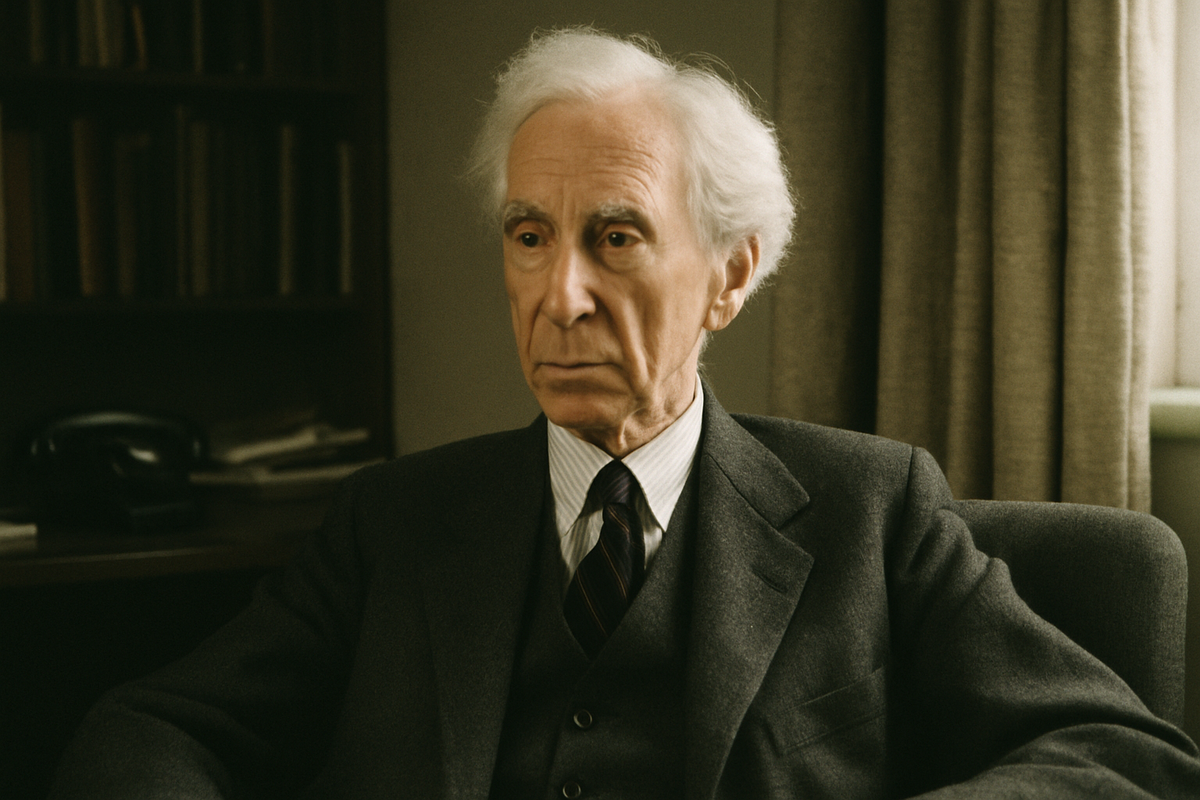
The Philosopher and the Pinup
When Bertrand Russell Brought Nuclear Dread to Playboy's Pages
In March 1963, American men opened their mailboxes to find something unprecedented: a magazine that offered both a blonde in a Playboy towel and a British philosopher predicting humanity's extinction. The juxtaposition wasn't accidental—it was the entire point.
Inside that issue, sandwiched between centerfolds and bourbon advertisements, sat one of the most urgent conversations of the Cold War: Bertrand Russell's warning that civilization stood three-to-one odds against survival. Just four months after the Cuban Missile Crisis had brought the world to the brink, Russell used Playboy's pages to deliver a message that no academic journal could reach: nuclear annihilation wasn't philosophical abstraction anymore. It was Monday morning's headlines.
This wasn't Russell slumming it for a paycheck. This was Playboy proving it could be both.
Archive Details
Historical Figure: Bertrand Russell, 3rd Earl Russell (1872–1970)
Issue Date: Playboy Magazine, March 1963
Historical Context: Published four months after the Cuban Missile Crisis (October 1962)
Archive Source: Original vintage magazine collection
The Magazine That Refused to Choose
By 1963, Playboy had carved out cultural territory no other publication dared claim. While Esquire played it safe with literary respectability and men's magazines like Argosy trafficked in adventure pulp, Hugh Hefner's creation insisted its readers could appreciate both Vargas girls and Sartre. The Playboy Interview—launched just two years earlier—had become the platform where cultural giants spoke without PR filters.
Russell's appearance wasn't an outlier. It was the format working exactly as designed: strip away the academic jargon, ignore the conventional wisdom, and let brilliant minds address the most consequential questions of the age. For readers accustomed to Cold War propaganda and newspaper euphemisms, Russell's bluntness must have landed like a gut punch.
October's Shadow
The timing mattered desperately. In October 1962—barely five months before this interview hit newsstands—Kennedy and Khrushchev had played nuclear chicken over Soviet missiles in Cuba. For thirteen days, American families stockpiled canned goods and schoolchildren practiced duck-and-cover drills. The crisis ended not with triumph but with collective nausea: everyone understood how close they'd come.
Russell had spent those October days frantically cabling world leaders, organizing protests, and publicly condemning both superpowers for their recklessness. At 90 years old, the Nobel laureate had transformed from Cambridge logician into something rawer: a prophet warning that human cleverness had finally outpaced human wisdom.
His credentials for apocalyptic warning were unimpeachable. This was the man who'd co-authored Principia Mathematica, reshaped modern logic, and won the Nobel Prize for Literature. He'd also gone to prison twice—once for pacifism during World War I, once for nuclear protest in 1961. Russell didn't theorize about civil disobedience. He practiced it in British jail cells.
What Russell Actually Said
The Playboy Interview format allowed Russell to speak with a directness that academic platforms wouldn't permit. The themes he addressed weren't abstract philosophy—they were survival instructions:
These weren't soundbites. They were a 90-year-old man trying to shake his species awake.
The Cover They Couldn't Reconcile
The March 1963 cover remains one of Playboy's most arresting visual contradictions. A blonde model, wrapped in a branded towel, beams against a red-orange backdrop—all warmth, playfulness, and carefully calculated sex appeal. The aesthetic screamed leisure, pleasure, and the good life.
Turn the page, and Russell is warning that there might not be a good life. Not for anyone.
This wasn't editorial schizophrenia. It was Playboy's entire thesis: that the modern American man could be sensual and serious, pleasure-seeking and politically engaged. Other publications forced readers to choose. Playboy refused.
The strategy worked because it trusted its audience. These weren't frat boys seeking cheap thrills (though they bought copies too). These were young professionals, returning veterans, college students—men navigating a culture that told them to settle down, buy a station wagon, and stop asking hard questions. Playboy gave them permission to ask everything.
Why Collectors Covet This Issue
Owning this issue means possessing a document that asked everyday Americans to confront humanity's potential end—and did it between bourbon ads and jazz reviews.
The Magazine as Time Machine
Playboy's legacy transcends its reputation. Yes, it helped drive the sexual revolution. Yes, it objectified women in ways that feel dated now. But it also published James Baldwin, Alex Haley, Vladimir Nabokov, and Kurt Vonnegut. It interviewed Martin Luther King Jr., Malcolm X, and Frank Sinatra. It treated politics, literature, and sexuality as equally worthy of sophisticated attention.
For historians, these magazines are irreplaceable because they show how ideas actually circulated—not through academic journals or policy papers, but through publications that sat on coffee tables and barbershop counters. Russell's warning about nuclear extinction reached more Americans via Playboy than through all his academic books combined.
These issues document a moment when mainstream culture hadn't yet fragmented into niche audiences. A single magazine could present a philosopher predicting apocalypse and a centerfold in the same 200 pages, and millions of readers took both seriously.
Access the Archive
Our collection preserves thousands of original Playboy issues from the 1950s through the 1970s—the era when the magazine functioned as both cultural lightning rod and serious forum. These aren't reproductions or digital scans. They're the physical artifacts that shaped how a generation thought about sex, politics, literature, and survival.
Browse Playboy Magazine CollectionRussell's Ghost
The March 1963 issue endures because Russell was right about the stakes, even if his timeline proved pessimistic. We didn't destroy ourselves in the 20th century, but the weapons remain. The brinkmanship continues. The question Russell posed—whether human beings can be rational enough to survive their own cleverness—never got answered. It just got postponed.
That's what makes this issue more than collectible nostalgia. It's a reminder that the most urgent conversations sometimes happen in the most unexpected places. That philosophy matters most when it leaves the seminar room. That a magazine famous for the Playmate of the Month also gave Bertrand Russell space to argue for humanity's survival.
The blonde in the towel sold the issue. Russell's warning is why it still matters.