
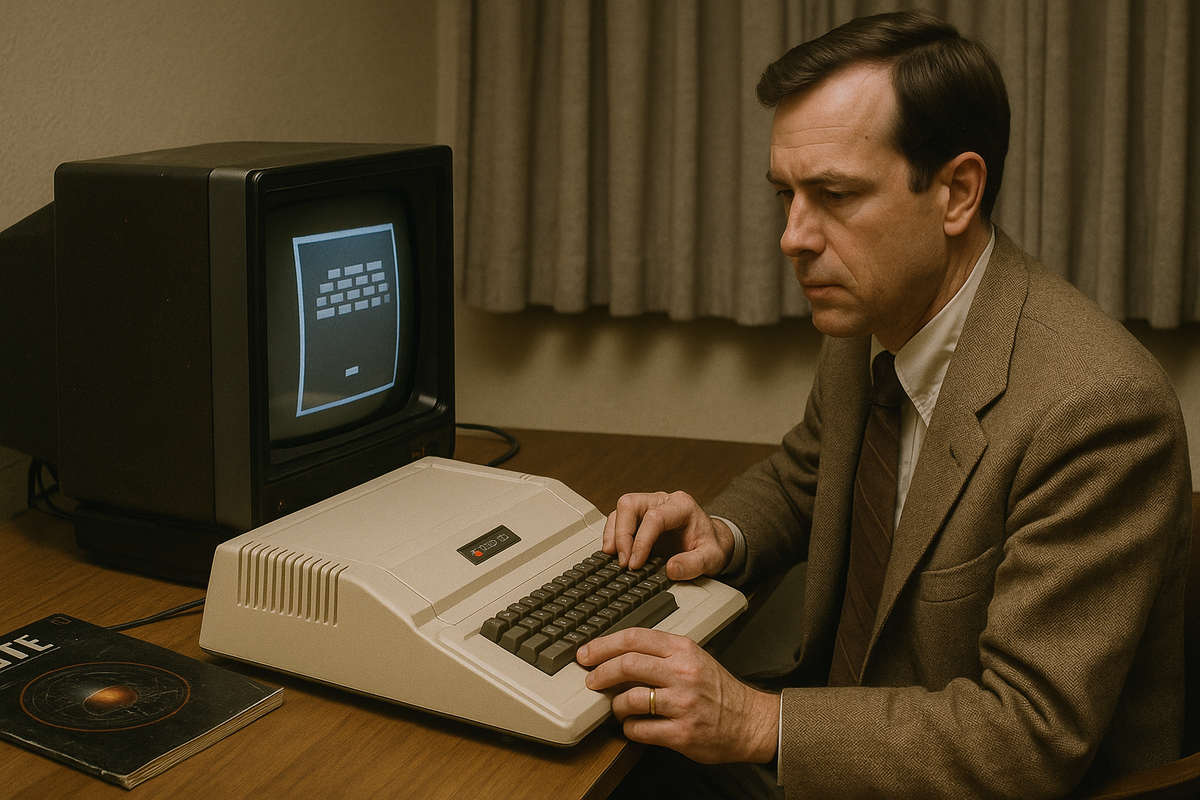
The Apple-II and the Dawn of Personal Computing
Inside BYTE Magazine, May 1977
Stephen Wozniak didn't just write a product announcement for the May 1977 issue of BYTE Magazine. He wrote the technical biography of a machine that would pull computing out of the basement workshop and place it on kitchen tables across America.
For readers who cracked open that issue in the spring of '77, the implications were immediate. Here was a computer you could buy, plug in, and program—no soldering iron required, no engineering degree necessary. The hobbyist era was ending. The personal computer industry was beginning. And BYTE had handed its audience the blueprints.
The Revolution Was Already Running
Two years before BYTE published Wozniak's article, the Altair 8800 had detonated the microcomputer movement. Thousands of engineers and hobbyists across the United States were building machines from scratch, writing code in machine language, and swapping programs through mimeographed newsletters. The Homebrew Computer Club in Silicon Valley had become ground zero for a generation convinced that computing belonged to individuals, not institutions.
Steve Jobs and Stephen Wozniak entered this scene in 1976 with the Apple-I—a single-board computer that could connect to a keyboard and monitor without requiring a forest of expansion cards. It was elegant. It was usable. But it was still a hobbyist's machine.
The Apple-II changed the equation entirely.
Unveiled in 1977 alongside the Commodore PET and the TRS-80—the trio historians now call the "1977 Trinity"—the Apple-II arrived with color graphics, built-in BASIC, audio output, and expandability, all housed in a molded plastic case that looked like it belonged in a home, not a lab. It wasn't a kit. It was a product. And Wozniak's article in BYTE gave readers something no press release could: the engineering logic behind the revolution.
Archive Details
Historical Figure: Stephen Wozniak, Co-Founder of Apple Computer
Issue Date: May 1977
Archive Source: BYTE Magazine
Significance: First comprehensive technical documentation of the Apple-II published by its designer
Why BYTE Mattered
By 1977, BYTE Magazine had already claimed its position as the journal of record for microcomputing. Its editors understood that the personal computer wasn't a gadget—it was a cultural rupture. So they published schematics alongside manifestos, source code alongside essays, product reviews alongside prophecies.
BYTE didn't merely report on the Apple-II. It dissected it. Readers got block diagrams of the video generator, annotated BASIC listings, photographs of high-resolution graphics in action. Where other magazines offered hype, BYTE offered access. For programmers and engineers, this was an education. For collectors today, it's primary source material.
The May 1977 issue didn't just inform. It activated. Readers who studied those pages weren't passive consumers—they were participants in a movement that would restructure work, education, and entertainment within a decade.
What Made the Cover Speak
BYTE's cover design for May 1977 rejected the glossy product photography that defined mainstream tech marketing. Instead, it featured bold, abstract electronic artwork—visual shorthand for a magazine that spoke to builders, not buyers.
Inside, Wozniak's system description operated on two levels. For the casual reader, it demonstrated what the Apple-II could do: display fifteen colors, run games, handle paddle input, produce sound. For the serious engineer, it revealed how: the memory architecture, the DRAM refresh cycles, the video timing tricks that let a $1,298 computer generate graphics competitive with machines costing ten times as much.
Other publications treated technical details as obstacles to reader engagement. BYTE treated them as the story itself. The logic of the circuits, the efficiency of the code, the cleverness of the design—these weren't footnotes. They were the reason the Apple-II mattered.
Ten Technical Breakthroughs That Defined a Platform
Integral Video Output
The Apple-II connected directly to a standard television, eliminating the need for expensive monitors and making the machine accessible to households that would never buy a dedicated display.
Color Graphics
Fifteen colors turned the Apple-II into a platform for games and educational software that felt less like programming exercises and more like experiences.
Dynamic Memory Design
Wozniak's use of 4K and 16K DRAM chips allowed the machine to scale from 4K to 48K of RAM without requiring users to discard earlier investments.
Built-In BASIC
Apple BASIC loaded instantly at boot, transforming the computer into a programmable tool the moment it powered on.
Audio Capabilities
Programmers could toggle the internal speaker directly from code, opening the door to sound effects, music, and auditory feedback.
Game Potential
BYTE's paddle-and-ball "brick wall" game, coded in Apple BASIC, demonstrated how quickly users could move from concept to playable software.
Debugging Tools
Features like TRACE mode and a built-in disassembler gave programmers the ability to understand not just what their code did, but how the machine executed it.
Expandability
Eight expansion slots meant the Apple-II could grow with its user—from hobbyist toy to business tool to multimedia platform.
Philosophy of Design
Wozniak's engineering ethos prioritized affordability, reliability, and usability over raw specifications, a decision that made the Apple-II commercially viable in ways more powerful machines were not.
Cultural Impact
The Apple-II wasn't positioned as hardware. It was positioned as possibility—a platform where creativity, education, and entrepreneurship could converge.
These weren't isolated features. They were interdependent decisions that, taken together, created a machine users could trust, extend, and evangelize.
The Permanence of Print
BYTE's issues endure because they were never designed for disposability. Each page carries the weight of careful editorial judgment: which machines mattered, which ideas would scale, which innovations would reshape industries. In an era where most tech news evaporates within hours, these magazines remind us that computing was once studied slowly, discussed seriously, and documented with care.
That permanence is what gives vintage BYTE magazines their power. They aren't just hardware reviews. They're intellectual records of the engineers, entrepreneurs, and enthusiasts who believed that personal computing would change everything—and then proved it.
Why Collectors Hunt This Issue
The May 1977 BYTE is not a back issue. It's an artifact.
Historical Timing
Published the same year the Apple-II launched, it captured the exact inflection point when personal computing transitioned from subculture to industry.
Author Significance
Stephen Wozniak wasn't a journalist writing about the Apple-II. He was the engineer who designed it. This article is primary testimony from one of the most consequential hardware designers of the 20th century.
Technical Richness
The diagrams, BASIC code, and photographs are original documentation of the machine that would dominate education and small business computing for the next decade.
Collector Demand
BYTE issues covering early Apple, Microsoft, and microcomputer hardware consistently command premium prices among vintage computing collectors. The May 1977 issue sits at the center of that market.
To hold this magazine is to hold the moment when the personal computer became real—not as a prototype, not as a promise, but as a product anyone could own.
Explore the Archive
Original BYTE magazines from the mid-1970s through the 1990s trace the complete trajectory of personal computing—from hobbyist experiments to global networks, from 4K of RAM to multimedia operating systems, from solitary programmers to billion-user platforms.
Whether you're a collector documenting the history of technology, a programmer who wrote code in BASIC before C existed, or someone discovering the roots of the digital world for the first time, these magazines offer something irreplaceable: history as it was first reported, by the people who built it.
Browse the Complete BYTE Collection
Explore decades of computing history through original BYTE Magazine issues
Browse BYTE Magazine CollectionThe May 1977 issue of BYTE Magazine remains one of the most important computing publications ever printed. Stephen Wozniak's article, "The Apple-II," gave readers not a sales pitch but a technical education—one that explained how a machine costing just over $1,200 could deliver capabilities that had been unimaginable in consumer products just two years earlier.
To hold this issue is to hold the moment when personal computing left the garage and entered the world. It's a reminder that the digital revolution didn't arrive as inevitability. It arrived as engineering, vision, and culture converging at exactly the right moment—and BYTE Magazine was there to record it all.
For anyone who values computing history, vintage BYTE magazines aren't collectibles. They're evidence.