
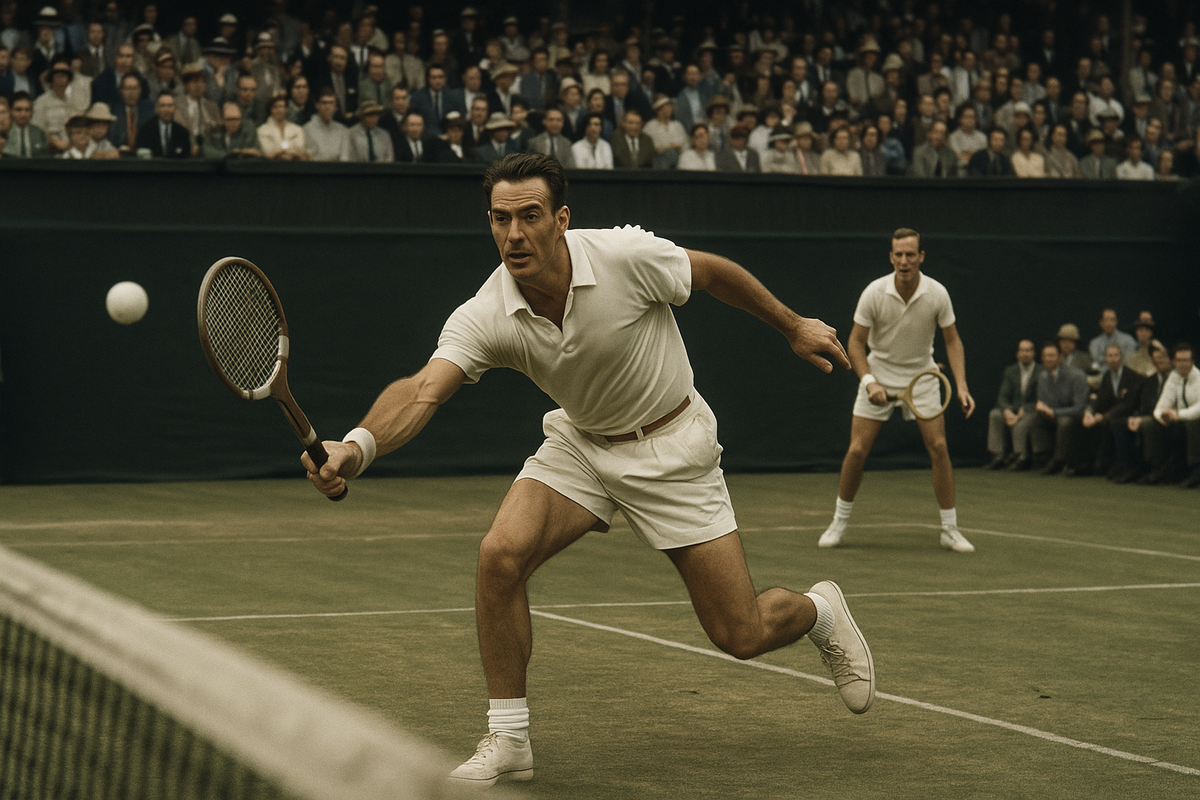
When Tennis Became America's Export
Inside Time's 1951 Championship Issue: How Dick Savitt, Frank Sedgman, and the Golden Age of Tennis Redefined National Prestige
August 1951. Forest Hills sweltered. The grass courts at the West Side Tennis Club baked under late summer heat, and inside those manicured grounds, something larger than sport was unfolding. Dick Savitt—a relative unknown twelve months earlier—had already claimed Wimbledon and the Australian Championships. Now he stood poised to complete an unprecedented sweep at the U.S. Nationals. Time Magazine dispatched its writers to capture not just the tournament, but a cultural pivot point.
The August 27, 1951 issue didn't merely report tennis scores. It documented the moment America began exporting athletic dominance as confidently as it exported Chevrolets and Hollywood films.
Archive Details
Publication: Time Magazine
Issue Date: August 27, 1951
Featured Article: "Linesmen Ready?"
Key Figures: Dick Savitt, Frank Sedgman, Tony Trabert, Art Larsen
Historic Context: U.S. National Tennis Championships at Forest Hills
The Postwar Court: Where Nations Measured Themselves
By mid-1951, the United States had settled into an uneasy prosperity. The Marshall Plan was rebuilding Europe. Korea was bleeding. And Americans, flush with disposable income for the first time in two decades, were discovering leisure as a form of national identity.
Tennis—once the domain of country club elites—was mutating into something more dangerous and compelling: a global proving ground. When Savitt demolished opponents with his power game, or when Australia's Frank Sedgman dazzled crowds with balletic quickness, they weren't just winning matches. They were waging proxy battles for national prestige, staged on grass instead of negotiating tables.
Time understood this instinctively. The magazine's coverage of the U.S. Nationals positioned tennis as cultural statecraft. These weren't athletes; they were ambassadors in white flannels, carrying the flags of postwar realignment across every baseline.
"Linesmen Ready?": Time's Editorial Mastery
The feature article opened with that question—"Linesmen Ready?"—and readers could practically hear the umpire's voice cutting through Forest Hills humidity. This was Time at its narrative peak, transforming a sporting event into immersive theatre.
The writing crackled with specificity. Savitt's game wasn't just powerful; it possessed "overwhelming" advantages that flattened opposition. Sedgman didn't simply move well; his speed and charm made him a fan obsession. Time's prose placed readers courtside, close enough to see the chalk dust and hear the gut strings snap.
But the magazine did more than scene-setting. It embedded tennis within the larger machinery of postwar culture. These players weren't seasonal amateurs anymore—they were globe-trotters, barnstorming from South America to Europe to the States, pioneering what would become professional sports as lifestyle. Time recognized that shift before most of its subjects did.
The article name-checked legends like Bill Tilden, Ellsworth Vines, and Don Budge, creating a genealogy that connected 1950s tennis to its aristocratic past while simultaneously showing how far the sport had traveled. This was transition literature, documenting the death of the amateur ideal in real time.
Why Savitt Mattered (And Why Time Knew It)
Dick Savitt's 1951 season remains one of tennis's most improbable achievements. Virtually anonymous entering the year, he claimed two of the sport's most prestigious titles with a game built on relentless aggression. Time spotted the narrative gold immediately: the self-made champion, the American meritocrat who rewrote the rules through sheer force.
Savitt embodied something the magazine's readers craved—evidence that postwar America rewarded talent over pedigree, effort over inheritance. Never mind that Forest Hills remained deeply exclusive; the symbolism was what mattered. Savitt's victories suggested a nation shedding its old hierarchies, even as it clung to them in practice.
Frank Sedgman provided the necessary counterweight. The Australian's charm and tactical brilliance offered international glamour, proof that tennis had become a genuine world sport. When Time framed the Savitt-Sedgman rivalry, it wasn't just covering athletics—it was mapping the new geography of global competition.
Meritocracy in Motion
Savitt's rise from unknown to champion embodied postwar American ideals of talent triumphing over privilege.
Global Rivalries
The Savitt-Sedgman dynamic represented tennis's transformation into an international spectacle.
Amateur to Professional
Players were becoming globe-trotting professionals, reshaping sports as a full-time career.
Cultural Diplomacy
Tennis matches functioned as proxy battles for national prestige in the postwar order.
Design as Document: Time's Visual Language
The August 27, 1951 cover featured sharp, unadorned tennis photography—no illustration, no artistic interpretation. This was Time's mid-century philosophy distilled: show readers the world without sentimentality or abstraction.
Inside, black-and-white action shots of Savitt, Sedgman, Tony Trabert, and Art Larsen captured bodies in violent motion, rackets blurred, faces twisted with effort. The photography didn't beautify; it documented athletic reality with forensic precision.
Time's typography remained boldface but clean, a visual system designed to guide readers through complex narratives without condescension. The layout balanced reportage with cultural analysis, sports journalism with social observation. This wasn't niche coverage for tennis fanatics—it was broad-spectrum storytelling that assumed readers cared about how sports reflected national character.
The advertisements alone—Sheraton Hotels promising postwar comfort, Old Overholt Whiskey selling masculinity through amber liquid—tell their own story about American aspiration in 1951. These weren't interruptions; they were part of the documentary fabric.
The Artifact as Argument
Vintage Time magazines from this era remain compelling because they refused to separate subject from context. A tennis tournament wasn't just a tennis tournament; it was a referendum on national values, a glimpse of shifting international hierarchies, a preview of coming cultural transformations.
The August 27, 1951 issue exemplifies this approach. When Time profiled Savitt's power game or Sedgman's court coverage, it was simultaneously profiling American ambition and Australian sophistication. Sports became a language for discussing things that couldn't be discussed directly—class mobility, national anxiety, the costs of empire.
That's why these magazines transcend nostalgia. They're not quaint historical curiosities; they're sophisticated cultural documents that reveal how a generation processed rapid change through the prism of leisure and competition.
The Collector's Case: Why This Issue Endures
Historical Precision
This issue captures the exact moment tennis pivoted from amateur gentility to professional globalism. Savitt and Sedgman were the hinge; Time documented the door swinging open.
Cultural Archaeology
Beyond the courts, every page reveals how postwar Americans understood themselves—what they bought, what they valued, how they imagined their place in a reconfigured world.
Design Integrity
Original issues preserve Time's visual language in its physical form—paper stock, printing techniques, the tactile experience of mid-century publishing.
Narrative Density
Modern sports coverage prizes hot takes over context. Time's 1951 approach embedded individual achievement within civilizational shifts. That editorial ambition has aged remarkably well.
For collectors, owning this issue means possessing a primary source—not a reproduction, not a digital facsimile, but the actual artifact that landed on American doorsteps in August 1951. It's the difference between reading about history and holding it.
Holding the Moment
The August 27, 1951 Time Magazine isn't just about tennis. It's about America declaring itself ready for a century of global dominance, one forehand at a time. It's about athletes becoming diplomats, courts becoming stages, and sport becoming the language through which nations spoke to each other.
Dick Savitt and Frank Sedgman have long since retired. Forest Hills no longer hosts the U.S. Open. Time Magazine itself has transformed beyond recognition. But this single issue preserves a moment when all three—player, venue, publication—operated at the peak of their cultural power.
For collectors and historians, that makes it irreplaceable.
Explore the Complete Archive
Discover thousands of original Time magazines from the 1920s through the late 20th century—each one a preserved moment covering politics, culture, and world events that shaped our modern world.
Browse Time Magazine CollectionThe August 27, 1951 issue captured American tennis taking the global stage. Hold that moment in your hands.