
When Sammy Davis Jr. Told Ebony Readers Why He Became a Jew
How a near-fatal car crash, a hospital chaplain, and the February 1960 issue of Ebony documented one entertainer's spiritual journey at the height of the civil rights movement
The hospital chaplain kept coming back.
It was 1954, and Sammy Davis Jr. lay in a San Bernardino hospital bed, his left eye destroyed in a car crash that should have killed him. Between visits from doctors and well-wishers, the chaplain returned—not to convert, but to listen. Davis had questions. About God. About purpose. About why a Black entertainer at the height of fame should survive when so many others didn't.
Six years later, in February 1960, Davis answered those questions publicly in the pages of Ebony magazine. His essay, "Why I Became a Jew," written with Trude B. Feldman, was not a celebrity fluff piece. It was a spiritual confession published at the exact moment when African Americans were redefining their place in American life—through sit-ins, boycotts, and an escalating fight for civil rights.
For Ebony's readers, Davis's conversion carried weight beyond personal faith. Here was one of the most visible Black men in America choosing a minority religion that faced its own persecution. His decision to align himself with Judaism—publicly, deliberately—spoke to questions of identity, resilience, and belonging that transcended any single congregation.
The February 1960 issue captured that complexity in full.
Issue Archive
Historical Figure: Sammy Davis Jr.
Issue Date: February 1960
Archive Source: Ebony Magazine
Essay Title: "Why I Became a Jew" (with Trude B. Feldman)
Cover Feature: Guinean President Sékou Touré's Chicago Visit
A Magazine Built for This Moment
By 1960, Ebony had evolved far beyond its origins as a picture magazine. Founded by John H. Johnson, it had become the authoritative voice of Black America—blending photojournalism, social commentary, and entertainment coverage in a format no other national publication could match.
The February issue embodied that range. The cover featured Guinean President Sékou Touré's historic visit to Chicago, connecting African American readers to the wave of post-colonial independence movements sweeping Africa. Inside, Davis's essay provided the intimate counterpoint: one man's search for meaning in a nation still deciding whether Black lives mattered at all.
That editorial pairing was no accident. Ebony understood that liberation happened on two fronts—the political and the personal. Davis's story belonged to both.
The Making of a Convert
Davis's religious upbringing offered no clear path. His mother was Catholic, his father Baptist, but neither faith took root. He grew up without strong religious ties, moving through a childhood shaped more by vaudeville stages than Sunday schools.
The 1954 car accident changed everything. The crash didn't just cost him his eye—it fractured his sense of invincibility. In the hospital, he began asking questions that couldn't be answered with charm or tap-dancing skill. Who am I? What do I believe?
Those questions led him to Rabbi Alvin I. Fine, whose teaching centered on a simple principle from the ancient sage Hillel: "Do unto others as you would have others do unto you." For Davis, that commandment cut through theological complexity. It offered a moral framework rooted in empathy and human dignity.
But the intellectual appeal was only part of the story. Davis also saw parallels between Jewish and Black suffering—two peoples who had survived centuries of oppression through resilience and refusal to disappear. That shared history of endurance spoke to something deeper than doctrine.
He studied the Talmud backstage between performances. He wore a Hebrew Holy charm given to him by Eddie Cantor. He surrounded himself with Jewish entertainers like Jerry Lewis, whose friendships reinforced his growing sense of spiritual home.
When he finally converted, it was not for publicity. It was for peace.
The Photo-Essay as Witness
Ebony told Davis's story through images as much as words. The photographs accompanying the essay were intimate, unvarnished, and deliberate:
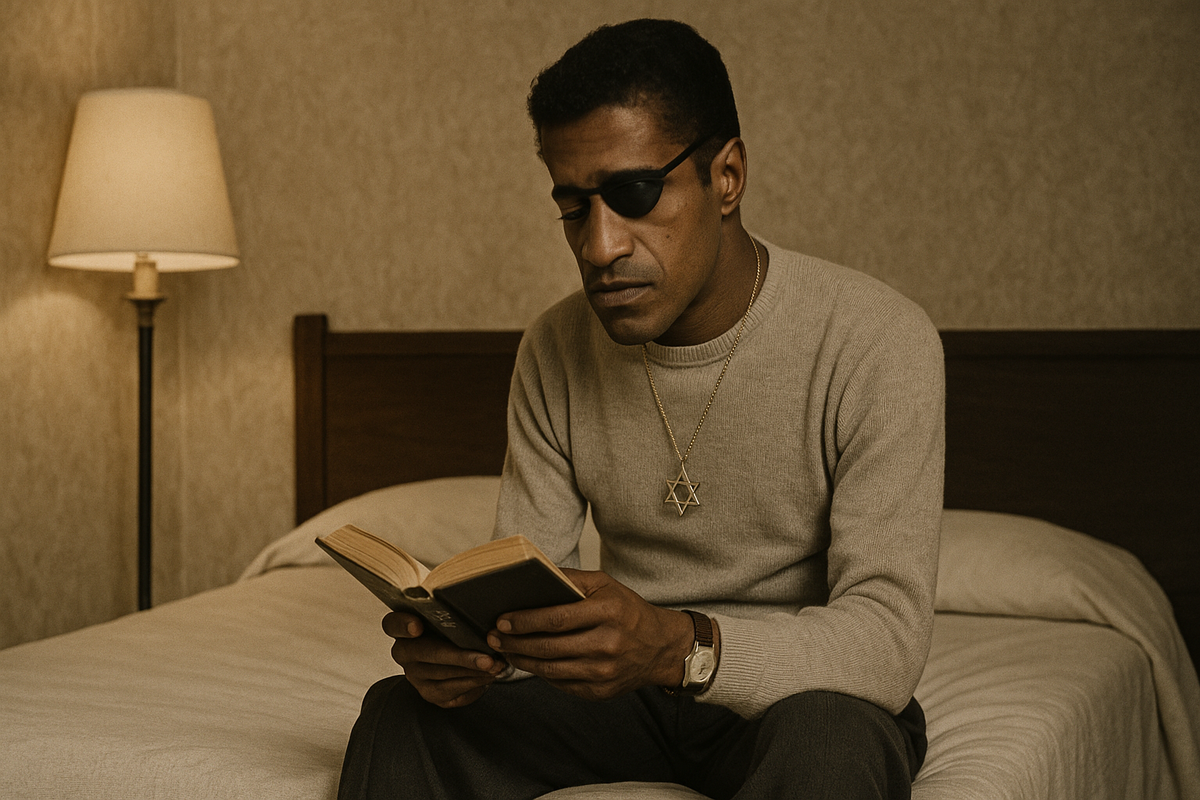
Davis studying the Talmud backstage, books open, face concentrated—proof that this was no passing fancy.
Performing with an eye patch after the accident, a visible reminder of mortality and survival.
Standing with Eddie Cantor and Jerry Lewis, the Jewish entertainers who guided him toward conversion.
Shirtless, wearing the Hebrew charm Cantor had given him—a private symbol made public.
His fiancée Joan Stuart, a Catholic dancer, caught in a moment of uncertainty about whether she too would convert.
These were not glamour shots staged for fan magazines. They were documentary photographs in the tradition Ebony had perfected: images that showed struggle, transformation, and the messiness of real life. The visual narrative carried as much authority as Davis's written testimony.
Why Black-Jewish Solidarity Mattered in 1960
Davis framed his conversion in explicitly racial terms. "As a Negro," he wrote, he felt an emotional kinship with Judaism because both peoples had known oppression and emerged stronger. That language resonated in 1960, when Black-Jewish alliances were critical to the civil rights movement's infrastructure.
Jewish organizations provided legal support, funding, and bodies on the ground for Freedom Rides and voter registration drives. Rabbis marched in Selma. The relationship was imperfect and would later fracture, but in 1960, it represented a shared commitment to justice.
Davis's public embrace of Judaism symbolized that alliance at its most personal level. He wasn't making a political statement—but the statement was made nonetheless.
The Journey in Five Moments
The Hospital Bed Awakening
After his 1954 car crash, Davis began deep conversations with chaplains, asking endless questions about meaning and faith.
The Rabbi's Wisdom
Rabbi Alvin I. Fine encouraged him with lessons rooted in Jewish tradition, particularly Hillel's Golden Rule.
Celebrity Friendships
Eddie Cantor, Jerry Lewis, and others offered support and symbols of faith, reinforcing Davis's sense of belonging.
Black-Jewish Solidarity
Davis wrote that as a Negro, he felt emotionally tied to Judaism because both peoples had endured oppression and triumphed through resilience.
Private Conviction
Davis emphasized that his decision was not publicity-driven but rooted in genuine belief and inner peace.
Why It Still Matters
Vintage Ebony issues from the 1950s and 1960s remain powerful because they document history as it was lived, not as it was later remembered. These magazines carried urgency, pride, and defiance in every page—not as nostalgia, but as necessity.
Sammy Davis Jr.'s testimony is both singular and representative. It tells the story of one man's faith, but it also reflects broader questions about race, resilience, and the right to define oneself on one's own terms. That Davis chose to publish his spiritual journey in Ebony—rather than in a mainstream white publication—underscores the magazine's unique role as a space where Black readers could witness complexity, vulnerability, and triumph without mediation.
Today, holding the February 1960 issue means holding a moment when celebrity, faith, and civil rights intersected. When a Black entertainer's private search for peace became a public testament of strength. When Ebony did what it always did best: affirm that Black lives were not just worthy of coverage, but worthy of depth.
What Collectors Understand About This Issue
Historical Timing
Published on the eve of the 1960s civil rights revolution, the issue documents a moment when questions of identity and freedom dominated Black American life.
Celebrity as Commentary
Davis was not just famous—he was one of the few Black entertainers who could command mainstream white audiences while remaining a figure of pride for Black communities. His conversion sparked national conversation precisely because he occupied that rare crossover space.
Photographic Power
The mix of vulnerable, backstage images with polished performance shots gives the issue a visual depth that transcends celebrity journalism.
Global Vision
The cover story on Sékou Touré and the Davis essay together demonstrate Ebony's ability to connect African American readers to both global liberation movements and intimate personal struggles.
For Collectors and Historians
Thousands of original Ebony magazines spanning the 1940s through the 1970s remain available for those who understand their value. These issues trace decades of African American culture, politics, entertainment, and progress as they were first reported—month by month, story by story, photograph by photograph.
Whether you are a seasoned collector, a cultural historian, or someone honoring family heritage, these magazines are more than reading material. They are living artifacts of a time when Black media shaped Black identity with intention and pride.
Browse Ebony Magazine CollectionThe February 1960 issue of Ebony remains one of the most significant cultural publications of its era. Sammy Davis Jr.'s "Why I Became a Jew" offered readers a rare glimpse into the inner life of a star, blending personal faith with the broader themes of race and resilience that defined the moment. Its words and images still resonate—not only as a record of one man's journey, but as a reflection of how identity was fought for, chosen, and claimed in mid-century America.