
Black Patriots at Bunker Hill: How Ebony Magazine Reclaimed Forgotten Revolutionary War Heroes
When Allan Morrison documented Black soldiers of 1775 in February 1964, he wasn't just recovering history—he was weaponizing it.
In February 1964, while Congress debated the Civil Rights Act and Freedom Summer organizers prepared to descend on Mississippi, a glossy magazine arrived in homes across Black America carrying a photograph of actress Janie Burdette on its cover. Inside, past the Valentine's fashions and celebrity profiles, readers encountered something unexpected: a musket.
Not just any musket. Peter Salem's musket—the weapon a former slave had used at Bunker Hill to kill British Major John Pitcairn in 1775. The image appeared in Allan Morrison's feature "Negroes Who Fought at Bunker Hill," and for readers navigating the most dangerous year of the Civil Rights Movement, it delivered a message more radical than any protest sign: We were here first.
Ebony Magazine understood what most history textbooks refused to acknowledge. Black Americans hadn't simply petitioned for equality—they had bled for it from the nation's first battle.
Archive Details
Publication: Ebony Magazine
Issue Date: February 1964
Featured Article: "Negroes Who Fought at Bunker Hill" by Allan Morrison
Cover Subject: Actress Janie Burdette
Historical Context: Published during peak Civil Rights Movement activity, months before the Civil Rights Act passage
When History Became Evidence
The Battle of Bunker Hill on June 17, 1775, marked the Revolution's first major engagement. Though the British claimed victory, their casualties—over 1,000 men killed or wounded—proved that colonial militias could wound an empire. What mainstream historians conveniently omitted was who stood in those militia lines.
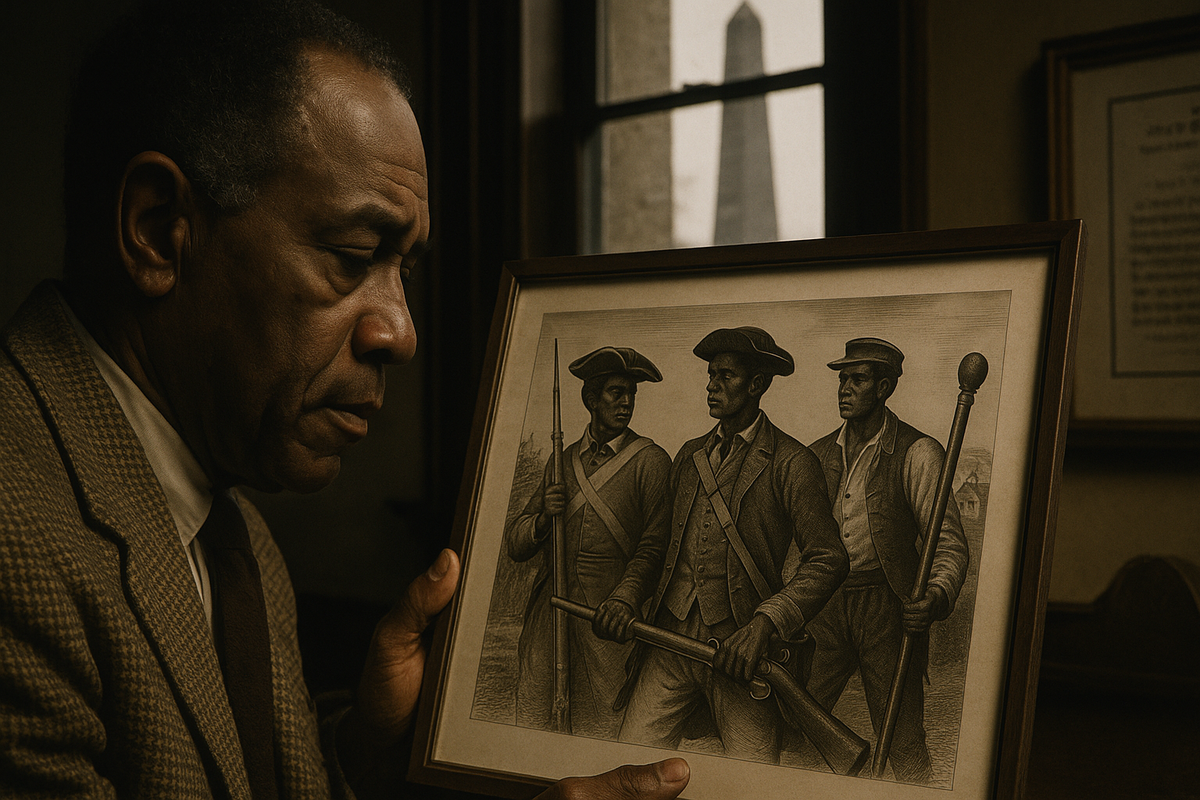
Morrison's article didn't argue the point. It documented it. Muster rolls reproduced in facsimile showed Black names listed alongside white militiamen. Engravings depicted African American soldiers in the chaos of battle. Family photographs showed descendants like Stuart Lew and Laura Ashe holding powder horns and reading names engraved at the Bunker Hill Monument.
This wasn't theory. It was evidence.
Peter Salem, a former slave, fought at Concord before firing the shot that felled Major Pitcairn at Bunker Hill. His musket resided in the Bunker Hill Monument collection—physical proof that couldn't be erased.
Salem Poor earned something even rarer: official recognition. Colonel Prescott and thirteen officers signed a commendation praising his courage, a document Morrison reproduced for Ebony's readers. In an era when Black testimony held no legal weight, white officers had testified to his valor in writing.
Barzillai Lew, a free Black fifer, played martial music as British volleys tore into American lines. He later served at Valley Forge, Saratoga, and Yorktown. His descendants preserved his powder horn and drum—artifacts Ebony photographed alongside the rebuilt Lew homestead, which later served as an Underground Railroad station.
The article named others confirmed by archival records: Seymour Burr, Cuffee Whittemore, Caesar Dickerson, Titus Coburn. Not legends. Soldiers, documented and real.
The Architecture of Memory
Morrison structured his account not as nostalgia but as tactical history. He walked readers through the battle's sequence, tracking Black soldiers through each phase:
The four-mile march from Cambridge to Breed's Hill, where ill-equipped militiamen—Black and white—advanced toward British guns.
Colonel Prescott's famous order to hold fire until the Redcoats closed to fifty yards, with Barzillai Lew's fife cutting through the tension.
The second British assault, when Peter Salem's shot dropped Major Pitcairn and shocked the enemy advance.
The aftermath, when Salem Poor's commendation entered the official record—written proof that Black contributions couldn't be denied, even by those who wanted to forget.
Then Morrison delivered the article's sharpest edge: while 5,000 Black men fought in the Revolution, 500,000 remained enslaved. Liberty was proclaimed, but not distributed.
For readers in 1964, the math was devastating. The contradiction hadn't been resolved. It had merely aged.
Editorial Genius in a Single Issue
Since John H. Johnson founded Ebony in 1945, the magazine had operated under a radical premise: African American life deserved documentation in all its dimensions—glamour and grief, celebrity and citizenship, fashion and forgotten history.
The February 1964 issue crystallized this philosophy. Janie Burdette's elegant cover portrait represented Ebony's commitment to Black beauty and aspiration. The Bunker Hill feature, buried inside, represented its commitment to Black memory and argument.
No other mainstream publication would have run this story. Not Life, not Look, not The Saturday Evening Post. They were busy covering the Civil Rights Movement as a current event, not connecting it to 1775. Ebony understood that the two revolutions were the same revolution, separated only by time.
This editorial architecture—placing contemporary glamour beside historical excavation—wasn't an accident. It was strategy. Readers could see themselves as both inheritors of past struggle and architects of future change. The magazine didn't choose between pride and politics. It insisted on both.
Why Collectors Pursue This Issue
The February 1964 Ebony occupies a unique position in the collector market. It functions simultaneously as historical document, cultural artifact, and political argument.
Historical Documentation
Few popular magazines devoted this depth of coverage to Black Revolutionary War service. Morrison's piece included reproduced muster rolls, artifact photography, and descendant interviews—primary source material now valuable to researchers.
Civil Rights Context
Published during the movement's most volatile year, the article carried immediate political weight. It reframed the demand for equality not as request but as overdue payment on a debt incurred in 1775.
Editorial Archetype
The juxtaposition of Burdette's cover and the Bunker Hill feature captures Ebony's editorial identity—the magazine that refused to separate Black life into fragments, insisting instead on presenting it whole.
Visual Record
The photography and reproduced engravings provide documentation of artifacts and descendants that might otherwise have disappeared from public view.
For collectors focusing on Civil Rights-era publications, African American military history, or 20th-century visual culture, this issue delivers on multiple fronts. It's not simply a magazine. It's a multi-layered historical object.
What Ebony Understood
Mainstream media in 1964 covered the Civil Rights Movement as news. Ebony covered it as the continuation of a story that began in 1775. While other publications erased Black history or relegated it to footnotes, Ebony preserved it, weaponized it, and returned it to the people whose ancestors had lived it.
The magazine operated on the principle that cultural memory is power. If African Americans could see themselves at Bunker Hill, they could see themselves anywhere. The narrative of begging for rights collapsed when confronted with evidence of rights earned in blood nearly two centuries earlier.
Morrison's article didn't plead. It presented. Here are the muster rolls. Here are the artifacts. Here are the descendants. Here is the musket. Dispute this.
Building Your Collection
For collectors of vintage magazines, Ebony issues from the 1940s through 1980s represent essential primary sources on how African American history and culture were documented during their own time. Each issue functions as a time capsule—preserving not just events but how those events were interpreted by the community experiencing them.
Civil Rights Movement
Publications and contemporary documentation of the movement as it unfolded.
Military History
African American military service and representation across American conflicts.
Visual Culture
Mid-century magazine design and African American photography and illustration.
Cultural Memory
Primary sources on historical reclamation and community documentation.
Explore the Complete Ebony Archive
From John H. Johnson's founding vision in 1945 through the magazine's evolution across four decades, every issue documents African American culture, politics, and pride as they unfolded.
Browse Ebony Magazine CollectionThe Artifact in Your Hands
The February 1964 issue of Ebony Magazine proved something traditional historians had tried to obscure: African Americans weren't latecomers to the American story. They were there at the beginning, muskets loaded, standing in militia lines on Breed's Hill while the Revolution's first major battle raged around them.
Morrison's article didn't recover this history for academic journals or museum exhibitions. He recovered it for the people whose ancestors had lived it, at the exact moment when those descendants were fighting the same battle for recognition.
When you hold this issue, you're holding evidence. Not of what America promised, but of what Black Americans earned—and how long they've waited to collect.