
The Body Was the Fashion: Inside Vogue's Radical April 1973 Manifesto
How twenty-six pages redefined American style and declared the end of disguise
On April 1, 1973, Vogue made a declaration that would redefine American style for the rest of the decade. Buried across twenty-six pages of silk-paper photography and authoritative editorial prose, the magazine's "First Look at Summer" spread reduced the entire philosophy of fashion to two non-negotiables: "One is a bare sandal—it will go with everything. The other is a good body—without which, nothing goes."
No frills. No embroidery. No salvation through accessories.
Just skin, sandals, and the confidence to wear almost nothing else.
This wasn't fashion advice. It was a cultural reckoning—and the women who opened that issue in the spring of '73 knew it.
Archive Details
Publication: Vogue Magazine
Issue Date: April 1, 1973
Feature: "First Look at Summer" (pp. 134–159)
Cover Model: Karen Graham
Featured Designers: Carol Horn, Jerry Silverman, Donald Brooks, Bill Blass
When Fashion Stopped Hiding
The early 1970s didn't ease into minimalism. It slammed the door on the previous decade's excess—the psychedelic prints, the costume jewelry piled to the collarbone, the maximalist fantasy of the late sixties. By 1973, all of it felt dated, desperate, overdone. Vogue acknowledged this shift with clinical precision: "When the razzmatazz is totally eliminated and clothes become more simplified, subtle, the whole emphasis is on the base."
Translation: your body was now the garment. Everything else was decoration.
This philosophy emerged from a perfect storm of cultural forces. The Women's Liberation Movement had spent years dismantling the corsetry—literal and metaphorical—of postwar femininity. Loose cuts, flowing fabrics, and practical separates replaced the suffocating tailoring that had imprisoned women's bodies since the New Look. Meanwhile, the Vietnam War dragged toward its bitter conclusion, Watergate metastasized in Washington, and the looming oil crisis promised a future of scarcity. In that climate, Vogue's call for simplicity, body maintenance, and versatile wardrobe essentials wasn't just aesthetic—it was survival logic dressed in silk.
And for the first time in mainstream fashion publishing, the magazine was telling women to build their style not from the closet out, but from the gym up.
Karen Graham and the Architecture of Elegance
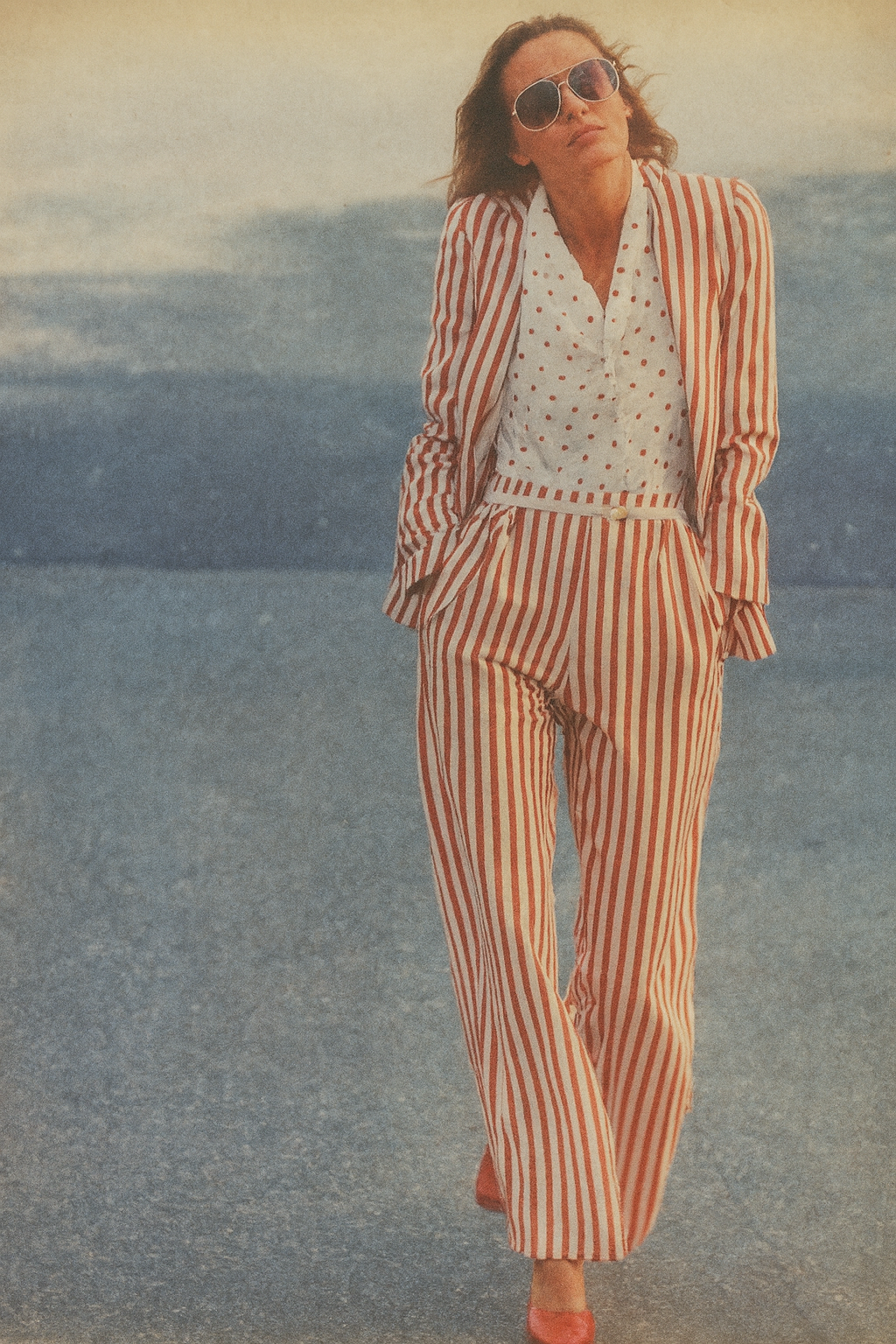
Model Karen Graham became the issue's visual anchor, embodying Vogue's new doctrine across every spread. In pajama-striped suits paired with aviator sunglasses, she looked like she'd just stepped off a transatlantic flight—effortlessly chic, unbothered by the chaos of modern life. In soft blue belted dresses cinched with red jackets, she moved through the frame with the kind of ease that only comes from knowing exactly who you are.
The designers Vogue championed—Carol Horn, Jerry Silverman, Donald Brooks, Bill Blass—all understood the assignment. Their pieces for summer '73 weren't about making a statement. They were about revealing the woman underneath: dresses that floated around the body instead of constricting it, day-to-night silhouettes that traveled from city to resort without a costume change, bare shoulders and exposed legs treated not as provocation but as fact.
Graham didn't model these clothes. She inhabited them. And in doing so, she gave American women permission to stop performing and start existing.
The Cover That Wouldn't Apologize
Unlike the illustrated covers of earlier decades, the April 1, 1973 issue featured Graham in stark photographic realism—no painterly softness, no fantasy filter. Her face, framed with understated elegance, stared directly into the camera with the kind of self-possession that felt radical for its time. This was the aspirational woman of 1973: polished but not precious, modern without trying, confident in a way that didn't require explanation.
Inside, "First Look at Summer" delivered what made Vogue indispensable: the seamless fusion of high fashion, cultural commentary, and visual storytelling. The magazine wasn't just dictating hemlines. It was diagnosing the moment—capturing how women were renegotiating their relationship with femininity, liberation, and their own bodies in real time.
Vogue understood something its competitors didn't: fashion was never just about clothes. It was about identity. And in 1973, identity meant stripping down to what was real.
What Made This Issue a Turning Point
The Bare Sandal Revolution
Declared the universal shoe of the season, the strappy sandal became both practical necessity and status symbol—proof that you didn't need elaborate footwear when your legs were the statement.
The Body as Foundation
Vogue's insistence that fitness, grooming, and health were prerequisites for style marked the rise of America's modern wellness culture. The gym was no longer optional.
Pajama Dressing Goes Public
What had once been private sleepwear became the uniform of cosmopolitan ease—loose, unstructured, borrowed from the bedroom and unapologetic about it.
City-to-Resort Fluidity
The summer wardrobe was designed for movement, for women whose lives no longer fit into neat compartments. One dress, multiple contexts, zero apologies.
Minimalism as Power
Sandals and sunglasses. That was it. In an era drowning in accessory excess, Vogue's restraint felt like rebellion.
The Designers Who Got It
Carol Horn, Jerry Silverman, Donald Brooks, Bill Blass—these names defined American ready-to-wear elegance, creating pieces that trusted women to complete the look with their presence alone.
Fashion as Historical Record
Just as LIFE magazine's wartime issues endure as irreplaceable records of mid-century America, vintage Vogue publications function as cultural artifacts that transcend their original purpose. They don't just document hemlines—they capture the aspirations, anxieties, and transformations of their era.
The April 1, 1973 issue reveals how fashion mirrored the liberation movements reshaping American society. It shows how beauty standards were rewritten through the language of simplicity and strength. And it demonstrates Vogue's unmatched influence in shaping not just what women wore, but how they understood themselves.
For collectors, these magazines are investments. For historians, they're primary sources. For anyone who believes that style is inseparable from culture, they're essential reading.
Why Collectors Covet This Issue
Iconic Cover Model
Karen Graham graced the cover during her peak as one of Vogue's most iconic faces, making this a cornerstone piece for collectors tracking her editorial legacy.
Landmark Editorial
The "First Look at Summer" feature captured a genuine inflection point in fashion philosophy—the moment American style shifted from disguise to revelation, from costume to confidence.
Designer Significance
The designers featured represent the golden age of American ready-to-wear, and the issue's historical timing gives it scholarly weight beyond its aesthetic value.
Cultural Moment
Published as society redefined gender, beauty, and autonomy, this issue documents women navigating a new decade of independence, uncertainty, and self-definition.
Market Value
Collector demand for Vogue issues tied to major models and landmark editorials remains strong, and this particular number checks every box.
Preservation Quality
Owning this means possessing the same pages women studied in 1973—the actual artifacts, preserved across decades, complete with the texture and scent of that era.
Explore the Archive
If the April 1, 1973 issue of Vogue speaks to you, the full collection awaits. Each original magazine offers direct access to its moment—capturing the evolution of style, beauty, and cultural identity as it happened.
These aren't reproductions or digital scans. They're the actual artifacts, waiting for collectors, designers, historians, and enthusiasts who understand that fashion history isn't written in textbooks—it's printed on glossy paper and bound in spines that still smell faintly of 1973.
Browse Vogue Magazine CollectionThe Last Word
The April 1, 1973 issue of Vogue remains a defining publication of its decade—not because it predicted the future, but because it captured the present with unflinching clarity. Its "First Look at Summer" feature understood that fashion was no longer about disguise or decoration. It was about revelation: the body, the sandal, the confidence to let both speak for themselves.
Through Karen Graham's poise, through flowing dresses that trusted the wearer to complete them, through a bold editorial voice that refused to apologize for its standards, Vogue gave American women a new template—not for how to dress, but for how to exist.
Fifty years later, that message still resonates. Fashion, at its best, isn't about what you wear. It's about who you are when you stop hiding.