
The Magazine That Held a Nation's Grief
Inside Jet's Haunting Coverage of Malcolm X's Assassination
When the bullets stopped echoing in the Audubon Ballroom on February 21, 1965, Malcolm X lay dying on a stage in Harlem. Within eighteen days, African Americans across the country would hold the evidence in their hands—not in the form of a police report or a sanitized wire service dispatch, but as a 20-cent pocket magazine that refused to look away.
The March 11, 1965 issue of Jet Magazine didn't ask readers to move on. It asked them to confront a question that white-owned media dared not print: "Will Death of Malcolm X Spur More Bloodshed?"
Flanked by dual portraits—Elijah Muhammad on the left, Malcolm X on the right—the cover framed the assassination not as an isolated crime but as a fracture with the potential to split the civil rights movement wide open. For the millions who picked up that issue in barbershops, living rooms, and church basements, Jet became something more than a magazine. It became a mirror held up to a community in crisis, a historical record compiled in real time, and a warning about what might come next.
This wasn't journalism at a safe distance. This was Jet doing what it had always done: bearing witness when the mainstream press turned away.
Archive Details
Historical Figure: Malcolm X (El-Hajj Malik El-Shabazz)
Issue Date: March 11, 1965
Archive Source: Jet Magazine
Historical Context: Published 18 days after Malcolm X's assassination at the Audubon Ballroom
The Man Who Died Becoming
By February 1965, Malcolm X had shed multiple identities like snakeskin. Born Malcolm Little. Reborn as Malcolm X under Elijah Muhammad's Nation of Islam. Finally arriving at El-Hajj Malik El-Shabazz after his pilgrimage to Mecca in 1964.
That Hajj changed him. The man who once preached racial separatism returned speaking of blue-eyed Muslims praying beside him, of a global struggle against oppression that transcended skin color. He founded the Muslim Mosque, Inc. and the Organization of Afro-American Unity, positioning African American liberation within a worldwide anti-colonial movement. This ideological evolution terrified his former allies in the Nation of Islam—and made him dangerous to those who preferred their Black leaders categorizable, predictable, contained.
On that Sunday afternoon in Harlem, as Malcolm rose to address his OAAU followers, gunmen rushed the stage. Nineteen bullets ended a life at 39 years old, cutting short a transformation that might have redefined American racial politics entirely.
The world didn't just lose a leader. It lost the man he was still becoming.
Jet's Unfiltered Lens
Where Life might have offered distant photojournalism and The New York Times cautious analysis, Jet brought readers into the blood and chaos. Since its 1951 founding by John H. Johnson, the pocket-sized weekly had established itself as the publication that showed Black America what mainstream media would not: Emmett Till's mutilated face in his casket. The raw testimonies of mothers whose sons were lynched. The unvarnished truth of what it meant to live Black in mid-century America.
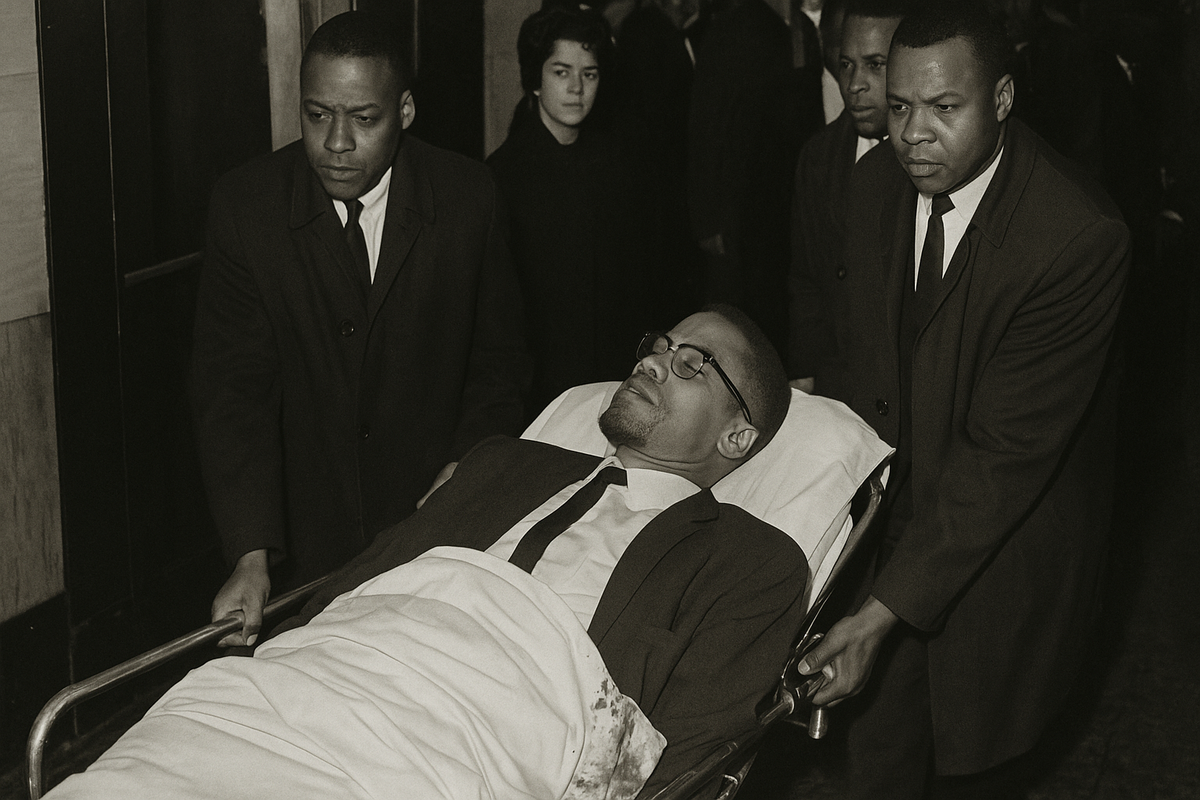
The March 11 issue delivered that same unflinching coverage. Readers saw the stretcher bearing Malcolm's body from the Audubon Ballroom. They read eyewitness accounts from the hundreds who watched their leader die. They encountered reactions from figures across the ideological spectrum—Ossie Davis mourning the "tragic futility" of Malcolm's death, Ruby Dee urging the movement not to lose focus on poverty, Dr. Kenneth Clark lamenting the loss of a maturing voice just as it was broadening toward reconciliation.
Jet refused to abstract the violence into statistics or reduce Malcolm to a radical footnote. The magazine treated his assassination as what it was: a seismic event that threatened to unleash retaliatory bloodshed across nationalist factions and urban streets alike.
The Question That Haunted America
"Will Death of Malcolm X Spur More Bloodshed?" wasn't hyperbole. It was prophecy—or warning—depending on who answered.
Inside the issue, Jet captured the raw fear rippling through Black communities. Leaders worried about reprisals between rival groups. Ordinary citizens wondered whether Malcolm's death marked the beginning of open warfare within the civil rights movement itself. Even CORE director James Farmer hinted at international intrigue, suggesting the assassination might involve forces "beyond U.S. borders"—a veiled reference to the Cold War paranoia that treated every act of Black resistance as potential communist insurgency.
The magazine didn't offer easy reassurance. It documented the tension between grief and rage, between calls for restraint and whispers of retaliation. Jet gave Malcolm's death the communal context it deserved: not as an isolated murder, but as a rupture that exposed how fragile the movement's unity had always been.
Nonviolent integrationists and Black nationalists had long eyed each other with suspicion. Malcolm's assassination—and the suspicion it fell on Nation of Islam members—threatened to turn that cold divide into open conflict. Jet made that danger explicit, giving voice to fears that polite media commentary preferred to ignore.
Fears of Retaliation
Leaders and citizens expressed deep concerns that Malcolm's death would ignite violence between nationalist groups or against wider society, with Jet documenting both the fear and hope for restraint.
Celebrity Testimonies
Ossie Davis, Ruby Dee, and other figures provided perspectives balancing grief with calls for unity, refusing to let the tragedy derail broader struggles.
Psychological Analysis
Dr. Kenneth Clark and others highlighted Malcolm's evolution toward integration, describing his death as a setback for a movement still maturing.
International Context
James Farmer's suggestion of foreign involvement reflected Cold War tensions where Black resistance was viewed through a global ideological lens.
The Artifact as Testament
Sixty years later, the March 11, 1965 Jet endures because it refused the comfortable fictions that usually follow political assassinations. It didn't sanitize Malcolm into a martyr whose death "had to happen" for progress to continue. It didn't reduce the Nation of Islam to a cartoon villain. It didn't pretend that Black America spoke with one voice about what Malcolm's death meant or what should come next.
Instead, Jet documented the messy, terrifying reality: a movement divided, a leader silenced at the precise moment his vision was expanding, and a community left to wonder whether his blood would be the first or the last to spill.
For historians, this issue serves as primary source material—the unfiltered reactions of a community processing trauma in real time. For collectors, it represents the pinnacle of Black press journalism, when a pocket magazine wielded more truth-telling power than newspapers ten times its size.
For anyone seeking to understand how African Americans experienced the 1960s—not as History Channel montage but as lived, uncertain, dangerous present tense—this issue is essential testimony.
Why Collectors Prize This Issue
Immediacy of Record
Published barely two weeks after Malcolm's death, it captures raw confusion and fear before official narratives calcified. This is history's first draft, unrevised.
Iconic Visual Symbolism
The dual-portrait cover—mentor and protégé frozen in tragic rupture—has become one of the defining images of the civil rights era's internal conflicts.
Cultural Preservation
Where establishment media portrayed Malcolm as a dangerous extremist, Jet mourned a leader whose ideas were evolving toward something potentially revolutionary.
Tangible Connection
To hold this issue is to hold what grieving families held in 1965, connecting physically to communal trauma and resilience in ways digital archives cannot replicate.
Preserving the Record
The March 11, 1965 Jet Magazine belongs in collections that take African American history seriously. Not as sidebar. Not as supplement to "mainstream" narratives. But as central document in understanding how a people chronicled their own struggle when the dominant press wouldn't.
Malcolm X's assassination could have become just another statistic in the long catalog of Black leaders murdered in America. Jet ensured it would be remembered as the complex, wrenching tragedy it was—complete with the fear, the anger, the grief, and the terrible question of what violence might follow.
That question, printed in bold on the cover, never fully left America. We're still answering it.
Explore the Archive
Whether you're building a research archive, preserving family heritage, or simply recognizing that some history demands to be held rather than scrolled, these issues remain what they've always been: witness to the price of justice and the power of a free Black press.
Browse Jet Magazine CollectionFinal Word
The March 11, 1965 issue didn't just report Malcolm X's death. It captured the moment when a movement looked into the abyss and wondered if it would survive what came next. Jet asked the hard question, documented the raw answers, and trusted its readers to handle the truth without platitudes.
That's why this issue matters. That's why it endures. And that's why serious collectors and historians still seek it out—not as nostalgia, but as necessary testimony to a moment when everything hung in the balance.
The magazine is small enough to fit in your pocket. The history it holds is too large to ever forget.