
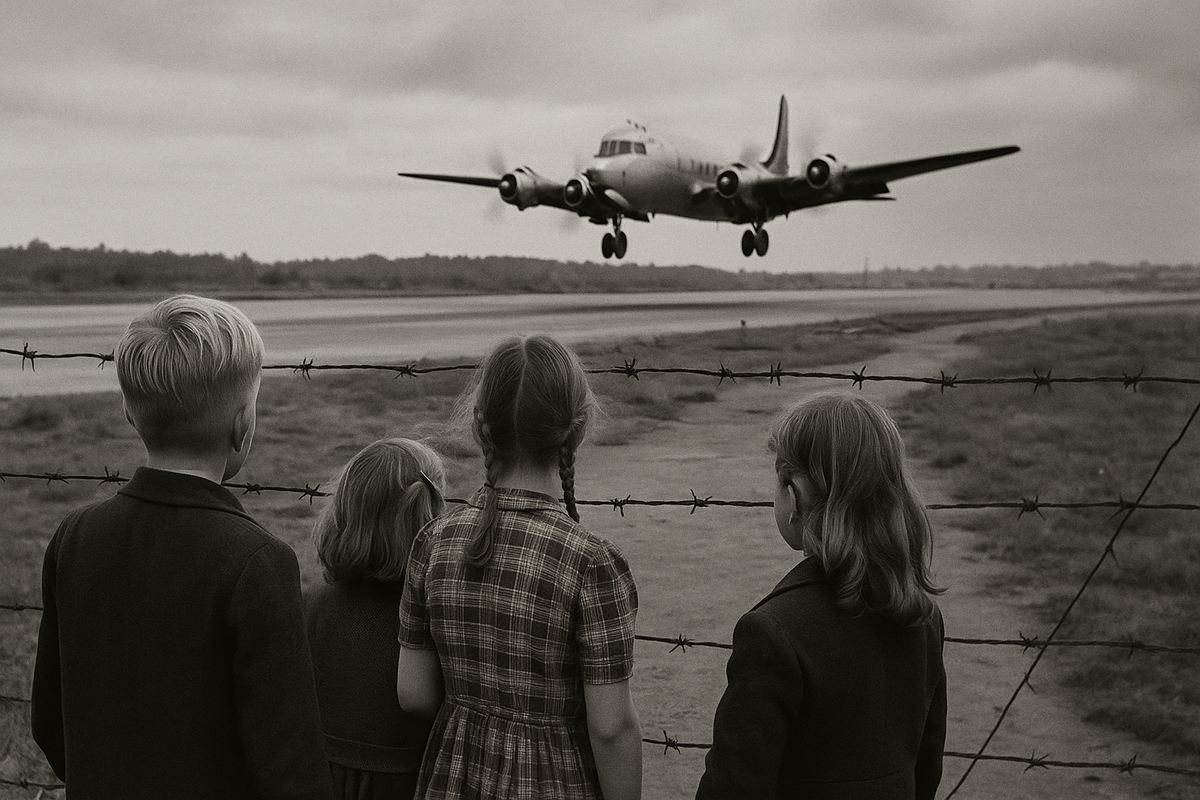
The Berlin Blockade and the Airlift
Courage, Diplomacy, and the First Great Crisis of the Cold War
On Christmas Eve 1949, an American family sits trimming their tree. The father steadies a glass ornament while his daughters hang tinsel, their faces glowing in the warm light. This is the cover of The Saturday Evening Post—wholesome, tender, utterly safe.
Turn the page.
Inside, Lt. Gen. Walter Bedell Smith—the man who sat across the table from Joseph Stalin during the most dangerous diplomatic poker game of the postwar era—reveals how close the West came to losing Berlin. His article, "My Three Years in Moscow: The Story Behind the Berlin Blockade," wasn't holiday reading. It was a firsthand account of the crisis that nearly ignited World War III, written by Eisenhower's former chief of staff and published mere months after Soviet tanks rolled back from the brink.
This wasn't distant news. For millions of Americans reading by firelight that December night, it was the first clear explanation of why their sons might be called to fight again—and why freedom's survival now depended on cargo planes landing in a divided city every 45 seconds.
The Crisis That Defined the Cold War
The Berlin Blockade began on June 24, 1948, when Stalin severed every road, rail line, and canal route into West Berlin. Twenty-five hundred thousand people—an entire city—were cut off from food, fuel, and medicine. The Soviet calculation was ruthless and simple: starvation would force the Western Allies to abandon Berlin within weeks.
Stalin had miscalculated.
What followed was Operation Vittles, the Berlin Airlift—an aerial supply line of such audacity that even its architects doubted it could work. For eleven months, American and British transport planes flew through Soviet-controlled airspace, defying weather, mechanical failure, and the constant threat of being shot down. At the operation's peak, a C-54 Skymaster touched down in West Berlin every 45 seconds, each one carrying coal, flour, powdered milk, and the message that the West would not yield.
On May 12, 1949, the Soviets lifted the blockade. They had blinked first.
By the time Bedell Smith's article hit newsstands seven months later, the world understood: the Cold War would be fought in inches, not invasions—and America intended to hold every inch.
Historical Record
Historical Figure: Lt. Gen. Walter Bedell Smith (Former Chief of Staff to Eisenhower, Later CIA Director)
Issue Date: December 24, 1949
Archive Source: The Saturday Evening Post
Article Title: "My Three Years in Moscow: The Story Behind the Berlin Blockade"
Why This Article Mattered
Walter Bedell Smith was no journalist. He was a general who had planned D-Day logistics, a diplomat who had negotiated with Stalin and Molotov in Moscow's suffocating conference rooms, and soon to be the CIA's director. When he wrote about the Berlin crisis, he wrote with the authority of someone who had watched Stalin's face when the airlift succeeded.
His article gave Americans what government briefings could not: the human texture of Cold War brinkmanship. Readers learned about:
Smith didn't traffic in abstractions. He showed Americans that the Cold War was personal, grinding, and far from over.
The Cover and the Contradiction
The juxtaposition was no accident. The Saturday Evening Post understood that its Christmas Eve cover—cozy, nostalgic, utterly American—would resonate precisely because of what lay inside. That father trimming the tree with his daughters could do so safely because other men were flying through Soviet airspace, risking their lives to supply a city most Americans couldn't find on a map.
This was the magazine's genius. It never asked readers to choose between comfort and truth. It gave them both, wrapped in the same issue. Holiday fiction sat beside geopolitical strategy. Norman Rockwell's warmth shared space with Walter Bedell Smith's warnings. The Post made the case that preserving the American living room required vigilance in Berlin.
No wire service could do this. No government communiqué could achieve it. Only The Saturday Evening Post, with its unmatched reach and editorial sophistication, could translate the Berlin crisis into something that felt both urgent and intimate.
The Saturday Evening Post as Cultural Record
Like LIFE's iconic wartime photography, The Saturday Evening Post endures because it refused to choose between the monumental and the mundane. It covered both Berlin airlift negotiations and Thanksgiving turkey recipes. It published both Bedell Smith and short fiction. It showed Americans their neighborhoods and their battlefields in the same breath.
These magazines weren't disposable media. They were weekly cultural anchors, shaping how middle America understood itself and the world beyond its borders. For collectors and historians, they remain irreplaceable—not because they're rare, but because they captured voices and moments that no other medium preserved with equal intimacy.
Why Collectors Seek This Issue
Explore the Archive
Original copies of this landmark issue—and hundreds of others that documented the American century—are available for collectors, researchers, and families preserving historical memory.
Browse The Saturday Evening Post Magazine CollectionFrom the Great Depression to the Space Race, from the Berlin Blockade to Vietnam, the Post recorded the stories that defined a nation.
Conclusion
The December 24, 1949 issue of The Saturday Evening Post stands as one of the defining cultural artifacts of the early Cold War. Its cover promised comfort; its feature article delivered a warning. Through Walter Bedell Smith's firsthand account, Americans learned that the Berlin Blockade wasn't a distant crisis—it was a preview of the decades ahead.
For those who preserve these magazines, the value isn't merely collectible. It's testimonial. This issue doesn't just report history; it is history—a living record of the moment when America realized the war had never truly ended, only changed forms.