
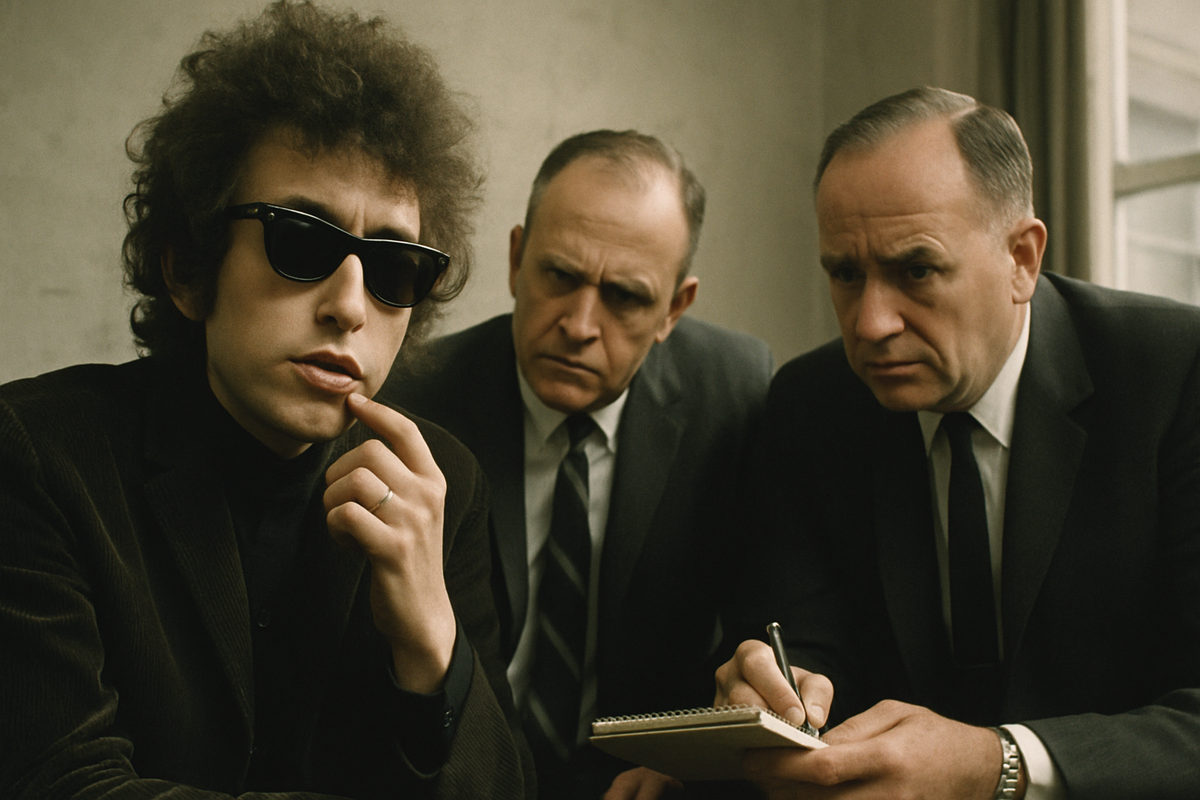
The Day Bob Dylan Became America's Most Dangerous Man
How Rolling Stone's November 1967 issue documented the paranoia, Cold War suspicion, and cultural warfare that turned a songwriter into public enemy number one
November 1967. While American boys died in Vietnamese rice paddies and their brothers burned draft cards on college quads, a more insidious threat was allegedly corrupting the nation's youth—at least according to a shadowy group monitoring the cultural battlefield from somewhere in Middle America.
Rolling Stone's November 23, 1967 issue landed on newsstands with a promise that would define the magazine's next five decades: it would tell the truth about the war being waged over America's soul, one song at a time.
The enemy? Bob Dylan. The weapon? His lyrics. The charge? Nothing less than sedition through music.
Archive Details
Historical Figure: Bob Dylan
Issue Date: November 23, 1967
Archive Source: Rolling Stone Magazine
Featured Article: "The Truth About Bob Dylan"
When Music Became Evidence
By late 1967, Dylan had vanished. His motorcycle crash the previous summer had given birth to a thousand rumors, but his absence only amplified his influence. The folk troubadour who'd soundtracked the civil rights movement had plugged in, gone electric, and then disappeared—leaving behind a catalog that conservative watchdogs were now dissecting like Kremlin analysts parsing Pravda editorials.
Enter TACT—Truth About Civil Turmoil—a group whose very name betrayed the paranoia coursing through establishment America. They'd targeted Dylan with the kind of scrutiny usually reserved for enemy propagandists. Their evidence? "Rainy Day Women #12 & 35" and its chorus: "Everybody must get stoned."
To TACT, this wasn't clever wordplay or blues tradition. It was a drug manifesto, broadcast to millions.
But the accusations went deeper. Dylan's producer, the legendary John Hammond—the man who'd discovered Billie Holiday, Count Basie, and Aretha Franklin—found himself pulled into Cold War crosshairs, his record company connections somehow twisted into vague "pro-Communist" associations. It was McCarthyism with a backbeat, blacklisting dressed up as cultural criticism.
Rolling Stone didn't champion these claims. It documented them—and in doing so, revealed something more unsettling than the accusations themselves: how thoroughly America's culture war had weaponized popular music.
The Magazine That Chose Sides Without Choosing Sides
What separated Rolling Stone from every other music publication in 1967 wasn't its love of rock and roll—it was its refusal to treat that love as separate from politics, protest, and power.
CBS had already declared Dylan "the leading cultural force among young people today." That wasn't praise in certain circles. That was a threat assessment. And Rolling Stone understood that treating Dylan's work as mere entertainment was to miss the entire story.
The magazine's coverage of "The Truth About Bob Dylan" wasn't defensive hagiography. It was journalism—clear-eyed reporting on how a 26-year-old songwriter had become the focal point for everything establishment America feared: sexual liberation, drug experimentation, political radicalism, and worst of all, the wholesale rejection of postwar conformity.
Dylan's earlier protest songs—"Blowin' in the Wind," "The Times They Are A-Changin'"—had already marked him as dangerous. But those were abstract, poetic. You could argue about their meaning. "Everybody must get stoned" required no interpretation, at least not to critics convinced that rock music was rotting America from within.
Rolling Stone's genius was recognizing that Dylan had become more than an artist. He was a symbol, and symbols don't need to be present to be powerful. His retreat to Woodstock only intensified the projection—everyone could imagine their own Dylan, whether savior or devil.
The Aesthetic of Authority
Flip through that November 23, 1967 issue today and you'll notice what's missing: color, gloss, celebrity glamour. Early Rolling Stone looked more like an underground newspaper than a music magazine, and that was the point.
Jann Wenner and his team understood that authority in 1967 didn't come from slick production—it came from substance. Dense text. Unvarnished photographs. The layout itself argued that what was happening in music mattered as much as what was happening in Washington or Saigon.
This approach placed the Dylan controversy alongside marijuana arrests, Beatles recording sessions, and San Francisco theater—not as separate stories, but as chapters in the same book. Rolling Stone wasn't covering the counterculture; it was chronicling a revolution in real time, and it knew that revolution's soundtrack was being written by the very artists under attack.
The magazine's plain-spoken design made another argument: this wasn't entertainment journalism. This was the first draft of history.
What They Said About Dylan
The Rolling Stone piece assembled a catalog of accusations that today read like fever dreams:
CBS's Assessment
The network identified Dylan as youth culture's primary influencer—an assessment that functioned as both credential and indictment.
TACT's Drug Accusations
The group explicitly accused Dylan of promoting drug use, transforming metaphor and double-entendre into criminal intent.
Hammond Under Scrutiny
John Hammond's decades-long career in music became suspect, his leftist sympathies weaponized against the artist he'd championed.
Cultural Anxiety
A nation so anxious about its changing identity that it convinced itself a songwriter posed a threat to national security.
The article's real revelation wasn't about Dylan at all—it was about America. Dylan wasn't creating the turbulence. He was reflecting it, amplifying it, giving it a voice. That made him even more dangerous.
The Verdict History Delivered
The paranoia didn't destroy Dylan. If anything, it proved his critics' central fear correct: his influence was undeniable, his impact irreversible.
Rolling Stone recognized this immediately. By covering the controversy seriously—by treating the attacks on Dylan as newsworthy, as symptomatic of larger forces—the magazine established the template it would follow for decades. Music wasn't separate from politics. Culture wasn't separate from power. And journalism that pretended otherwise was cowardice dressed as objectivity.
That's why these early issues endure. They didn't just report on the 1960s—they understood what was happening while it happened, and they had the courage to say it out loud.
Why This Issue Still Matters
Primary Source Document
A cultural turning point captured while still in motion—journalism documenting history as it unfolded, not in retrospect.
Dylan at Peak Mythology
Captures the songwriter at his most mythologized—absent, silent, yet omnipresent in the national conversation.
Historical Intersection
Published in the wake of the Summer of Love, sitting at the crossroads of Vietnam, civil rights, drug culture, and generational warfare.
Early Rolling Stone
One of the magazine's earliest issues—raw, unfiltered, still finding its voice but already unafraid to use it.
For Collectors and Cultural Historians
If you're building a collection that documents how America processed its most transformative decade, this issue is essential. It's not celebrity gossip or record reviews—it's anthropology, captured in newsprint before anyone knew how the story would end.
Browse Rolling Stone Magazine CollectionThe November 23, 1967 Rolling Stone didn't just cover Bob Dylan. It documented the moment when a generation's soundtrack became evidence in a trial over America's future—and when a magazine barely three months old proved it had the vision to recognize what was really at stake. Hold this issue in your hands, and you're holding the moment when music journalism grew up and decided to tell the truth, consequences be damned.