
The 1950s Marriage Deadline
Inside the Ladies' Home Journal Article That Told Women Time Was Running Out
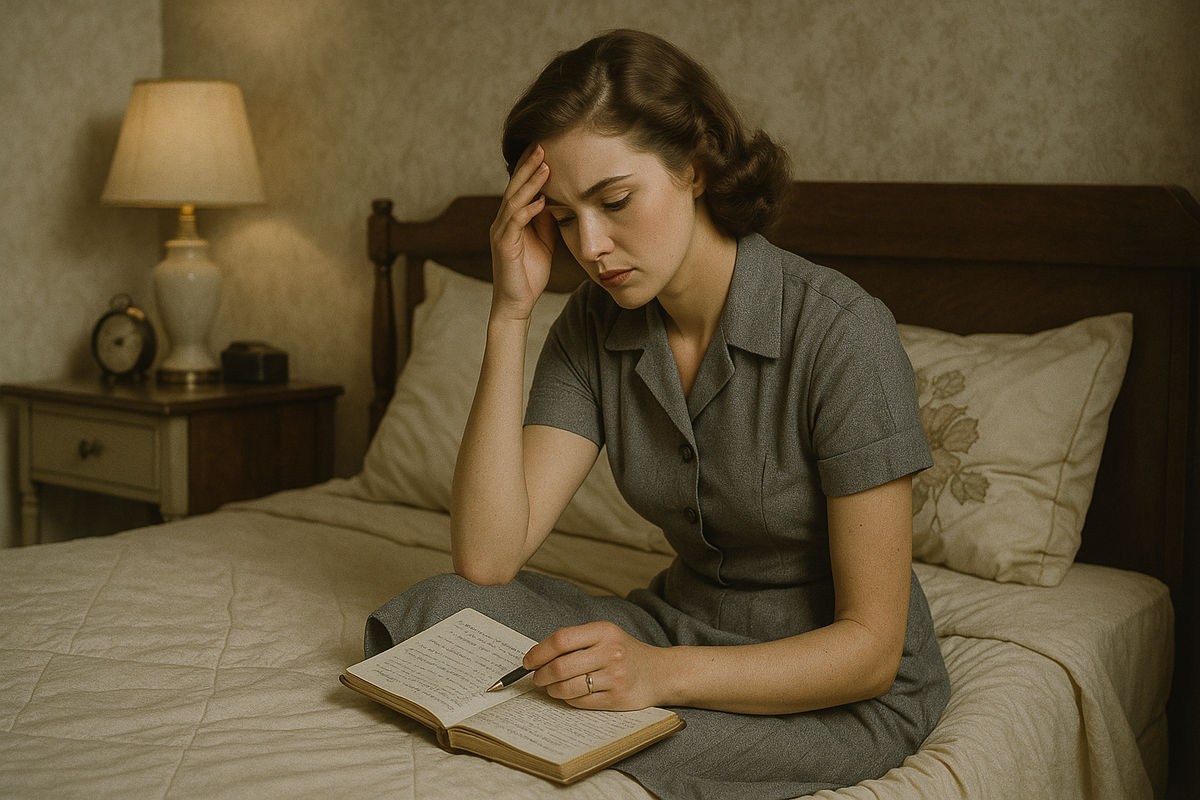
She's lying on her bed, one hand pressed to her forehead, diary open beside her. The photograph, printed in the March 1954 issue of Ladies' Home Journal, captures what the caption calls quiet despair: "More than anything on earth, I wanted a husband, home and children."
This wasn't melodrama. It was the opening salvo of "How to Be Marriageable"—one of the most revealing artifacts of postwar gender anxiety ever published in a major American magazine.
When millions of women opened their copies that spring, they found something more unsettling than recipes or fashion spreads. They found a blueprint for fixing themselves. The article promised that marriage wasn't just desirable—it was measurable, teachable, and for women pushing thirty, urgently necessary.
Archive Details
Publication: Ladies' Home Journal
Issue Date: March 1954
Featured Article: "How to Be Marriageable"
Key Figure: Dr. Paul Popenoe, American Institute of Family Relations
Cover Photography: Mead–Maddick
The Marriage Crisis That Wasn't
By 1954, America was deep in the Baby Boom. Veterans had married quickly after the war, and the domestic ideal dominated every corner of public life. Ladies' Home Journal, read in millions of households, didn't just reflect this reality—it enforced it.
"How to Be Marriageable" opened with a statistic designed to unnerve: 82% of American women were married by age 30. The implicit threat was clear. If you weren't among them, you were running out of time.
Enter Dr. Paul Popenoe and his Marriage Readiness Course, operated through the American Institute of Family Relations in Los Angeles. Popenoe's program promised to identify and eliminate "barriers" to marriage—personality flaws, social awkwardness, insufficient domestic training. In the Cold War era, when family stability was framed as a bulwark against social chaos, this wasn't self-help. It was civic duty.
The Journal wasn't merely prescribing traditional roles. It was documenting a moment of cultural fracture—when women were entering the workforce in growing numbers, when the conditions for feminism's second wave were taking shape, and when the old certainties about gender were beginning to crack.
The Architecture of Anxiety
What made "How to Be Marriageable" so effective was its construction. The article didn't lecture—it seduced through a carefully layered narrative.
Personal testimony came through "Marcia Carter," a 29-year-old single woman who enrolled in Popenoe's program. Her story provided emotional entry—readers could see themselves in her longing and her fear.
Scientific authority arrived via the Johnson Temperament Test, complete with charts measuring personality traits and marriage potential. The message: your romantic fate could be quantified, graphed, and corrected.
Therapeutic reassurance promised that no woman was beyond saving. With counseling, emotional training, and self-improvement, marriageability could be achieved.
This trinity—confession, data, cure—gave readers both identification and instruction. You weren't alone in your panic, the article suggested, and there was a clinical solution.
The cover, photographed by Mead–Maddick, showcased fashion and domestic contentment. But inside, that image of the woman with her diary told a different story. Marriage wasn't just a dream. It was an existential requirement.
What the Article Actually Said
Beneath its compassionate veneer, "How to Be Marriageable" delivered a series of brutal verdicts:
Marriage represented the highest achievement available to women.
Remaining single past your twenties marked you as socially defective.
"Career women" were characterized as lonely and unfulfilled—professional success couldn't compensate for romantic failure.
Your marriage potential could be scientifically measured and found wanting.
Counseling and self-improvement could "fix" unmarriageable women—the problem was you, not the institution.
These weren't fringe opinions. They were mainstream doctrine, printed in one of America's most influential publications and absorbed by millions of readers.
Why This Issue Matters Now
Historical Precision
It captures the Baby Boom's peak pressure on women, when postwar domesticity reached its most codified form.
Cultural Evidence
"How to Be Marriageable" provides direct testimony of how marriage anxiety was manufactured and marketed to women as scientific fact.
Visual Power
From the Mead–Maddick cover to that arresting bedroom photograph, the issue offers visceral period imagery that conveys more than text alone could.
Scarcity
Magazines were disposable media. Most copies were read, discarded, and lost. Complete, well-preserved issues are increasingly rare.
For scholars of women's history, gender studies, or mid-century American culture, this isn't a collectible—it's primary source material. It shows exactly how mass media shaped women's self-perception and enforced social norms through a combination of emotional manipulation and pseudoscientific authority.
The Artifact
Ladies' Home Journal wielded enormous influence over American women's lives. Owning the March 1954 issue means possessing a document of that power—a record of the precise moment when marriage was presented not as one life path among many, but as the only path that mattered.
Browse Ladies' Home Journal Magazine CollectionExplore decades of women's cultural history, from fashion and literature to the social pressures that defined each era.
The Legacy
"How to Be Marriageable" stands as one of the most revealing documents of how women's magazines shaped mid-century American identity. By packaging personal testimony as scientific truth and framing marriage as both destiny and diagnosis, the article crystallized the era's gender anxieties in a single feature.
Today, this issue serves dual purposes. It's a collectible with increasing market value, yes—but it's also evidence. Evidence of how far cultural norms have shifted, and how powerfully magazines like Ladies' Home Journal once dictated the terms of women's lives.
For anyone interested in women's history, the evolution of gender roles, or the mechanics of cultural influence, this magazine isn't just interesting. It's essential.