
Bob Dylan, Fame, and the Myth of the 1960s
Inside Playboy's Landmark 1978 Interview
Bob Dylan gave fewer than a dozen significant interviews in the entire decade of the 1970s. When he finally spoke—really spoke—it wasn't to Rolling Stone or The New York Times. It was to Playboy.
In March 1978, America's most elusive artist sat down with the magazine that had become an unlikely cathedral of serious conversation, wedged between centerfolds and car ads. The result was one of the most revealing documents of Dylan's career: a portrait of the artist as a middle-aged mystic, wrestling with the weight of his own legend while the wreckage of the 1960s calcified into nostalgia all around him.
For collectors and cultural historians, this issue represents far more than a celebrity Q&A. It's a seismograph of American disillusionment—the moment when the counterculture's prophet looked back at his decade and wondered aloud whether any of it had survived.
Archive Details
Historical Figure: Bob Dylan
Issue Date: March 1978
Archive Source: Playboy Magazine
Cultural Significance: One of Dylan's rarest interviews from the 1970s, examining fame, spirituality, and the legacy of the counterculture
The Cultural Moment: 1978 and the Hangover Generation
By the time readers picked up the March 1978 Playboy, the utopian fever of the 1960s had broken. Vietnam was over but not resolved. Watergate had exposed the rot at the center of American power. The economy wheezed under stagflation. The counterculture hadn't disappeared—it had been shrink-wrapped, repackaged, and sold back to the very people who created it.
Dylan himself embodied this cultural vertigo. The troubadour who had soundtracked the civil rights movement with "Blowin' in the Wind" and upended folk music by going electric at Newport had spent the early '70s in semi-seclusion. A 1966 motorcycle crash became his escape hatch from the machinery of fame. He retreated to Woodstock, raised children, and emerged sporadically with albums that confused fans expecting protest anthems. Blood on the Tracks (1975) was a masterpiece of personal reckoning, not political manifesto.
By 1978, Dylan was no longer the voice of a generation. He was something stranger and more interesting: a man trying to outlive his own mythology.
Why Playboy Mattered
Playboy in the 1970s occupied a peculiar cultural position. Hugh Hefner had built an empire on the promise that American men could be both sexually liberated and intellectually engaged—that the same magazine offering airbrushed fantasy could also publish Nabokov, interview Miles Davis, and run investigative journalism that mattered.
The Playboy Interview series had become one of the most prestigious platforms in American media. Malcolm X's 1963 interview introduced his philosophy to white America. Martin Luther King Jr., John Lennon, and Jimmy Carter all sat for the magazine's interviewers, knowing their words would reach millions of educated, affluent readers.
Dylan choosing Playboy as his venue wasn't a surrender to the mainstream. It was a recognition that the magazine had become a space where the myths of the 1960s could be interrogated by the people who lived them.
The Interview: Evasion as Art Form
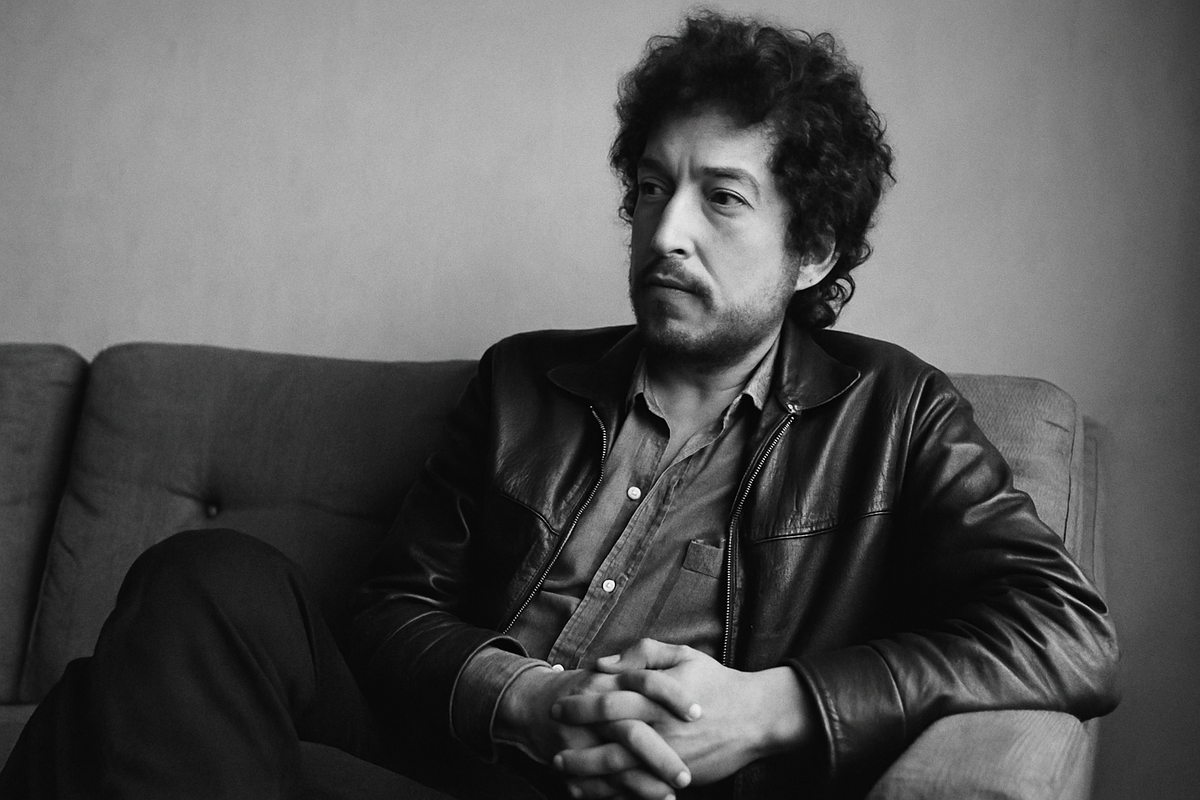
Dylan had always understood that mystery was part of his power. The Playboy interview didn't break that pattern—it refined it. Photographed in intimate black-and-white, Dylan appeared both present and distant, answering questions with the same slippery precision that made his songs inexhaustible.
He dismissed the legend as a distortion, insisting the public persona bore little resemblance to the man: "I'm not sure how much of Bob Dylan and Joan Baez concern anybody. To me, it isn't important… I don't think it's a relevant issue." The very idea that he embodied the 1960s was, to Dylan, a trap.
Dylan described celebrity as a funhouse mirror that distorted everything it touched. "I don't feel old, but certain things don't attract me anymore that I used to succumb to very easily," he noted—a rare admission that the machinery of stardom had worn him down.
He compared his craft to painting, rejecting the notion that being a rock star was somehow elevated: "You climb up as high as you want to." The metaphor was quintessentially Dylan—egalitarian and cryptic, inviting interpretation while resisting definition.
Dylan flirted with mysticism throughout the conversation, hinting at forces—God, fate, destiny—that shaped an artist's path. Within a year, he would convert to Christianity and release Slow Train Coming, one of the most divisive albums of his career. The seeds of that transformation are visible here, in his restless probing of purpose and mortality.
Most tellingly, Dylan questioned whether the spirit of the 1960s had endured or simply evaporated. By 1978, the revolution had been commodified—sold as nostalgia, frozen in amber. Dylan recognized that the decade's energy had either dissipated or been repackaged for profit.
The brilliance of the interview lies in its refusal to provide easy answers. Dylan offers glimpses, not revelations. He's a man who understands that once you explain the magic trick, it stops working.
The Magazine as Artifact: March 1978
The cover of the March 1978 issue captured Playboy's dual identity perfectly: a model in a satin dress posed against a sleek automobile, selling glamour and aspiration. Inside, the Dylan interview shared space with reviews of Louis Malle's controversial "Pretty Baby," Gore Vidal's science fiction, and the usual gadgetry that defined late-'70s bachelor consumption.
This juxtaposition wasn't accidental. Playboy thrived on contradiction—on being simultaneously highbrow and lowbrow, provocative and respectable. The magazine's genius was making its readers feel sophisticated for buying it, even as critics derided it as smut. Dylan's presence legitimized that formula. If the prophet of the 1960s was willing to sit for Playboy, perhaps the magazine really was a forum for serious ideas, not just a vehicle for centerfolds.
The Enduring Significance
What makes the March 1978 issue vital isn't just what Dylan said—it's what the interview reveals about the peculiar moment when the 1960s became history. Dylan was caught between eras, between the myth people needed him to be and the restless artist he remained. Playboy, for its part, was the perfect venue: a mainstream publication with countercultural credibility, where Americans could grapple with fame, identity, and authenticity while pretending they'd bought it for the pictures.
The interview doesn't resolve Dylan's contradictions. It deepens them. And in doing so, it captures something essential about what it meant to live in the shadow of the 1960s—that sense of unfinished business, of promises made and only partially kept.
Why Collectors Covet This Issue
Dylan sat for fewer major interviews during the 1970s than almost any other artist of his stature. This conversation offers insights unavailable elsewhere in his discography or public statements.
Issues featuring landmark conversations—with musicians, politicians, intellectuals—consistently rank among the most collectible in the magazine's history.
This single issue speaks to Dylan completists, vintage magazine collectors, scholars of 1970s American culture, and enthusiasts of Playboy's editorial golden age.
The advertisements, articles, and visual design reflect the anxieties and aspirations of late-'70s America with documentary precision. It's not just a magazine—it's an archive.
For serious collectors, this issue represents the convergence of multiple collecting categories: music history, cultural journalism, and the strange, contradictory legacy of Playboy itself.
Explore the Archive
Whether you're a Dylan scholar tracking his creative evolution, a cultural historian mapping the afterlife of the counterculture, or a collector of vintage magazines, the March 1978 Playboy offers something irreplaceable: a window into how America understood fame, art, and identity at the end of the 1970s.
Browse Playboy Magazine CollectionFrom the 1950s through the 1990s, Playboy preserved the voices, images, and debates that defined modern American culture. This issue isn't just memorabilia—it's a primary source, a conversation with history that continues to resonate.
Holding it in your hands is like eavesdropping on the moment when one era acknowledged it had died and another hadn't quite figured out what to replace it with.