
When America Built Bombers Like Ford Built Cars
Inside the factory floor that would win World War II—documented in The Saturday Evening Post, February 24, 1940
On February 24, 1940, a magazine landed on kitchen tables across America carrying a message most readers weren't ready to hear: the nation's vaunted aircraft industry was a handcraft operation masquerading as modern manufacturing. Hurd Barrett's "Bombers by the Pound" didn't just report on airplane production—it exposed the fragile machinery behind what would soon become the Arsenal of Democracy.
Twenty-two months before Pearl Harbor, with Europe already burning and isolationist sentiment still dominating Washington dinner tables, The Saturday Evening Post gave its millions of readers an unsettling factory-floor tour. What they discovered was that American bombers weren't rolling off assembly lines. They were being assembled by hand, rivet by painstaking rivet, in a process closer to shipbuilding than the mass production that had made Detroit the envy of the industrial world.
Barrett's article arrived at the perfect inflection point—after Hitler's invasion of Poland, during the Soviet assault on Finland, but before anyone on Main Street believed American boys would be fighting overseas. It was a warning shot disguised as industrial journalism.
Historical Context
Article: "Bombers by the Pound" by Hurd Barrett
Publication: The Saturday Evening Post
Issue Date: February 24, 1940
Historical Moment: 22 months before Pearl Harbor, during the "Phoney War" period
Significance: Pre-war documentation of America's aircraft industry on the cusp of total mobilization
The Assembly Line That Didn't Exist
Barrett stripped away the comforting mythology. Unlike automobiles, which Henry Ford had taught the world to manufacture by the thousands, bombers remained bespoke machines. Each aircraft demanded coordination between engineers revising blueprints on the fly, draftsmen translating specifications into workable plans, machinists fabricating custom components, and riveters crouching inside aluminum fuselages to seal every joint by hand.
The title itself—"Bombers by the Pound"—carried a brutal economic truth. These weren't warplanes measured by speed or firepower alone. They were measured in raw material tonnage, in man-hours consumed, in the sheer industrial weight required to put a single bomber into the sky. Every pound of aluminum represented scarce resources. Every rivet meant labor that couldn't be deployed elsewhere.
For a nation still climbing out of the Depression, still calculating costs in human terms, this was the mathematics of war production laid bare: steel, sweat, and time.
February 1940: The World on the Edge
Context matters. When this issue hit newsstands, the American public was watching Europe's catastrophe from a carefully maintained distance. The Wehrmacht had crushed Poland in weeks. The Luftwaffe was already demonstrating what modern air power could do to cities and armies alike. Britain and France were bracing for the Nazi onslaught that would come that spring.
The U.S. Army Air Corps, by contrast, was a boutique operation. America had brilliant aeronautical engineers and a handful of cutting-edge prototypes, but nothing resembling the industrial scale that Germany had mobilized. Barrett's article made the vulnerability explicit: if war came to America's shores—or if the nation chose to defend its allies—the existing aircraft industry couldn't possibly meet demand.
The article functioned as both alarm bell and blueprint. It showed readers that preparedness wasn't about political speeches or military parades. It was about factory capacity, skilled labor, and the unglamorous logistics of converting raw materials into functional warplanes faster than the enemy could shoot them down.
The Saturday Evening Post as National Interpreter
By 1940, The Saturday Evening Post had become America's living room—a weekly ritual for millions of families. With circulation in the stratosphere, it wielded cultural authority that no single publication commands today. Its editorial formula blended Norman Rockwell's idealized Americana with hard-nosed reporting on everything from politics to industry to foreign affairs.
"Bombers by the Pound" exemplified this balancing act. Barrett didn't bury readers in technical specifications or bureaucratic abstractions. He took them inside the factories. He showed them engineers hunched over drafting tables under deadline pressure. He described workers threading themselves into aircraft frames to install components by feel. He made the bottlenecks visceral: the design revisions that delayed production, the inspection protocols that slowed output but prevented catastrophic failures at altitude.
The article transformed airplane manufacturing from an abstract defense concern into something tangible—a story about American workers, American ingenuity, and American industrial potential waiting to be unleashed.
The Factory Floor as Battlefield
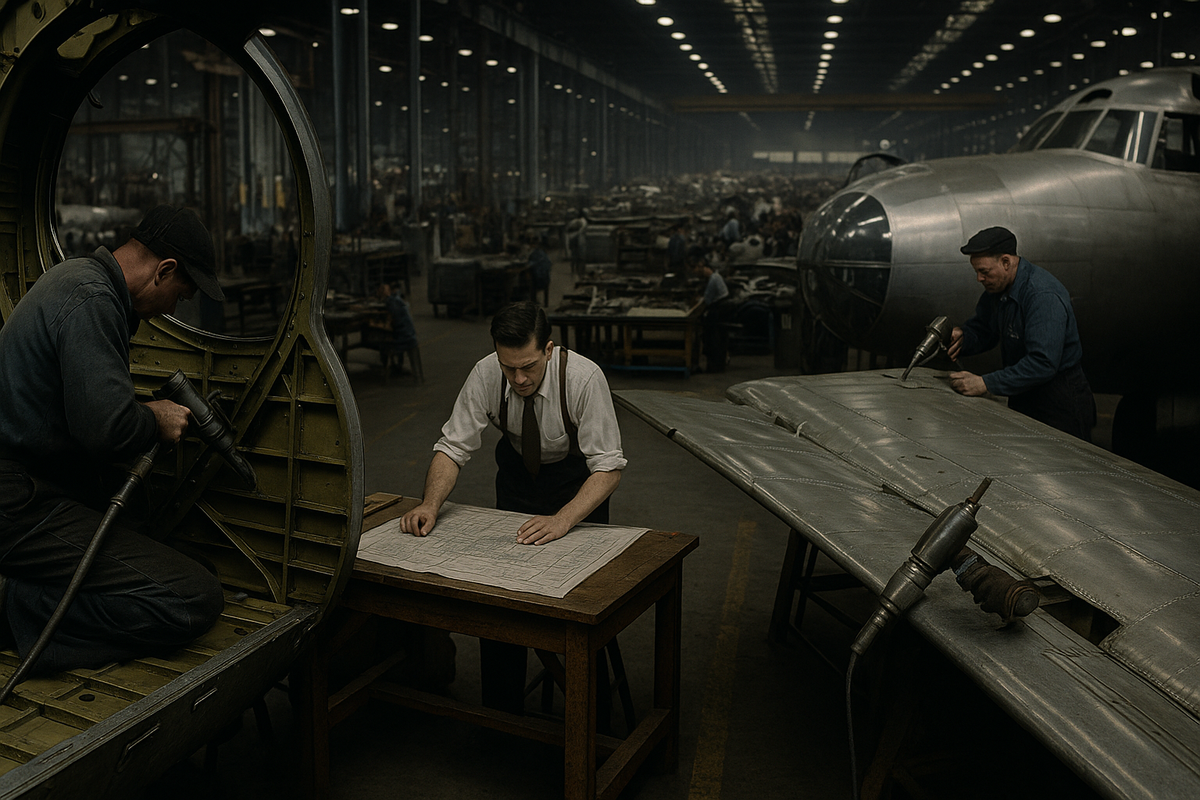
The magazine's visual storytelling reinforced Barrett's narrative. Photographs captured riveters illuminated by work lights inside bomber fuselages, their faces concentrated on tasks that required millimeter precision. Assembly lines stretched into the background—not yet the efficient conveyor systems they would become, but sprawling workshops where craftsmen solved problems aircraft by aircraft.
These weren't propaganda images in the traditional sense. They were documentary evidence of how far American industry had to go before it could claim parity with the Axis powers. But they also radiated a distinctly American confidence: give us time, give us resources, and we'll figure out how to build anything.
Barrett walked readers through the specific challenges. Sourcing materials for thousands of specialized components. Training workers for tasks that didn't exist in civilian manufacturing. Navigating the bureaucratic maze of military procurement and design approval. Balancing the urgent need for more aircraft against the non-negotiable requirement that each one had to actually fly—and return—safely.
What emerges from the article is a portrait of an industry caught between eras: still artisanal in practice, but racing toward the mass production techniques that would define America's contribution to Allied victory.
Key Insights From Barrett's Investigation
Mass Production vs. Custom Craftsmanship
Barrett revealed that bombers were still more hand-built than mass-produced, with each aircraft requiring painstaking individual attention from skilled craftsmen.
The Weight of Warplanes
Every component, from bolts to engines, was measured in pounds of material and labor hours, making production as much an economic issue as a military one.
Bottlenecks in Design
Engineers faced constant revisions and inspections, which slowed output but were vital for ensuring aircraft could withstand combat conditions.
The Role of Workers
From riveters to inspectors, the article celebrated the skilled labor force that made the difference between success and disaster in the air.
Industry at the Crossroads
The story suggested that America's factories would soon need to shift from civilian to military production—a foreshadowing of the vast mobilization after Pearl Harbor.
Prophecy in Print
Barrett's documentation captured American air power at its most vulnerable moment, inadvertently preserving the baseline from which the Arsenal of Democracy would emerge.
The Human Infrastructure of Air Power
Barrett understood something that pure aviation enthusiasts often miss: bombers weren't just engineering marvels. They were human systems. Behind every successful aircraft was an invisible army of workers whose skills made the difference between a functional warplane and an expensive coffin.
The riveters who could seal joints in confined spaces without compromising structural integrity. The inspectors who caught flaws that would only reveal themselves under combat stress. The machinists who fabricated replacement parts when supply chains broke down. The engineers who revised designs on deadline when field testing exposed weaknesses.
This wasn't glamorous work. It didn't come with medals or newspaper headlines. But as Barrett's article made clear, these factory workers were the true front line of American defense—long before troops landed on foreign beaches.
The Enduring Power of Ink on Paper
Digital archives have their place, but there's something irreplaceable about holding the physical object. The paper stock, the advertisement layouts, the editorial decisions about what ran adjacent to Barrett's article—all of it contributes to understanding how 1940s America processed information and constructed meaning.
These magazines functioned as national conversation platforms in ways that modern media fragments can't replicate. When millions of families read the same articles in the same week, shared assumptions formed. Cultural consensus emerged. The groundwork for collective action was laid.
The Saturday Evening Post didn't just report on American life—it shaped American consciousness. Issues like February 24, 1940 are architectural elements in the construction of mid-century national identity.
Why February 24, 1940 Matters to Collectors
Historical Timing
Published in the narrow window between European war and American entry, it captures the exact moment when industrial preparedness shifted from policy debate to national imperative.
Primary Source Value
Unlike retrospective histories, Barrett's article provides contemporary analysis with the blind spots, anxieties, and assumptions of someone living through the events in real time.
Visual Documentation
The factory photography and illustration work represents a specific moment in industrial design and workplace culture that influenced how Americans visualized war production.
Cultural Artifact Status
A preserved fragment of the communication infrastructure that prepared a nation for total war. Museum exhibitions actively seek these period publications to contextualize battle artifacts.
Collector Market Dynamics
Aviation history, World War II preparedness, and industrial heritage all drive sustained demand. Wartime-related Saturday Evening Posts maintain value across collecting categories.
Documentary Evidence
When you acquire this issue, you're obtaining proof of how America talked itself into readiness—one factory floor, one magazine article, one family subscription at a time.
Start Your Collection With History
From the Gilded Age through the Space Age, The Saturday Evening Post documented American culture at every turning point. Whether you're building a research library, honoring family history, or simply seeking tangible connections to the past, these magazines offer something no digital reproduction can match.
Browse The Saturday Evening Post Magazine CollectionFinal Assessment
The February 24, 1940 issue of The Saturday Evening Post, anchored by Hurd Barrett's "Bombers by the Pound," stands as one of the essential pre-war documents of American industrial capacity. It captured the aircraft industry at its most critical juncture—when artisanal craftsmanship had to give way to mass production, when skilled labor became the defining strategic resource, when factories transformed into the true front lines of national defense.
For collectors, historians, and anyone who understands that wars are won in factory bays as much as battlefields, this issue represents more than vintage journalism. It's a preserved moment when America confronted its own unreadiness—and began the industrial mobilization that would change the course of the 20th century.
Hold this magazine, and you're holding the blueprint for the Arsenal of Democracy, published before anyone knew that's what it would become.