
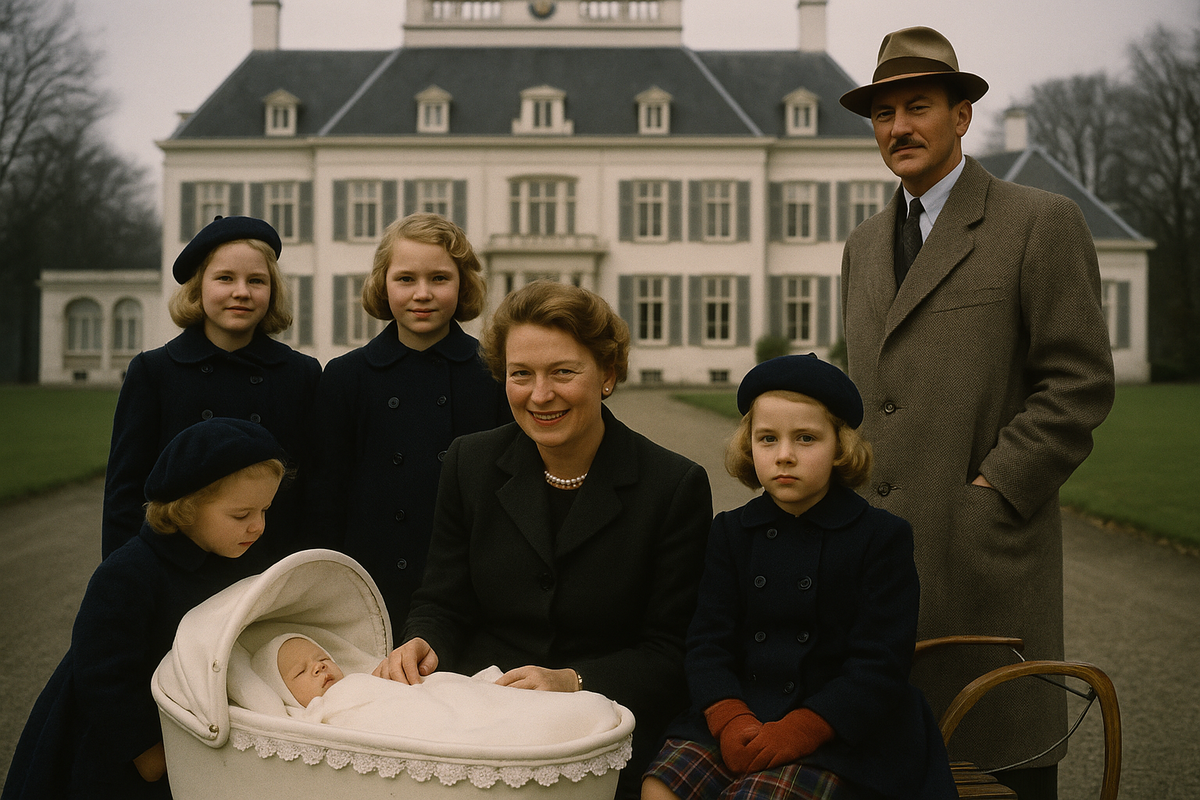
The Queen Who Refused the Crown
How a 1955 Magazine Taught America That Royalty Could Be Real
When Princess Juliana of the Netherlands told reporters that her firstborn daughter would not be "raised in tissue paper" and would never even hear the word "princess," she wasn't merely making headlines. She was drawing a line in the sand against centuries of royal protocol—and American women, flipping through the March 1955 issue of Ladies' Home Journal, were paying attention.
The six-part serialized biography Born to Be Queen, written by Betty Hoffman and the Netherlands News Agency, arrived at a peculiar moment in American cultural history. The war was over. The suburbs were full. And millions of women who had riveted bombers and managed factories were now being told that their highest calling was a well-organized linen closet. Into this tension walked Juliana: a queen who sold soap and towels from her palace, who raised her children without pretense, and who seemed to suggest that power and domesticity weren't mutually exclusive—they were inseparable.
This wasn't just a royal profile. It was a cultural negotiation, printed on glossy paper and delivered to kitchen tables across America.
Archive Details
Historical Figure: Queen Juliana of the Netherlands
Issue Date: March 1955
Archive Source: Ladies' Home Journal
Feature: "Born to Be Queen" Part I (Six-Part Series)
Authors: Betty Hoffman & Netherlands News Agency
The Palace That Felt Like Home
Soestdijk Palace, as described in Born to Be Queen, bore little resemblance to the gilded fortresses Americans associated with European royalty. No marble halls echoing with the footsteps of servants. No velvet ropes separating the sovereign from the merely mortal. Instead, the article painted a portrait of a working household: books on shelves, children underfoot, and—most startlingly—a palace that occasionally sold household goods to visitors.
The photographs reinforced this calculated ordinariness. One image showed young Juliana on a sleigh ride, her expression so solemn that the caption felt compelled to note she didn't seem to be "having much fun." Another featured the cradle that had held generations of Dutch royals, but the framing was intimate, almost clinical—a reminder that even queens give birth like everyone else.
Then there was Princess Beatrix, Juliana's eldest daughter, captured in an anecdote that became the emotional center of the piece. When Beatrix told a schoolmate, "My granny is a queen," the classmate replied without missing a beat: "My grandfather has a bakery. I get cakes every day." Beatrix's response? "You win."
For American readers in 1955—women who were navigating their own questions about ambition, duty, and the boundaries of acceptable femininity—this wasn't just charming. It was permission.
What Ladies' Home Journal Understood About Power
By the mid-1950s, Ladies' Home Journal had perfected a delicate editorial alchemy. With a circulation in the millions, it occupied a unique space in American media: neither purely aspirational like Vogue nor narrowly domestic like competing homemaking magazines. It offered advice columns alongside serious fiction, celebrity memoirs next to international profiles, fashion spreads that sat comfortably beside discussions of motherhood and mental health.
The inclusion of Born to Be Queen was strategic. The magazine's editors understood that their readers were hungry for models of womanhood that didn't require them to choose between intelligence and domesticity, between public significance and private devotion. Juliana, as presented in these pages, was proof that the choice itself was false.
The same issue featured a serialized memoir by actress Ethel Barrymore, recipes for spring entertaining, and layouts showcasing the latest in suburban home design. This editorial mix wasn't accidental—it reflected the full bandwidth of postwar women's lives. Juliana's story fit seamlessly into this tapestry because it addressed the unspoken question hanging over every kitchen table in America: What does it mean to be a modern woman with real power?
Prince Bernhard and the Limits of Domesticity
Juliana's husband, Prince Bernhard, added another dimension to the narrative. Described as a skilled racing driver who had survived multiple crashes, he embodied a certain postwar masculine ideal: stylish, daring, physically capable. Juliana's quip that he had "more lives than a cat" humanized him while also establishing her as his intellectual equal—the woman who could afford to tease a man who cheated death for sport.
The photographs showed Bernhard as both a fashion plate and a family man, threading the needle between traditional masculinity and the emerging ideal of the engaged father. This, too, was part of the magazine's careful choreography: presenting a royal marriage that looked recognizably modern without threatening the fundamental gender arrangements that still governed most American households.
Why This Issue Matters Now
Original copies of the March 1955 Ladies' Home Journal have become significant collectibles, and the reasons extend beyond nostalgia. This issue represents a hinge point in American women's history—the moment when the contradictions of the 1950s were most visible, before the upheavals of the 1960s resolved (or at least named) them.
For collectors of women's history, the issue is invaluable because it captures an in-between moment: after Rosie the Riveter but before Betty Friedan, after victory gardens but before second-wave feminism. The magazine itself is a primary source document, offering unmediated access to how American culture was teaching women to think about power, duty, and selfhood.
For royal memorabilia enthusiasts, the first installment of Born to Be Queen is particularly prized. Serialized features create a different kind of collectibility—the beginning of a narrative arc has its own gravity. And Juliana herself, now recognized as one of the more progressive European monarchs of the twentieth century, makes this profile historically significant beyond its immediate cultural context.
For students of media history, the issue demonstrates how magazines functioned as cultural mediators in the pre-television age. Ladies' Home Journal wasn't just reporting on Juliana—it was actively constructing a version of her that American women could use. The magazine was, in effect, translating Dutch royalty into a language that spoke directly to the anxieties and aspirations of suburban America.
Well-preserved copies are increasingly rare. Paper degrades, bindings fail, and the bright colors of 1950s printing fade under fluorescent lights and careless storage. To hold an intact copy of this issue is to hold a physical artifact of a vanished conversation—one that shaped how a generation of American women understood the relationship between public duty and private life.
What the Magazine Knew That History Forgot
The genius of Born to Be Queen wasn't in making Juliana seem ordinary. It was in making ordinariness seem worthy of a queen.
At a time when American culture was pushing women back into narrow domestic roles while simultaneously celebrating their wartime contributions, Juliana offered a third way: dignity without grandeur, power without pretense, motherhood without martyrdom. She ran a palace like a household because, the article suggested, that's what palaces actually were—households with consequences.
The magazine understood something that much of postwar America was trying to forget: that women could hold real authority and still value the textures of daily life. That you could be born to power and choose to wield it quietly. That the most radical act might be refusing to perform royalty as spectacle.
By the time readers reached the end of Part I, they had seen Juliana's cradle, her solemn childhood face, her practical palace, her witty daughter. They had been given a model of womanhood that didn't require them to be less intelligent, less capable, or less ambitious—only more honest about what actually mattered.
Holding History in Your Hands
To collect vintage issues of Ladies' Home Journal is to collect the infrastructure of American womanhood—the magazine that millions of women read while sitting at kitchen tables, waiting in beauty parlors, riding commuter trains. These weren't just magazines. They were instruction manuals for a culture in transition.
The March 1955 issue, with its portrait of a queen who refused to act like one, captures that transition at its most revealing. Between the recipes and the fashion spreads and the serialized memoirs, American women were being taught how to think about themselves. And Juliana, standing in her unpretentious palace in the Netherlands, was giving them permission to want more without apologizing for wanting it.
That's the article you're holding. That's the conversation you're preserving. That's why it matters.
Collector Significance
Historical Rarity
First installment of a six-part serialized biography makes this issue particularly valuable to completists and royal memorabilia collectors.
Cultural Document
Captures the exact moment when postwar American women were negotiating between domestic roles and public ambition.
Media History
Demonstrates how mid-century magazines functioned as cultural translators, mediating between international events and American domestic life.
Preservation Value
Well-preserved copies with intact color photography and minimal spine damage are increasingly difficult to find as paper degrades over seven decades.
Research Primary Source
Offers unmediated access to 1950s gender ideology, royal presentation strategies, and women's magazine editorial practices.
Cross-Collector Appeal
Valuable to collectors of women's history, Dutch royal memorabilia, mid-century design, and vintage magazine advertising.
Explore the Full Collection
Every issue of Ladies' Home Journal tells a story about American women at a particular moment in history—their concerns, their contradictions, their carefully negotiated freedoms. The March 1955 issue is just one chapter in a larger archive of voices, fashions, and cultural turning points.
Browse our complete collection of original Ladies' Home Journal magazines and discover the artifacts that shaped how generations of American women saw themselves and the world around them.
Browse Ladies' Home Journal Magazine Collection