
When Victory Became a Burden: The Saturday Evening Post and the Liberation of Korea
November 1950—Norman Rockwell's cheerful cover concealed William L. Worden's harrowing dispatch from Seoul, revealing the true cost of Cold War triumph
November 1950. American mailboxes received a magazine that would become a historical fault line.
On its cover, Norman Rockwell had painted a boy torturing a trumpet while his dog howled in mock agony—pure Americana, warm and absurd. But inside, war correspondent William L. Worden delivered a dispatch from Seoul that stripped away any illusions about what "winning" meant in the atomic age. His article, "We Won Back Korea — and We're Stuck With It," wasn't triumphant. It was a reckoning.
For readers barely five years removed from V-J Day, the message was clear: America had liberated Korea, and now it owned the consequences.
Archive Details
Publication: The Saturday Evening Post
Issue Date: November 18, 1950
Cover Artist: Norman Rockwell
War Correspondent: William L. Worden
Article Title: "We Won Back Korea — and We're Stuck With It"
Historical Context: Published two months after the Inchon landing and MacArthur's recapture of Seoul
The Strategic Moment: September's Victory, November's Reality
The military situation in Korea had reversed with shocking speed. In June, North Korean forces had stormed across the 38th parallel, seizing Seoul within days and pushing UN forces into a desperate defensive perimeter around Pusan. Then came General Douglas MacArthur's audacious amphibious assault at Inchon in September—a gamble that shattered North Korean supply lines and allowed UN forces to retake the capital.
By the time Worden filed his report in late October, Seoul was back in Allied hands. The invasion had been repelled. The maps showed progress.
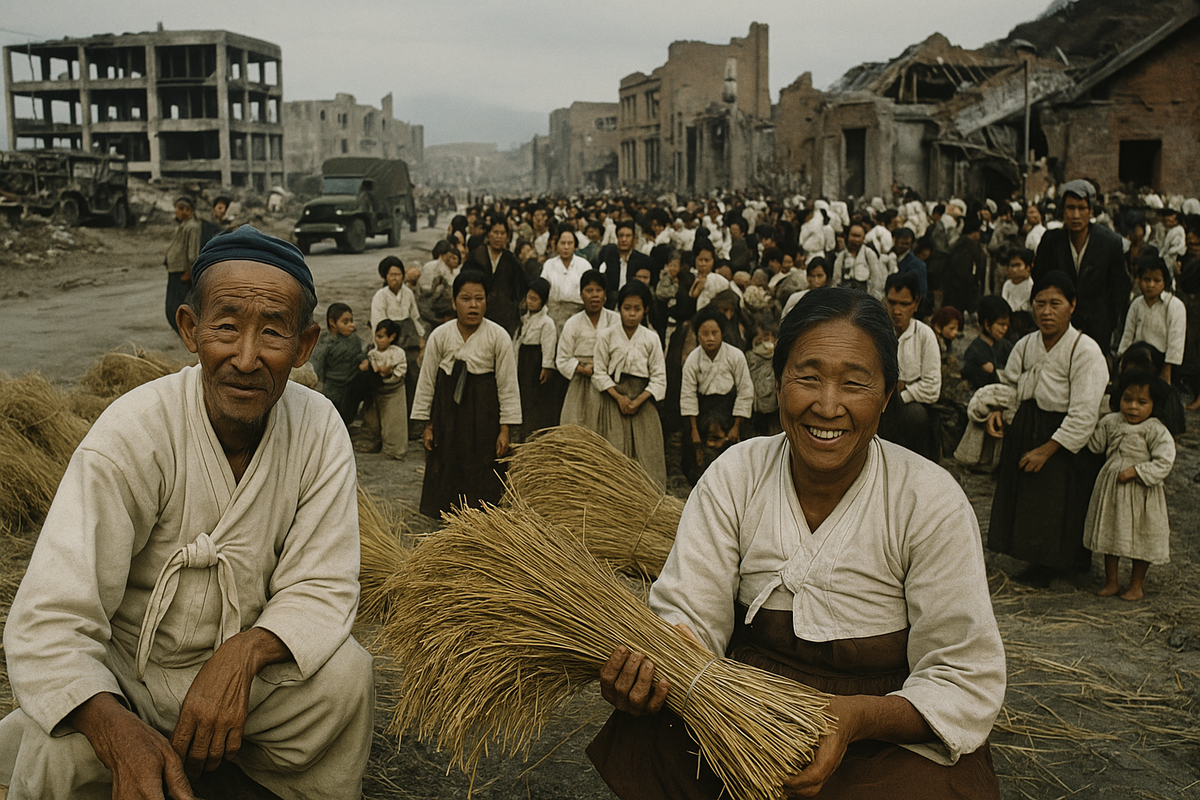
But Worden wasn't writing about maps. He was writing about what liberation looked like on the ground: rail yards choked with twisted locomotives, factories bombed into skeletal frameworks, and millions of civilians who had survived the war but faced something worse—a winter with no shelter, no fuel, and no functioning economy.
The Saturday Evening Post published his account on November 18, 1950, and Americans confronted an uncomfortable truth: military victories in the Cold War would not end cleanly. They would metastasize into reconstruction projects, humanitarian crises, and indefinite commitments.
Worden's Dispatch: The Price of Recapture
Worden's reporting carried the weight of direct observation. He walked through Seoul's ruins and catalogued the wreckage with precision. Locomotives lay overturned for miles. Industrial plants stood idle, their machinery looted or destroyed. Bridges that had carried commerce for decades were now rubble in riverbeds.
But the physical destruction was only part of the story. Worden described what he called "twenty million miserable human beings" now added to America's ledger of responsibility. These were not abstractions—they were families crowding into single-room huts, refugees streaming along bombed roads, farmers harvesting rice with hand tools because mechanized agriculture had been obliterated.
One photograph in the issue captured the paradox perfectly: elderly Korean men smoking pipes beneath a hand-painted banner reading "Welcome U.N. Army." Their faces showed exhaustion, not celebration. They had endured Japanese colonial rule, Soviet occupation in the North, Communist invasion, and now Allied "liberation." Each wave of foreign soldiers had promised something. Each had left scars.
Worden understood what many Americans did not yet grasp: Korea wasn't a battle to be won. It was a nation to be rebuilt, and that work would stretch far beyond any armistice.
Physical Devastation
Locomotives overturned for miles, industrial plants shuttered, bridges destroyed—Seoul's infrastructure lay in ruins after four months of invasion and counterinvasion.
Humanitarian Crisis
Worden documented "twenty million miserable human beings" facing winter without shelter, fuel, or functioning supply chains—a burden now falling on American shoulders.
Agricultural Resilience
Despite the devastation, Korean farmers brought in the fall rice harvest—a rare bright spot amid the suffering, captured in the Post's photography.
Cycle of Occupation
The "Welcome U.N. Army" banner symbolized Korean weariness—decades of foreign armies promising liberation, each leaving destruction in their wake.
The Post's Editorial Gambit: Rockwell and Ruin
The November 18 issue exemplified The Saturday Evening Post's editorial genius—and its understanding of mid-century American psychology.
Norman Rockwell's cover was a masterpiece of domestic tranquility: a boy wrestling with a trumpet, his dog's head thrown back in comic suffering, the scene drenched in small-town innocence. It was the America readers wanted to believe still existed—uncomplicated, humorous, safe.
Then they turned the page.
Worden's feature presented the inverse reality: a world where American power brought not safety but obligation, where victory meant inheriting chaos, where the trumpet's playful noise gave way to the silence of bombed cities. The editorial contrast was deliberate. The Post was telling its readers that they lived in both worlds now—Rockwell's Main Street and Worden's ruined Seoul—and there was no escaping either.
This wasn't propaganda. It was journalism sophisticated enough to hold contradictions in tension. The magazine refused to simplify the war into heroism or tragedy. Instead, it documented both: the resilience of Korean farmers bringing in their fall harvest, and the impossibility of feeding twenty million people through a winter with no infrastructure. The bright spot of UN forces driving back Communist aggression, and the dark reality that South Korea now depended entirely on American aid to survive.
The Post made Korea real for readers who would never see it. Through stark photography and unflinching prose, it transformed Cold War abstractions into human particulars—faces, wrecked trains, rice paddies, refugee children.
The Cycle of Occupation: Korea's Long Memory
Worden grasped something many American policymakers missed: for Koreans, liberation in 1950 was not a new beginning. It was the latest chapter in a brutal pattern.
Japanese colonial rule had lasted from 1910 to 1945—thirty-five years of cultural suppression, forced labor, and economic extraction. When Japan surrendered, Koreans had hoped for independence. Instead, the Soviet Union occupied the North and the United States occupied the South, dividing the peninsula at the 38th parallel as a temporary expedient that calcified into permanence.
Then came the Communist invasion of June 1950, followed by the UN counteroffensive that fall. By the time Worden arrived, Seoul had changed hands twice in four months. Each occupation—Japanese, Soviet, Communist, Allied—had promised order. Each had delivered destruction.
The Saturday Evening Post's coverage captured this exhaustion. The photographs showed not jubilation but wariness. The farmers harvesting rice weren't celebrating liberation; they were simply trying to survive the next winter. The pipe-smoking elders beneath the "Welcome U.N. Army" sign had seen too many welcomes turn into farewells, too many armies march through and leave wreckage behind.
Worden's reporting acknowledged this history without dwelling on it, but the implication was clear: America couldn't just win and leave. The Korean people had been abandoned too many times.
Cold War Stakes: Why Korea Couldn't Be Lost
The strategic context made withdrawal impossible, even if the humanitarian cost hadn't.
By late 1950, the Cold War had hardened into a global confrontation. The Soviet Union had detonated its first atomic bomb in 1949. China had fallen to Communist forces that same year. Eastern Europe was locked behind the Iron Curtain. American policymakers viewed every conflict through the lens of containment—the Truman Doctrine's promise to support free peoples resisting subjugation.
Korea became the first military test of that doctrine. If the United States liberated South Korea and then abandoned it to starvation and chaos, what message would that send to allies in Europe, Japan, and Southeast Asia? Would any nation trust American security guarantees if Washington treated its commitments as disposable?
Worden's article captured this bind without spelling it out explicitly. The title itself—"We Won Back Korea — and We're Stuck With It"—framed the dilemma. American forces had achieved their military objective, but the real war was just beginning: the war against hunger, displacement, and the economic collapse that could drive desperate populations toward Communism.
The Saturday Evening Post gave readers the unvarnished calculation: Korea mattered not because Americans loved Korea, but because abandoning it would unravel the entire architecture of containment. Victory had purchased responsibility, and responsibility had no exit clause.
Why This Issue Endures: History as Artifact
The November 18, 1950 issue of The Saturday Evening Post holds significance that extends beyond its immediate historical moment.
For collectors, it represents a convergence of elements: a Norman Rockwell cover from his artistic prime, eyewitness war reporting from a conflict still unfolding, and early Cold War journalism that presaged decades of American foreign entanglement. The issue is a primary source—not an interpretation of history, but history itself, printed on paper, mailed to homes, read at kitchen tables across the country.
For historians, it captures the precise moment when American confidence in quick military solutions began to erode. World War II had ended with clear victory and occupied enemies. Korea offered no such clarity. Worden's dispatch showed Americans what their global leadership would actually require: not just soldiers and bombers, but food shipments, reconstruction aid, and the indefinite presence of troops on foreign soil.
For anyone trying to understand how America transitioned from reluctant isolationist to permanent global policeman, this magazine is evidence. It documents the psychological shift—the realization that winning battles no longer meant winning wars, that liberation created obligations, that the Cold War would be measured not in years but in generations.
The issue also demonstrates what magazine journalism could achieve in 1950. Before television dominated visual storytelling, before the internet fractured attention into fragments, magazines like the Post delivered comprehensive reporting paired with world-class illustration. They were slow media—meant to be read carefully, discussed, kept. That durability is part of their value now. Digital news evaporates; these pages remain.
For Collectors and Historians
Historic Timing
Published just months into the Korean War, providing one of the earliest American accounts of the conflict's true human cost and strategic implications.
Rockwell at His Peak
A Norman Rockwell cover from 1950 represents his artistic prime—highly sought after by collectors for both aesthetic value and cultural significance.
Primary Source Material
William L. Worden's eyewitness dispatch offers unfiltered contemporary reporting—history as it was understood in real time, not through hindsight.
Cold War Document
This issue captures the dawn of America's permanent global military commitments, making it essential for understanding modern U.S. foreign policy.
Explore the Archive
Original copies of the November 18, 1950 Saturday Evening Post and thousands of other vintage magazines are available in our collection. Browse Cold War-era journalism, Norman Rockwell covers, and firsthand accounts from history's pivotal moments.
Browse The Saturday Evening Post Magazine CollectionThe Long Shadow
Worden's article proved prophetic. The Korean War would drag on for three more years, ending not in victory but in stalemate—an armistice that left the peninsula divided, American troops permanently stationed along the DMZ, and the question of Korea's future unresolved even today.
But his warning about the burden of liberation applied far beyond Korea. Vietnam, Iraq, Afghanistan—each conflict would replay the same pattern Worden identified in 1950. American forces could win battles, seize territory, topple governments. What they couldn't do was leave. Victory created obligations, and those obligations became traps.
The November 18, 1950 Saturday Evening Post documented the moment Americans began to learn this lesson. Rockwell's trumpet-playing boy remained on the cover, oblivious and cheerful. But inside, Worden was already writing the template for every war that would follow—wars that America would win militarily and lose strategically, conflicts that would grind on not because the enemy was strong, but because victory itself proved inescapable.
That's why this issue matters. It's not just about Korea. It's about the price of power, the weight of responsibility, and the question America is still asking seventy-five years later: What does it mean to win?