
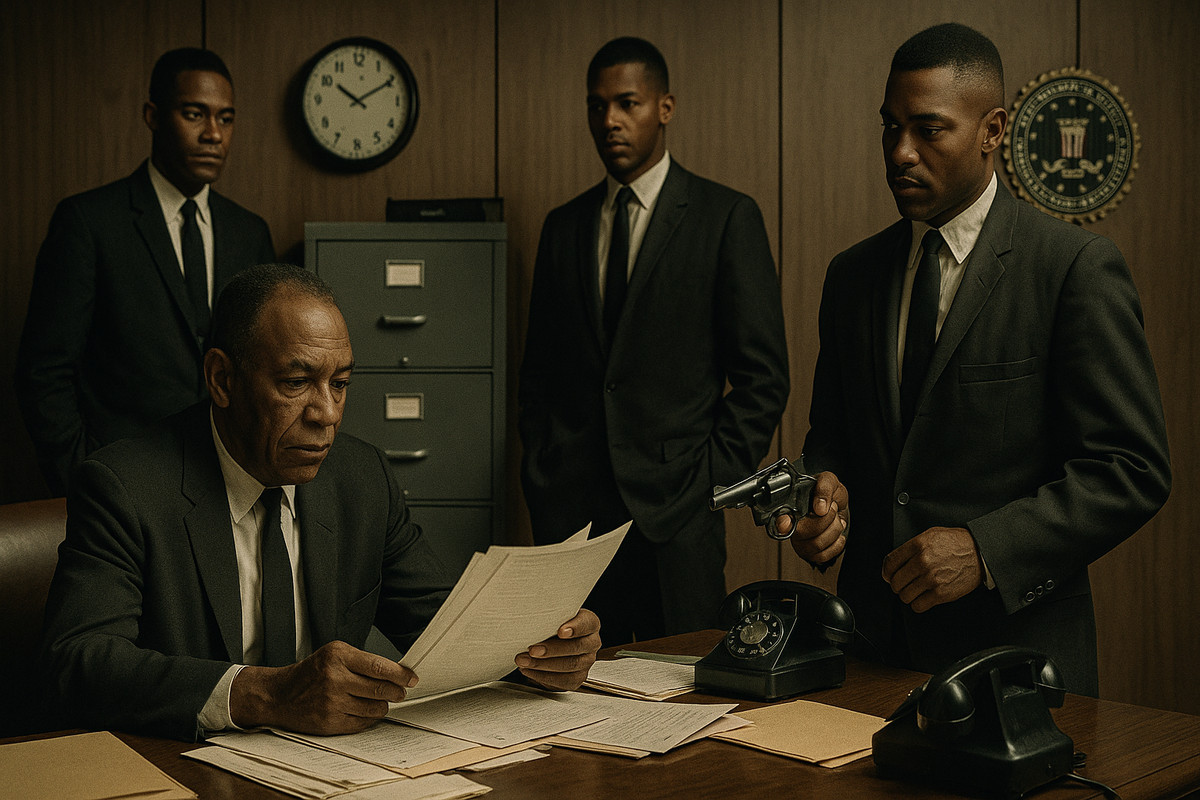
The September 1962 FBI Feature That Changed What Black America Could See in the Mirror
How Ebony Magazine documented Black special agents inside J. Edgar Hoover's Bureau—and gave a generation proof that representation at the highest levels was possible
When Simeon Booker's typewriter fell silent in the summer of 1962, he had just completed one of the most improbable assignments in the history of Black journalism: documenting African Americans inside J. Edgar Hoover's FBI.
Not as suspects. Not as informants. As special agents.
The resulting feature—"The Negro in the FBI"—appeared in the September 1962 issue of Ebony Magazine and detonated quietly across Black America. Here was visual, documented proof that Black men were training at the FBI Academy, solving bank robberies, exposing Nazi spy rings, and earning commendations from one of the most powerful—and racially opaque—institutions in the country.
For a community watching Freedom Riders board buses into violence, for families whose children were being turned away from universities at gunpoint, this was more than journalism. It was ammunition for the imagination.
Archive Details
Publication: Ebony Magazine
Issue Date: September 1962
Feature Article: "The Negro in the FBI" by Simeon Booker
Historical Context: Published two years before the Civil Rights Act of 1964, during the height of the Civil Rights Movement
Significance: One of the first mainstream profiles of African American FBI agents, combining investigative journalism with powerful visual documentation
The Timing Was Everything
September 1962 sits at a hinge point in American history. James Meredith had just integrated the University of Mississippi under armed federal protection. The March on Washington was less than a year away. Birmingham's children would soon face fire hoses and police dogs. The Civil Rights Act was still two legislative battles from passage.
Against this backdrop, the FBI occupied a strange position. Publicly, it was America's premier crime-fighting force—Hoover's "G-Men" were cultural icons. Privately, civil rights leaders accused the Bureau of lethargy, if not outright hostility, toward investigating racial terrorism in the South. Hoover himself would later surveil Martin Luther King Jr. with an obsessiveness that bordered on vendetta.
So when Ebony published photographs of Black agents firing weapons at Quantico, practicing judo holds, sitting in classrooms beside white trainees—readers understood the subtext. Representation inside the machine mattered, even if the machine itself remained ambivalent about justice.
What Booker Found: The Men Behind the Badges
Booker's reporting was meticulous. He profiled agents by name, by accomplishment, by humanity. These were not abstract symbols. They were men with service records, families, hobbies, and reputations inside the Bureau.
James E. Amos stood at the summit of Black FBI history. A former bodyguard to Theodore Roosevelt, Amos had earned legend status for his detective work in the "House on Ninety-Second Street" case, which dismantled a Nazi espionage network during World War II. Ebony photographed him cleaning a service weapon—an image that radiated both competence and longevity.
Jesse Strider built his name on the West Coast, cracking bank robbery cases with speed and precision. Leo McClaren, working out of Miami, tracked fugitives and located missing witnesses with instincts that made him indispensable. Worthington Smith, a Washington-based agent, appeared in the magazine with his hunting dog—a deliberate portrait of approachability, the agent as neighbor.
Then there were the New York operatives: Harold A. Carr and James Thomas Young, both singled out by Hoover for their loyalty and investigative acumen. Samuel Noisette, one of the Bureau's longest-serving Black agents, possessed a photographic memory so sharp that Hoover publicly praised him—a rare commendation from a man not known for effusiveness.
But perhaps the most symbolic figure was Aubrey Lewis. A star athlete at Notre Dame in both football and track, Lewis embodied the merging of Black excellence in sports with federal service. Ebony captured him standing at the FBI Academy, shoulders back, jaw set—an image of discipline meeting pride.
Hoover Speaks (and Dodges)
Booker secured quotes from Hoover himself, who insisted the FBI maintained a strict policy of evaluating agents without regard to "race, creed, or color." He praised Black agents for their discipline, their loyalty, their exemplary personal lives.
But when pressed about assigning Black agents to civil rights cases in the South—where their presence might carry both symbolic and investigative weight—Hoover demurred. It was "not realistic," he said.
Ebony printed the contradiction without editorial comment. The magazine's genius lay in its restraint: present the facts, frame the images, let readers draw their own conclusions. The tension between individual achievement and institutional inertia hung in the air, unresolved but impossible to ignore.
The Visual Language of Possibility
Ebony's photography in this issue was surgical in its intent. Agents appeared in action shots—firing weapons, grappling in judo training, conferring in offices. But the magazine also humanized them: men with children, men with pets, men engaged in hobbies unrelated to their federal identity.
This dual approach was Ebony's signature move. Founded by John H. Johnson in 1945, the magazine had spent seventeen years constructing a counter-narrative to mainstream media's erasure and caricature of Black life. While Life and Look either ignored Black achievement or framed it through condescension, Ebony built its pages around beauty, intelligence, sophistication, and progress.
The FBI feature fit seamlessly into the magazine's larger mission. In the same September 1962 issue, readers found fashion spreads, music coverage, society events, religious commentary—a holistic portrait of Black life that refused to flatten itself into a single story. Glamour and struggle. Progress and heritage. Individual triumph and collective reckoning.
For generations of African Americans, Ebony was the mirror that reflected them as they knew themselves to be: fully human, multiply talented, deserving of every opportunity the nation promised.
The Dual Legacy
The September 1962 Ebony offers two lessons, both still relevant.
First: Representation is not the same as justice, but it is not nothing. Seeing Black agents in the FBI inspired young people to imagine federal careers previously thought unreachable. It expanded the boundaries of possibility, even as the institution itself remained imperfect.
Second: Progress is always complicated. Individual breakthroughs occur inside systems that resist broader change. Ebony gave its readers both the triumph and the tension, trusting them to hold the complexity.
Flipping through this issue today is not an exercise in sentimentality. It is an encounter with how change happens—incrementally, unevenly, carried forward by named individuals whose achievements mattered precisely because the doors they walked through were so recently locked.
Why This Issue Still Commands Attention
Historical Proximity
Published two years before the Civil Rights Act, this issue captures the urgency of representation when federal power still felt inaccessible to most Black Americans.
Rarity of Subject
Articles profiling African Americans in the FBI were almost nonexistent. Booker's feature remains one of the most comprehensive treatments of the topic from that era.
Photographic Record
The images of agents in training, at work, and at home are irreplaceable cultural documents. They exist nowhere else in such concentration.
Cultural Completeness
Beyond the FBI story, the issue functions as a time capsule—fashion, entertainment, sports, religion—all documented from a Black editorial perspective at a pivotal moment in American history.
For collectors, this is not nostalgia. It is preservation. Holding this magazine is holding evidence of progress when it was still fragile, still contested, still being written in real time.
For Collectors and Historians
If you study the Civil Rights Movement, the evolution of federal law enforcement, or the history of Black media, the September 1962 Ebony is essential. Like all vintage Ebony magazines, it offers more than journalism—it offers a direct line to the voices, images, and stories that mainstream America tried to silence or ignore.
Browse Ebony Magazine CollectionWhether you are building a research archive, preserving family heritage, or simply drawn to the elegance of mid-century Black journalism, these magazines remain what they always were: proof that the story was being told, even when the rest of the country wasn't listening.
Conclusion
Simeon Booker's "The Negro in the FBI" was not just a feature story. It was a declaration: We are here. We are capable. We are watching.
For its time, it was galvanizing. For our time, it is irreplaceable. The September 1962 Ebony connects us to a moment when every breakthrough carried weight, when every image of Black excellence in a federal uniform was a small act of defiance against the lie that such excellence did not exist.
Owning this issue is not about collecting paper. It is about refusing to let those voices, those faces, those carefully documented achievements slip into obscurity. The magazine endures because the struggle it documented has never stopped demanding to be remembered.