
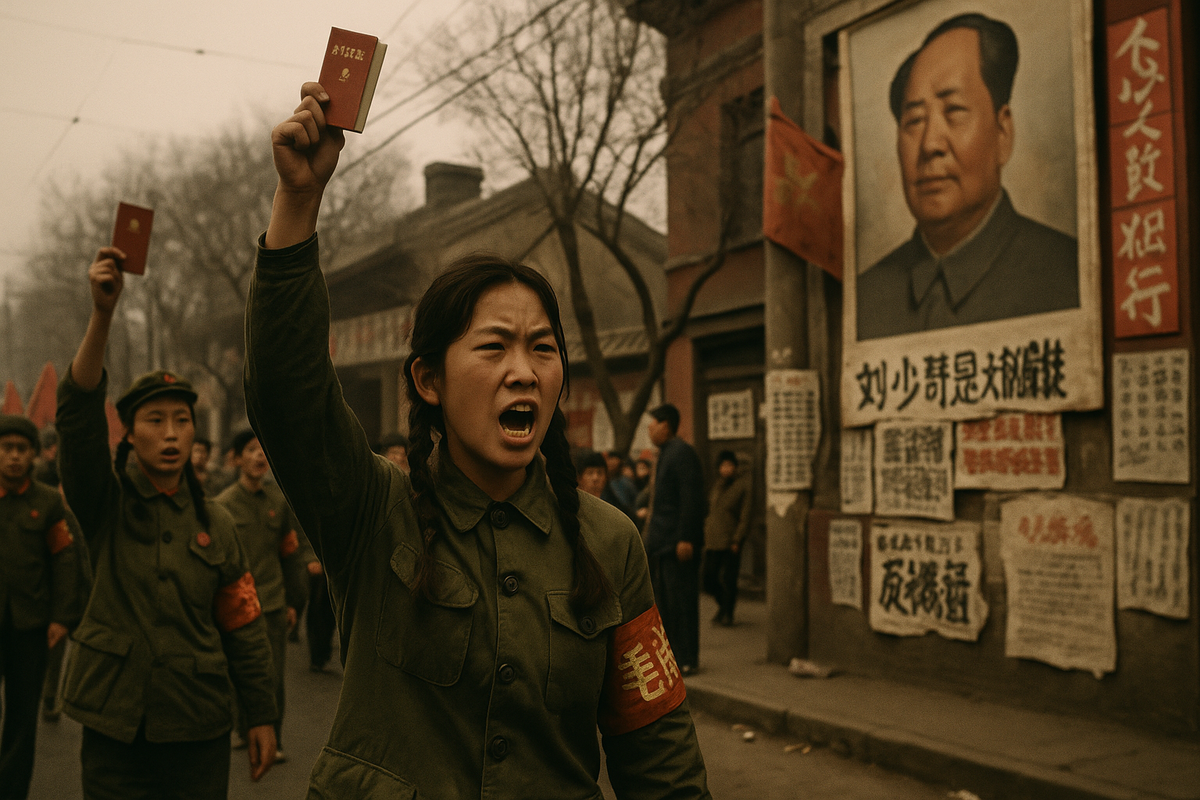
When America Watched China Burn
Time's "Dance of the Scorpion" and the Revolution That Shook the Cold War
The date was January 13, 1967. Across American breakfast tables, commuters unfolded their weekly Time Magazine to find something unsettling: China was devouring itself.
The cover story—"Dance of the Scorpion"—wasn't just reporting. It was a warning shot. Mao Zedong had unleashed millions of teenagers to destroy their own civilization, and Time's correspondents were watching it happen in real time. For a nation already neck-deep in Vietnam and staring down the Soviets, the question wasn't academic: Was the world's most populous Communist power about to implode, or was Mao forging something more dangerous than anyone had imagined?
This issue didn't just report history. It became history.
The Revolution No One Saw Coming
By 1966, Mao had a problem: his own government. The Great Leap Forward had starved millions. His colleagues—pragmatists like President Liu Shao-chi and a rising party operative named Deng Xiaoping—were quietly sidelining him, implementing market reforms that worked but contradicted everything Mao stood for.
His solution was elegant and catastrophic: destroy the system from within.
In August 1966, Mao launched the Great Proletarian Cultural Revolution, summoning China's youth to "smash the Four Olds"—old customs, old habits, old culture, old ideas. He gave them a name: the Red Guards. He gave them a mandate: tear down anyone who stood in the way of revolutionary purity. He gave them a weapon: the Little Red Book, a pocket-sized manifesto of Mao's thoughts that became the most printed book on earth after the Bible.
What followed was bedlam dressed as ideology.
By January 1967—when Time's correspondents filed their dispatches—universities had been shuttered. Teachers were paraded through streets wearing dunce caps. Ancient temples were ransacked. Red Guard factions battled each other in the streets with homemade weapons. And everywhere, everywhere, were the posters: wall-sized denunciations of Liu Shao-chi, Premier Chou En-lai, Deng Xiaoping. Their faces crossed out. Their names synonymous with treason.
Mao's portrait, meanwhile, hung over it all—in classrooms, factories, public squares—watching a nation cannibalize itself in his name.
Archive Details
Publication: Time Magazine
Issue Date: January 13, 1967
Cover Story: "Dance of the Scorpion"
Historical Context: Early months of China's Cultural Revolution
Key Figures: Mao Zedong, Jiang Qing, Lin Piao, Liu Shao-chi, Deng Xiaoping
Time's Lens: Cold War Journalism at Its Peak
Time Magazine in 1967 wasn't just a news weekly. It was the lens through which middle America understood the world. Its editors didn't just report events—they interpreted them, framed them, made them matter.
The "Dance of the Scorpion" feature was journalism as intelligence briefing. Time's correspondents synthesized fragmented reports from a closed society, interviewed refugees streaming out of China, and pieced together a portrait of revolution that most Americans could barely fathom.
The article delivered three things simultaneously:
Vivid Ground Truth
Red Guards crowding trains from Shanghai to Beijing. Schoolchildren chanting against "U.S. imperialists." Propaganda posters transforming entire cities into ideological battlegrounds. This wasn't abstract Marxist theory—it was chaos made visible.
Heroes and Villains
Mao, his wife Jiang Qing (the former actress turned revolutionary zealot), and Defense Minister Lin Piao were lionized as the revolution's holy trinity. Liu Shao-chi, Tao Chu, and Deng Xiaoping were branded enemies of the people, their political careers disintegrating in real time.
Cold War Stakes
Every American reader understood the subtext: if China collapsed into civil war, what happened to the Communist bloc? If Mao consolidated total power, what kind of adversary would emerge? The revolution wasn't just China's problem—it was a geopolitical wildcard.
Time didn't bury the analysis in academic language. The prose was urgent, muscular, designed to make suburban Americans care about factory seizures in Canton and Red Guard rallies in Tiananmen Square.
The Visual Archive: Photography as Historical Evidence
Open this issue today and you're struck by the images: young faces twisted with revolutionary fervor, waving the Little Red Book like a talisman. Mao's face reproduced ten thousand times over. The contrast between the "heroes"—photographed with dramatic lighting, faces set in revolutionary determination—and the "villains," whose images were defaced or absent entirely.
This was visual propaganda about propaganda. Time's editors understood that to explain Mao's revolution, you had to show how it consumed every surface, every wall, every public space in China. The magazine became a kind of museum exhibit, preserving images that Chinese authorities would later try to erase.
The photographs weren't neutral documentation. They were chosen to produce specific reactions in American readers: bewilderment, concern, a sense that ideology unchecked could turn a society inside out. In an era before CNN, before the internet, these images were how most Americans visualized modern China.
They still are.
Why January 13, 1967 Matters Now
For collectors and historians, this issue occupies a unique position: it's not retrospective analysis. It's real-time intelligence from inside a historical rupture.
The Cultural Revolution would rage for another decade. It would destroy countless lives, erase cultural treasures, and traumatize a generation. Deng Xiaoping—vilified in these pages—would survive, return to power, and transform China into an economic superpower. Mao would die in 1976, leaving a legacy so contested that China still hasn't fully reckoned with it.
But in January 1967, none of that had happened yet. Time's correspondents were filing dispatches from the eye of the storm, trying to make sense of events that wouldn't be fully understood for decades.
That immediacy—the not-knowing, the urgency, the attempt to explain the inexplicable—is what makes this issue irreplaceable. It's history before it knew it was history.
The Artifact in Your Hands
Vintage magazines endure because they preserve something books and documentaries cannot: the feeling of living through events as they unfolded. The advertisements, the typeface, the smell of aging paper—all of it anchors you to a specific moment when Americans sat down with their coffee and confronted a world that refused to make sense.
The January 13, 1967 Time Magazine is more than collectible ephemera. It's a primary source. It's a window into how Cold War America processed information. It's evidence of journalism's power to shape how nations understand their rivals.
Hold this issue, and you're holding the moment when the Red Guards filled the streets, when Mao's revolution hung in the balance between triumph and catastrophe, when the world watched and wondered what came next.
Why Collectors Value This Issue
Historical Timing
Published in the early months of the Cultural Revolution, it documents events as they unfolded, not with hindsight. This is journalism from inside the moment.
Cold War Context
It captures the tension of an era when every Communist upheaval was viewed through the lens of global rivalry. Essential reading for understanding American perceptions of China.
Visual Legacy
The stark images of Mao, the Red Guards, and the vilified party leaders remain some of the most iconic portrayals of China's turmoil.
Primary Source Material
For researchers and educators, this issue serves as authentic documentation of how Western media reported on one of the 20th century's most transformative events.
Preserve the Past. Own the Moment.
For collectors, historians, and anyone fascinated by the Cold War's most volatile decade, vintage Time magazines offer unmatched historical depth and visual impact.
Browse Time Magazine CollectionWhether you're building a collection, researching an era, or preserving family history, these magazines are living documents—carrying the raw urgency of the moments they captured.