
The Issue That Refused to Whisper
On New Year's Day 1959, a pocket-sized magazine hit newsstands across America carrying what many wouldn't recognize as revolutionary cargo: twelve photographs of young Black women who refused to apologize for taking up space.
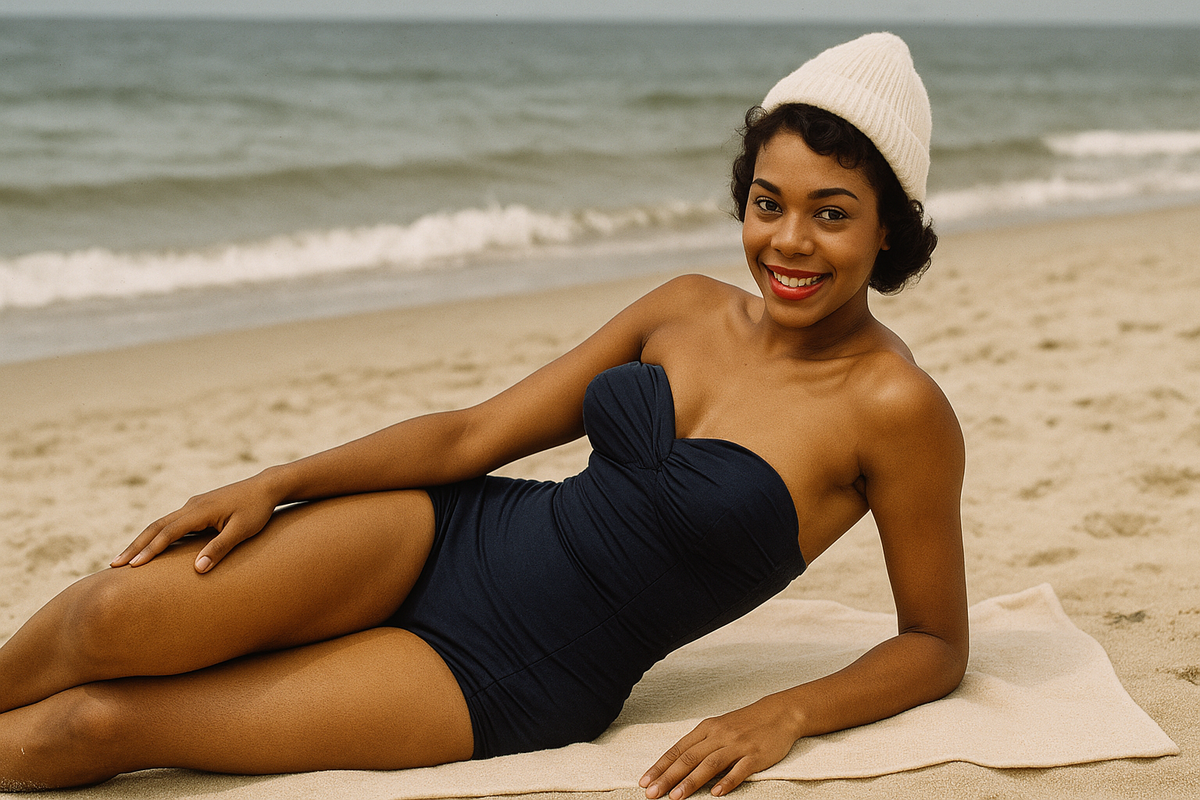
The January 1, 1959 issue of Jet Magazine opened with Eloise Lee—nineteen years old, Chicago-born, draped in a bathing suit and winter cap—reclining across the cover with the kind of ease that suggested she belonged there. Because she did. Inside, eleven more women waited, each assigned a month, each carrying a dual identity the mainstream press couldn't fathom: beautiful and bound for something bigger.
This wasn't accidental. This was architecture.
Archive Details
Publication: Jet Magazine
Issue Date: January 1, 1959
Cover Feature: Eloise Lee, 19, Chicago model and sales clerk
Special Edition: Annual Calendar Pin-Ups (12 women, January–December)
Historical Context: Released one year before the 1960 sit-in movement
Original Price: 20 cents
1959: The Year Before the Decade Caught Fire
The timing matters. When Jet published its 1959 calendar portraits, America stood at an inflection point it didn't yet recognize. The Little Rock Nine had walked through hatred into Central High School barely a year earlier. The sit-in movement that would define 1960 was still gathering in church basements and college dorm rooms. The nation was holding its breath without knowing why.
In this charged atmosphere, Jet did something deceptively simple: it printed images of Black women as objects of admiration rather than service, aspiration rather than subjugation. While beauty pageants across the country enforced color lines with the efficiency of lunch counters, Jet's calendar offered counter-programming. These weren't women asking for permission. They were women announcing arrival.
Each portrait carried a caption that doubled as a manifesto. Not just a name and a smile, but a trajectory: student nurse, loan officer, television broadcaster, artist. The message landed with precision—Black women could inhabit glamour and ambition in the same breath, could be stylish without surrendering seriousness.
The Architecture of Representation
Jet's pocket-sized format—small enough to fold into a purse, cheap enough at twenty cents to circulate through barber shops and beauty salons—made it infrastructure rather than luxury. Publisher John H. Johnson understood that representation required distribution. The magazine moved through Black communities like currency, passed from hand to hand, discussed over kitchen tables and beneath hair dryers.
The editorial formula worked because it refused simplicity. Civil rights coverage sat alongside celebrity profiles. Fashion spreads neighbored investigative journalism. And once a year, the calendar portraits arrived—not as frivolous distraction from serious work, but as extension of it. Visibility itself was serious work in 1959.
Eloise Lee's cover photograph captured this tension perfectly. She reclines, yes, but her gaze meets the camera straight-on. Playful but not performing. Present but not pleading. The composition suggests someone who knows exactly what she's worth and expects you to catch up.
Twelve Months, Twelve Futures
The women Jet selected for 1959 formed a cross-section of Black American ambition at mid-century. Their stories reveal pathways that were opening and barriers that remained.
January brought Agnes Morris, twenty years old and training as a nurse at Chicago's Michael Reese Hospital. Healthcare was becoming a proving ground for Black professional women, and Agnes represented that vanguard.
February featured the cover's Eloise Lee, who worked as a sales clerk while building a modeling portfolio—the double shift familiar to anyone whose dream required a day job.
March showcased Carol Mason, twenty-six, holding down a loan officer position at Detroit's Metropolitan Mortgage Company. In an industry built on gatekeeping and exclusion, Carol's presence was tactical resistance.
April introduced Betty Jean Johnson, a twenty-year-old Wayne State student and former bank employee, proving that business credentials and academic pursuits could compound rather than compete.
May highlighted Yvonne Betts, Philadelphia's "Miss Fire Prevention of 1955," demonstrating how community pageants could launch women into broader recognition without mainstream approval.
June presented Vivian Jackson, just seventeen, a Jamaica, New York high school senior already named Press Photographers Model of 1959. Her youth underscored how early talent could surface when given the slightest opening.
July featured Doris Benoit, twenty, a St. Louis native who'd migrated to Chicago for post office work—embodying the Great Migration's continuing pull and the working-class professionalism that sustained it.
August brought Noble Butler, fresh from Oakland High School and launching into modeling, representing California's emerging role as a center of Black cultural production.
September introduced Sylvia Ebron, a junior at Newark's Arts High School specializing in painting. Her inclusion signaled that creative ambitions deserved equal billing with practical careers.
October showcased Dolores Dent, twenty-four, working in Los Angeles television broadcasting—a foothold in an industry that had spent decades pretending Black women didn't exist.
November featured Barbara Ann Jones, a twenty-year-old Los Angeles college senior preparing for teaching, honoring education as the traditional pathway to Black middle-class stability and community leadership.
December closed with Gloria Johnson, eighteen, working as both secretary and dancer in Chicago. The pairing suggested that ambition didn't require choosing between security and art.
Together, these twelve portraits mapped a geography of possibility. From Newark to Oakland, from hospital wards to television studios, from high school hallways to mortgage offices, Black women were claiming territory.
Why Collectors Pursue This Issue
Historical Threshold
Released at the dawn of 1959, this issue arrived at the threshold of the decade that would reshape American society—one year before the sit-in movement ignited.
Iconic Cover Image
Eloise Lee's photograph remains one of the most recognizable images from Jet's late-1950s run, capturing both glamour and defiance.
Complete Calendar Archive
Contains the full twelve-month calendar series in a single issue, making it a standalone archive of Black women's representation at a pivotal moment.
Material Authenticity
Original copies preserve the paper stock, advertisements, and editorial juxtapositions that digital scans cannot replicate—the reading experience of 1959 intact.
The Long Shadow of a Twenty-Cent Magazine
The Jet calendar portraits of 1959 endure because they documented something that shouldn't have needed documentation but absolutely did: Black women existed as full human beings with interior lives, professional ambitions, and aesthetic presence worth celebrating.
Every name listed, every career goal noted, every city represented sent the same message to readers: you are here, you are seen, you matter. In a media landscape that routinely rendered Black women invisible or reduced them to stereotype, Jet offered correction. Not argument—correction. Here is the truth, in twelve photographs across twelve months.
That these images arrived in a pocket-sized magazine that cost less than a movie ticket made them more powerful, not less. Accessibility was the point. Johnson Publishing understood that representation required reach, and reach required meeting people where they actually lived.
The January 1, 1959 issue of Jet Magazine isn't just a collectible—it's evidence. Evidence that even in the suffocating atmosphere before the 1960s civil rights explosions, Black Americans were building counter-narratives, claiming space, and refusing to wait for permission to be seen.
To hold an original copy today is to touch that refusal. To see Eloise Lee's cover portrait is to meet the gaze of a nineteen-year-old who knew she belonged on that cover, who knew the thousands of readers opening that issue deserved to see themselves reflected back.
Explore the Archive
Whether you collect to preserve family heritage, to study mid-century African American culture, or simply to own a piece of history that mainstream archives overlooked for too long, vintage Jet magazines offer a portal to a moment when visibility itself was victory.
Browse Jet Magazines Collection