
When Britt Ekland Made Transparency Respectable
Vogue's Sheer Revolution of 1970
In May 1970, Britt Ekland stood before Vogue's cameras wearing next to nothing—and it was perfectly acceptable for daytime.
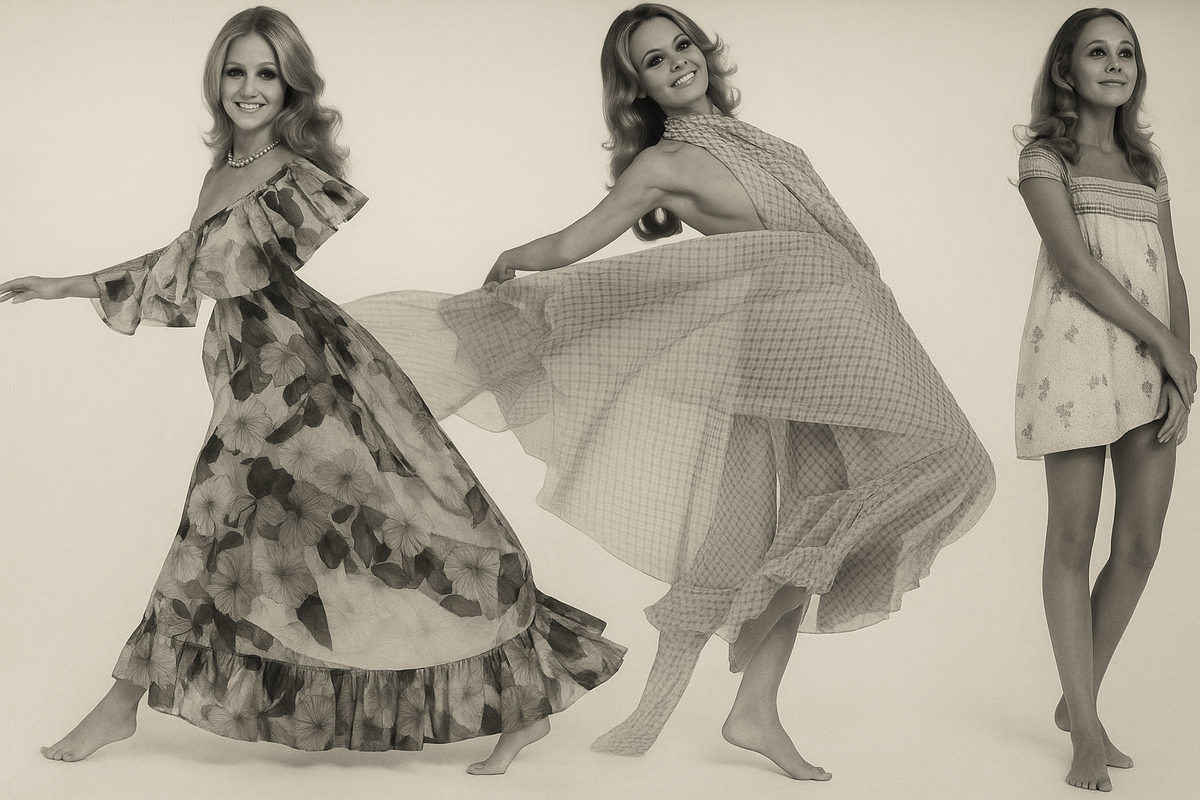
The Swedish actress twirled through the pages of the May 1st issue draped in organza so sheer you could read newsprint through it, chiffon that caught light like soap bubbles, and voile prints that seemed engineered to scandalize an earlier generation. But this wasn't scandal. This was the new normal. Under Diana Vreeland's transformative editorship, Vogue had stopped asking permission and started granting it instead.
The spread—titled "Breezing Through the Prints" and "Breezing Through the See-Throughs"—captured something larger than seasonal trends. It documented the precise moment when fashion stopped being about propriety and became about presence.
Archive Details
Historical Figure: Britt Ekland, Swedish actress and fashion icon
Issue Date: Vogue, May 1, 1970
Archive Source: Original magazine research and documentation
Editor-in-Chief: Diana Vreeland
The Cultural Fracture of 1970
The year 1970 arrived with the 1960s still burning in its rearview mirror. The counterculture hadn't been absorbed yet—it was still raw, still threatening, still in the process of reshaping what mainstream culture would tolerate. Women's liberation wasn't a historical footnote; it was an active confrontation. The Vietnam War filled front pages while second-wave feminism filled consciousness, bringing conversations about autonomy—political, personal, physical—into living rooms and boardrooms alike.
Fashion responded with fabrics that revealed rather than concealed. The sheer revolution wasn't about titillation; it was about visibility. Transparency became a metaphor women could wear.
Britt Ekland, already known for her film career and glamorous persona, became the ideal ambassador for this shift. She wasn't photographed as a static mannequin in couture armor. She was caught mid-motion—swirling, striding, smiling—garments flying around her in soft yet high-contrast frames that suggested energy rather than elegance, youth rather than refinement, freedom rather than form.
This was fashion as verb, not noun.
Vreeland's Vision: Movement Over Monuments
Diana Vreeland understood that Vogue couldn't just document fashion—it had to prophesy it. Her editorial direction pushed the magazine beyond clothing catalogs into cultural commentary, lifestyle manifestos, aspirational blueprints for modern femininity.
The Ekland editorial epitomized this philosophy. Every frame rejected the rigid couture framing of earlier decades. Arms extended. Hair loose and windswept. Skirts suspended mid-air. The photography didn't ask viewers to admire static perfection; it invited them to imagine themselves in motion, unbound by the tailored constraints that had defined respectable dress for generations.
The captions reinforced this liberation, highlighting not just designers and fabrics but "the spirit of movement and joy." Ekland wasn't modeling clothes—she was embodying a way of being.
The Global Wardrobe
The styling pulled from everywhere at once. Flamenco skirts. Voile djellabas evoking North African exoticism. Tassel belts suggesting bohemian wanderlust. Purple, yellow, pink, and green florals exploding across sheer fabrics like spring had been weaponized against winter's austerity.
This wasn't cultural appropriation in the modern sense—it was fashion's enthusiastic ransacking of global aesthetics, filtered through Western commercial infrastructure and sold through American department stores. The editorial referenced Jon Haggins and Onondaga fabric, Nan Duskin and Henri Bendel, Bonwit Teller, Bullock's Wilshire, Lord & Taylor, Stix, Baer & Fuller, Sakowitz, and I. Magnin—retail powerhouses positioned as arbiters of taste for Vogue's increasingly broad readership.
Prices ranged from $25 cotton-polyester dresses to $80 chiffon gowns. This was critical: Vreeland was democratizing style, making high fashion accessible to aspirational readers who couldn't afford couture but could afford to participate in its vision. The magazine was no longer speaking exclusively to elite society women—it was reaching shopgirls and secretaries, college students and young professionals, anyone eager to adopt the visual language of modernity.
Celebrity as Style Oracle
The Ekland spread foreshadowed a fundamental shift in fashion's power structure. For decades, designers had been the primary authors of style; models were beautiful blanks who brought designs to life. But by 1970, celebrities were becoming co-authors, bringing their own glamour and cultural capital to whatever they wore.
Britt Ekland wasn't just a body in beautiful clothes—she was a personality, a film star, a woman whose off-screen life generated headlines. Her presence in Vogue elevated the editorial beyond fashion photography into cultural documentation. She was proof that Hollywood and high fashion were converging, that celebrity would soon become fashion's most powerful currency.
The Essence of 1970
What makes this editorial endure isn't nostalgia—it's recognition. Modern readers see in those floating organza dresses and joyful poses a philosophy that still resonates: fashion as self-expression rather than social compliance, beauty as energy rather than perfection, style as personal freedom rather than prescribed uniform.
Britt Ekland breezing through those see-throughs wasn't just modeling spring fashion. She was demonstrating what visibility looked like when women stopped asking permission to be seen.
Holding an original copy of this issue today is like holding the essence of 1970 itself: light, sheer, joyful, and unapologetically free.
Why Collectors Covet This Issue
Historical Inflection Point
The editorial captures fashion at a precise moment of transformation—when sheer fabrics and bold prints marked a philosophical break from previous decades, when transparency literally and figuratively became respectable.
Vreeland's Editorial Apex
This issue reflects Diana Vreeland's vision at full power, pushing Vogue toward greater experimentation and cultural relevance before her departure in 1971.
Retail Archaeology
The captions documenting department stores and designers serve as primary source material for understanding mid-century American fashion commerce—how styles were distributed, priced, and marketed to different consumer tiers.
Celebrity-Fashion Nexus
Ekland's appearance documents the rising influence of film stars as style arbiters, a trend that would come to dominate fashion media by decade's end.
Feminist Context
Beyond the garments themselves, this editorial embodies the broader cultural conversation about women's autonomy, visibility, and the right to occupy space boldly and unapologetically.
Cultural Artifact
For serious collectors, this isn't just a magazine—it's an artifact of gender politics, consumer culture, and artistic ambition intersecting at a revolutionary moment.
Own a Piece of Fashion History
Original issues from this pivotal year remain available through specialized vintage magazine dealers. These pages preserve more than style—they document the moment when fashion stopped reflecting culture and started reshaping it.
Browse Vogue Magazine Collection