
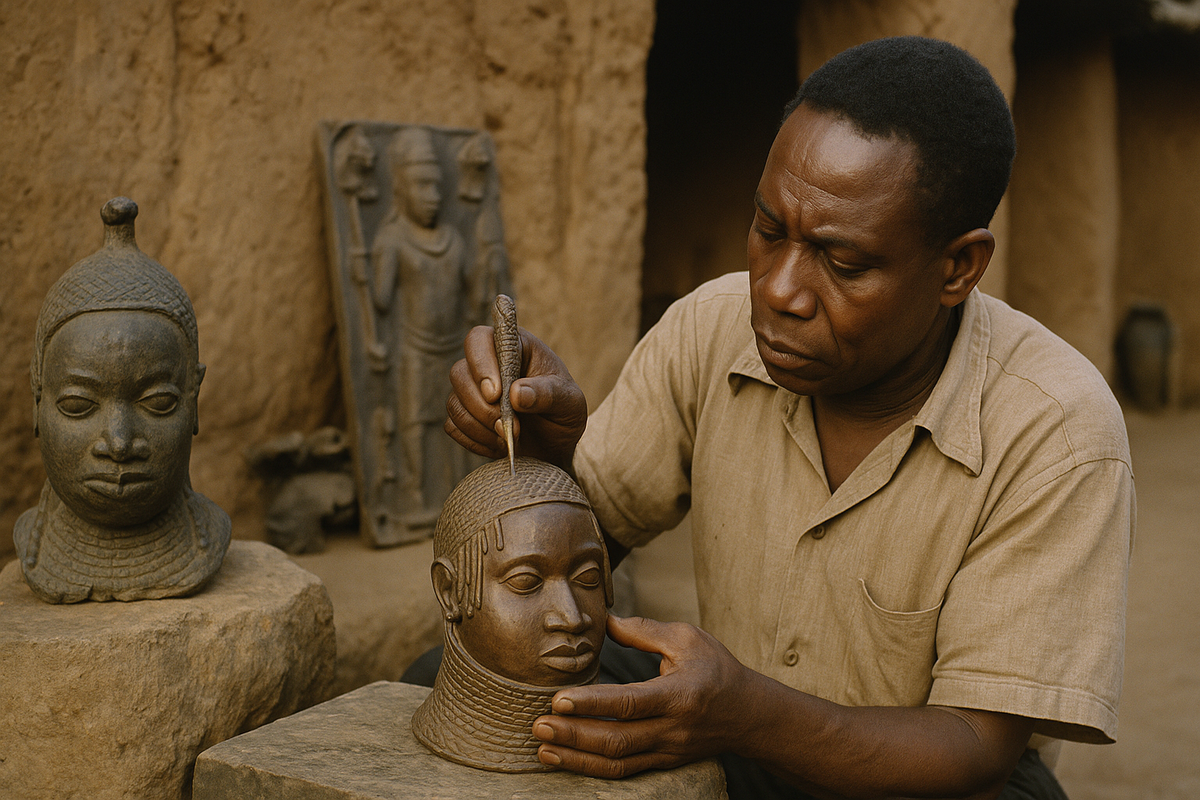
Bronze Legacy of Benin: Art, Power, and the Global Recognition of African Civilization
How Ebony Magazine's February 1963 feature connected civil rights activism to African artistic mastery—and armed readers with cultural truth
In February 1963, while America burned with the urgency of the civil rights movement, Ebony Magazine did something radical: it refused to wait for white institutions to validate Black history.
Between the pages of fashion spreads and political profiles, readers encountered "The Art of Benin" and "Benin Art Ranks With Best; Bronze Casting is Superb"—features that presented African bronzes not as ethnographic curiosities but as masterworks equal to anything produced in Renaissance Florence or ancient Greece. The timing was no accident. As African nations seized independence and African Americans marched for dignity, Ebony connected its readers to a lineage of sophistication that predated colonialism by centuries.
For many who opened that issue, these were the first images of African art they'd seen presented with the reverence reserved for Western masters. In living rooms across Black America, the message arrived with force: your heritage was never primitive. It was stolen, hidden, and misrepresented—but it was always magnificent.
The Kingdom That Europe Tried to Forget
The Kingdom of Benin—centered in what is now Nigeria—operated as a highly organized Edo-speaking state from the 12th through 19th centuries. Its rulers, the Obas, commanded guilds of master craftsmen who produced bronze memorial heads, ivory carvings, ceremonial plaques, and ritual objects that encoded both religious cosmology and political power.
The technical achievement alone demands respect. Benin's artists mastered cire perdue, the lost-wax casting method: sculpting intricate wax models over clay cores, encasing them in clay molds, melting out the wax, then pouring molten bronze into the void. The results—brass heads rendered with precise scarification patterns, amulets bearing symbolic motifs, carved war scenes of astonishing detail—represent a level of craftsmanship that required institutional knowledge, specialized training, and generations of refinement.
Then came 1897. British forces invaded Benin City, razed it, and looted thousands of bronze and ivory works in what they euphemistically termed a "punitive expedition." These treasures were shipped to European museums, where they were displayed as evidence of primitive cultures needing civilizing—a grotesque inversion that turned stolen art into propaganda for the very system that stole it.
By 1963, however, the narrative was collapsing. African independence movements had redrawn the map. Civil rights activists had exposed American hypocrisy. And institutions like the Chicago Natural History Museum—which mounted an exhibition of 329 Benin pieces that year—were beginning to reckon with what these objects actually represented.
Ebony saw the opening and seized it.
Issue Archive Details
Publication: Ebony Magazine
Issue Date: February 1963
Featured Articles: "The Art of Benin" and "Benin Art Ranks With Best; Bronze Casting is Superb"
Exhibition Context: Chicago Natural History Museum's display of 329 Benin pieces
Historical Context: Pre-March on Washington civil rights era; African independence movements
Why Ebony Told the Story Differently
Unlike academic journals or mainstream American magazines, Ebony approached Benin art with a specific mission: to arm its readers with cultural ammunition.
The February 1963 issue featured prominent African statesmen on its cover, signaling Black political leadership on the global stage. Inside, the Benin spread operated on multiple registers. Full-page photographs presented bronze statues and ceremonial objects with museum-quality reproduction. But Ebony went further: it included images of Nigerian craftsmen actively practicing the lost-wax method. One photograph captured Chief Ilhama applying wax strips to a clay core. Another showed molten metal being poured into a mold.
This editorial choice was strategic. Ebony wasn't just documenting dead artifacts in Western museums—it was proving continuity. African artistic traditions weren't relics to be studied; they were living practices carried forward by contemporary masters.
The text reinforced what the images declared. Writers positioned Benin's bronzes alongside the greatest art traditions in human history, citing scholars like Dr. Alain Locke—the Harlem Renaissance philosopher who insisted African art belonged at the center, not the margins, of world civilization. Every sentence pushed back against colonial mythology that had dismissed these works as "tribal crafts."
For Ebony's readers in 1963—many of whom were fighting for the right to attend integrated schools, eat at lunch counters, or vote without terror—the subtext was clear: if your ancestors created this, no one can tell you what you're worth.
What the Art Actually Meant
Ebony didn't just celebrate Benin art aesthetically; it explained its cultural architecture:
This was art produced within a sophisticated state apparatus—one with specialized guilds, patronage systems, and theological frameworks. The Obas didn't commission bronze heads as decoration; they commissioned them as instruments of governance, memory, and divine legitimacy.
The 1897 looting wasn't just theft. It was dismantling the symbolic infrastructure of an entire civilization and scattering it across European museums, where context was stripped away and meaning distorted.
The Civil Rights Context That Made This Issue Essential
In early 1963, America stood at the precipice. The March on Washington was months away. Bull Connor's fire hoses and police dogs would soon appear on television screens. The battle over desegregation was entering its most violent phase.
Ebony's decision to dedicate substantial space to Benin art wasn't escapism—it was groundwork. The magazine understood that the fight for civil rights required more than legal victories; it required cultural reclamation. If African Americans were going to claim full citizenship, they needed to confront and dismantle the foundational lie that their ancestors were primitive, that Africa contributed nothing to human civilization, that Black history began with enslavement.
Other American magazines weren't making this argument. Life, Look, and The Saturday Evening Post rarely treated African culture with serious attention. When they did, it was often through a colonial lens—exotic, distant, fundamentally other.
Ebony operated differently. It blended civil rights reporting with fashion, music, politics, and history, creating an editorial ecosystem where African heritage and African American struggle were inseparable. The Benin feature wasn't a sidebar to the movement—it was ammunition for it.
The Larger Archive
Ebony published from 1945 to 2019, creating an unparalleled chronicle of 20th-century Black life. Each issue captured not just events but the texture of how African Americans understood themselves during periods of transformation: post-war optimism, civil rights battles, Black Power assertions, economic gains, cultural flowering, political setbacks, and enduring resilience.
The February 1963 issue—with its convergence of African art, political leadership, and cultural pride—represents Ebony at its most ambitious. But it's one artifact in a much larger archive.
Why This Issue Matters to Collectors Today
The Enduring Argument
The 1963 Ebony feature on Benin art made an argument that still resonates: African civilization was never waiting to be discovered by Europe. It existed, thrived, and created works of profound beauty and meaning long before colonialism arrived to distort the record.
By placing Benin's bronzes in conversation with the world's acknowledged masterpieces, Ebony didn't just educate its readers—it armed them. It provided historical evidence against the racist mythologies that justified segregation, disenfranchisement, and violence.
Today, as museums worldwide confront the ethics of holding looted artifacts, as nations demand repatriation, as scholars rebuild African art history from colonial distortions, this issue of Ebony stands as proof: Black media was ahead of the curve, telling the truth while others perpetuated lies.
Owning this issue means preserving that truth. It's not nostalgia—it's evidence. Not memorabilia—it's testimony. And in a world still grappling with whose history gets told and who gets to tell it, that testimony remains urgent.
Build Your Archive
From the 1940s through the 1980s, each issue of Ebony tells a story of resilience, creativity, and progress. Holding one in your hands means engaging with history as it was first told.
Browse Ebony Magazine Collection