
The Homosexual in America: When Time Magazine Broke the Silence
How the October 31, 1969 issue brought gay liberation into American living rooms—and changed journalism forever
Four months after patrons of the Stonewall Inn fought back against a police raid in Greenwich Village, Americans opened their mailboxes to find something unprecedented waiting for them.
The October 31, 1969 issue of Time Magazine arrived in millions of homes that week carrying a feature that would have been unthinkable just a year earlier: "The Homosexual in America: Newly Visible, Newly Understood." For the first time, one of the nation's most powerful media institutions was treating homosexuality not as gossip, scandal, or psychiatric curiosity—but as a social force demanding serious attention.
The timing was no accident. The ground was shifting beneath American culture, and Time's editors understood they were documenting a rupture.
The Perfect Storm
By late 1969, the civil rights movement had rewritten federal law. The antiwar movement had driven a sitting president from office. The women's liberation movement was challenging every assumption about gender and power. Into this cauldron of social upheaval came another demand for recognition: gay liberation.
The Stonewall uprising that June had announced a new era. When police raided the Stonewall Inn on June 28, expecting the usual scene of frightened patrons slipping out back doors, they encountered resistance instead. For several nights, protesters clashed with officers in the streets of Greenwich Village. From that defiance emerged the Gay Liberation Front and a network of activist organizations modeling themselves on the Black Panthers and radical feminists.
Time's coverage arrived as this movement was still finding its voice—raw, urgent, and impossible to ignore.
Archive Details
Publication: Time Magazine
Issue Date: October 31, 1969
Feature Title: "The Homosexual in America: Newly Visible, Newly Understood"
Historical Context: Published four months after the Stonewall uprising (June 28, 1969)
Archive Classification: Social History • LGBTQ+ Documentation • Media Milestone
What Readers Saw
Time had built its reputation on distilling complexity into sharp prose and striking visuals. The October 31 issue delivered both.
The homosexual feature spanned multiple pages, combining data from Alfred Kinsey's landmark studies with street-level reporting from New York and San Francisco. Readers encountered:
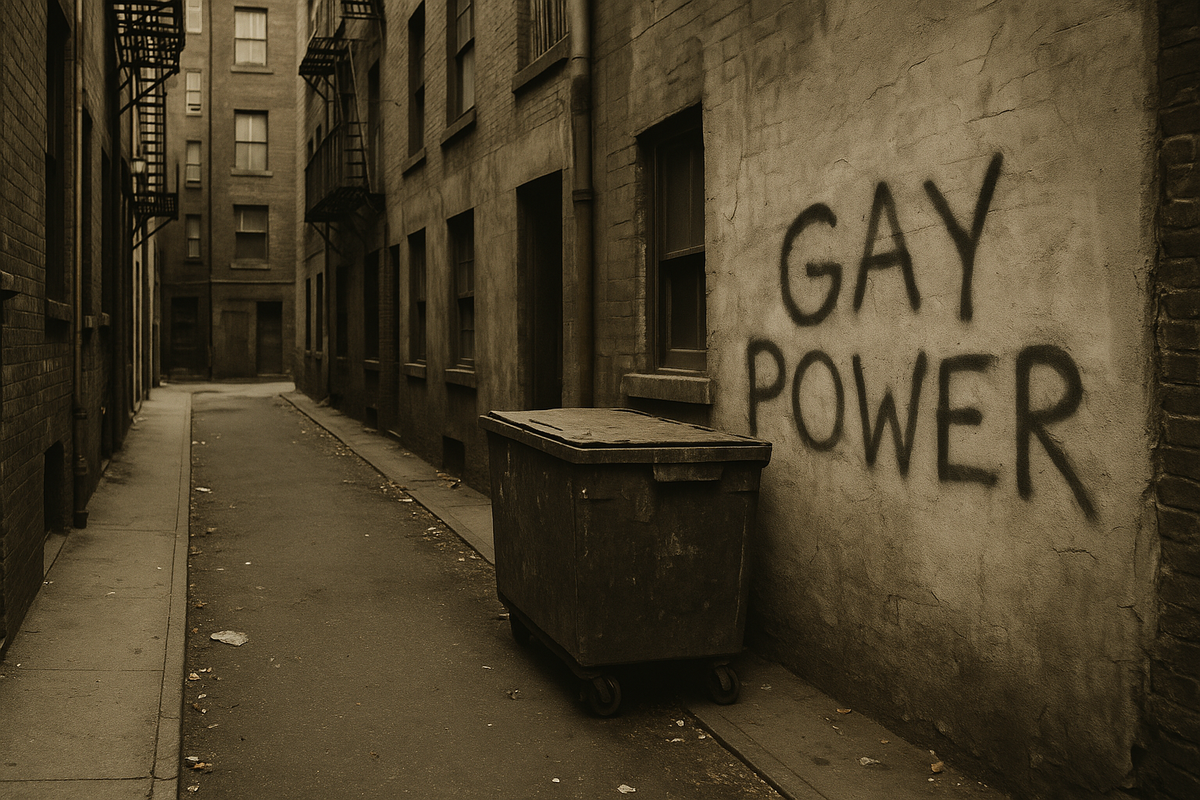
Protest documentation—photographs of picketers in Manhattan holding signs demanding "Gay Power," evidence that this was no longer a hidden population but an organized political force.
A hidden world revealed—images from inside San Francisco gay bars showed men gathered to watch classic films, suggesting a cultural life that had existed in shadow for decades.
Individual testimonies—the "Four Lives in the Gay World" section profiled men and women navigating careers, families, and relationships in a society that criminalized their existence.
For Americans who had never knowingly encountered a homosexual person, these pages represented a revelation. Time was not trafficking in rumor or stereotype. It was presenting faces, voices, and documentary evidence.
The magazine's visual journalism—refined over decades of war photography and political coverage—brought the same technique to gay liberation that it had brought to civil rights marches and Vietnam battlefields. The effect was to make the abstract concrete, the invisible visible.
The Editorial Tightrope
The cover of the October 31 issue did not feature the homosexual story. The subject remained too volatile for front-page treatment. But inside, Time devoted unprecedented space to the topic, using bold subheads and full-page photography to signal its significance.
The editorial voice walked a careful line. This was not advocacy journalism. Time still described homosexuality through the lens of psychiatry and social pathology, reflecting a medical establishment that would not declassify homosexuality as a mental disorder until 1973. Terms like "deviance" and clinical assessments of "promiscuity" appeared throughout.
Yet the magazine also granted legitimacy simply through attention. By treating gay liberation as part of the American story—worthy of analysis, documentation, and serious reporting—Time performed a journalistic act that carried political weight whether its editors intended it or not.
What the Article Revealed
Political Mobilization
Time noted the emergence of homosexual organizations borrowing tactics from civil rights and feminist movements, signaling that this was not a cultural fad but a sustained campaign for legal recognition.
Geographic Scope
From New York to San Francisco, the article mapped a nationwide network of gay bars, community centers, and activist groups, demolishing the fiction that homosexuality was confined to coastal enclaves.
The Cost of Secrecy
Personal accounts revealed the psychological toll of living in hiding: lost jobs, severed family ties, constant fear of exposure. Even as Time indulged in pathologizing language, these testimonies exposed the real pathology—a society that forced millions into invisibility.
Generational Defiance
The article captured a generational split, with younger gay men and lesbians rejecting the accommodationist strategies of earlier homophile organizations in favor of confrontational visibility.
Together, these elements constructed a narrative that could not be walked back: homosexuals were claiming public space, demanding legal protections, and refusing to disappear.
The Power of the Permanent Record
Time succeeded as a publication precisely because it functioned as a time capsule. Each issue froze a moment in history—its anxieties, its language, its blind spots, and its breakthroughs—in a form that could be studied decades later.
In an era when digital news evaporates within hours, vintage magazines offer something increasingly rare: permanence. They are not just historical documents. They are witnesses.
Why This Issue Matters to Collectors
The October 31, 1969 Time Magazine occupies a singular place in 20th-century publishing history.
Historical Proximity
Published only four months after Stonewall, it represents one of the first national attempts to assess gay liberation as it was unfolding, capturing the movement before it had solidified into institutional memory.
Visual Documentation
The photographs provide rare archival evidence of LGBTQ+ life in the late 1960s, preserving images of protest signs, community spaces, and individual faces that might otherwise have been lost.
Cultural Artifact
This issue marks the moment when mainstream media could no longer treat homosexuality as either unspeakable or purely prurient. It is a threshold document, separating the era of silence from the era of visibility.
Market Demand
Like other watershed Time issues—the integration of Little Rock, the fall of Saigon, Watergate—this edition commands serious interest from collectors of social history and LGBTQ+ archival material.
To hold an original copy is to hold physical evidence of a cultural inflection point, preserved in ink and paper.
Explore the Archive
Our collection houses thousands of original Time magazines spanning the 1920s through the 1970s, tracing the full arc of American cultural and political transformation as it happened.
Browse Time Magazine CollectionWhether you collect for historical research, cultural preservation, or personal connection to the struggles that shaped the present, these issues offer direct access to history in its raw, unrevised form.
A Document That Refuses to Fade
The October 31, 1969 issue of Time Magazine stands as one of the most consequential pieces of social journalism published in the 20th century. Its coverage of homosexuality—conflicted, imperfect, yet groundbreaking—delivered both information and legitimacy to millions of American readers at the precise moment when silence was becoming impossible to maintain.
More than fifty years later, this issue remains a testament to the power of visibility. It captured the instant when a marginalized community stopped asking for tolerance and started demanding recognition. Through Time's pages, that demand entered the American mainstream and never left.
For collectors and historians alike, this magazine is not simply paper and ink. It is a preserved fragment of the moment when the closet door began to open—and stay open.