
Original Magazines • Archive Series
Buddhism, the Dalai Lama, and the Crisis of Tibet in 1959
How Time Magazine Introduced America to a Young Spiritual Leader's Flight into Exile—and a 1,500-Year-Old Civilization Fighting for Survival
When Americans picked up the April 20, 1959 issue of Time Magazine, they encountered a story that fused religion, politics, and Cold War tension into one of the decade's most dramatic narratives. The article, titled "Buddhism—The Dalai Lama's Faith," hit newsstands as the Tibetan uprising against Chinese Communist control collapsed and the Dalai Lama fled into exile in India. For Western readers, this was no distant abstraction. It was a front-row seat to the collision between ancient faith, modern geopolitics, and a civilization fighting for survival.
Archive Details
- Historical Figure
- The 14th Dalai Lama (Tenzin Gyatso)
- Issue Date
- April 20, 1959
- Publication
- Time Magazine
- Archive Source
- Original Magazines Collection
The World in 1959: Cold War Reaches the Roof of the World
The late 1950s saw ideological rivalries spread to unexpected corners of the globe, and few places were stranger than the Himalayas. After China's Communist takeover in 1949, Tibet—long semi-independent—faced mounting pressure from Beijing. By 1951, Tibet had signed the "Seventeen Point Agreement" with the People's Republic of China, acknowledging Chinese sovereignty while retaining local authority under the 14th Dalai Lama.
By 1959, that arrangement had fractured. Chinese military presence expanded. Tibetan traditions faced suppression. Whispers of resistance spread through Lhasa. In March 1959, Tibetans revolted against Chinese authority. The uprising failed. Thousands died. The Dalai Lama, just 23 years old, fled across the Himalayas into India, beginning a lifelong exile that continues to this day.
Time's coverage placed this upheaval into global perspective. Americans, accustomed to hearing about Soviet and Chinese maneuvers in Europe or Korea, now witnessed how the Cold War was reshaping one of the most remote yet symbolically powerful regions on Earth.
Buddhism Explained to Middle America
The Time article served as a primer on Buddhism, emphasizing how central the faith was to Tibetan identity. For readers unfamiliar with Asia's spiritual traditions, the magazine explained that Buddhism claimed some 500 million followers across Asia, from Sri Lanka and Burma to Mongolia, Japan, and Tibet.
The article contrasted Hinayana (Theravāda) and Mahayana Buddhism, highlighting the uniquely Tibetan tradition of the Lamaism system, in which the Dalai Lama was revered as both spiritual leader and political ruler. He was presented as a "Living Buddha," the reincarnation of his predecessors, embodying both divine wisdom and temporal authority.
Time also explored Tibetan society: its monasteries, chanting monks, sacred rituals, and isolation from much of the modern world. For many Western readers, this was their first serious introduction to the mysticism and political significance of Tibetan Buddhism.
By embedding this spiritual explanation within the political crisis, Time helped its audience understand that Tibet's resistance to Chinese rule was not simply nationalism. It was a defense of a 1,500-year-old religious civilization.
How Time Told the Story
Time's editorial style in the 1950s blended journalistic rigor with sweeping narrative, making even faraway events vivid and immediate. This issue exemplified that approach.
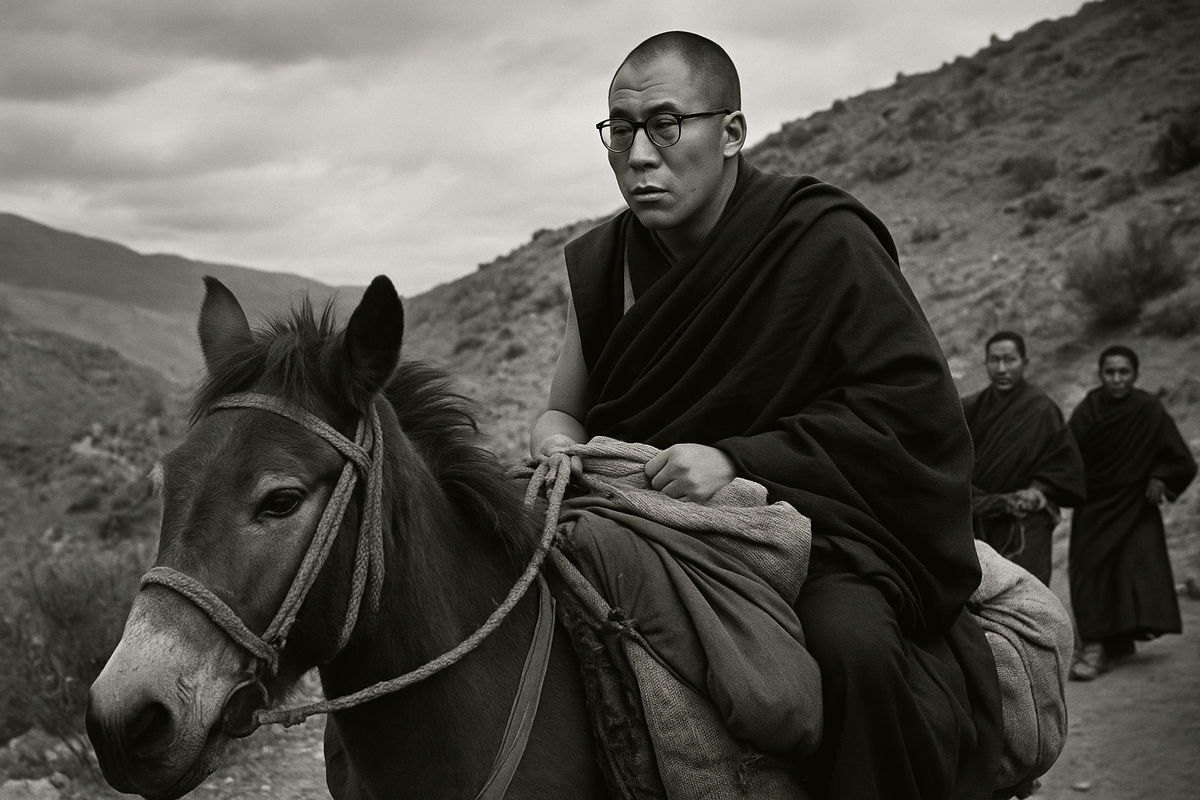
Photography and Maps. The spread included dramatic images—the Dalai Lama's peasant family, Tibetan monks in flight, maps illustrating the escape route into India. These visuals made the crisis tangible for readers who had never seen Tibet.
Narrative Voice. Time wrote with a mixture of authority and drama. The article was not merely news; it was storytelling on a global stage, turning geopolitics into human drama.
Cultural Commentary. The issue did not simply report events—it contextualized them, explaining what Buddhism was, why the Dalai Lama mattered, and why Tibet's fate resonated across the Cold War world.
In an age before the internet or televised international news, Time Magazine served as a bridge between Americans and global struggles they might otherwise never have witnessed.
Key Themes From the April 20, 1959 Issue
Buddhism as Civilization
Time explained how Buddhism, with its emphasis on compassion and renunciation of desire, shaped entire cultures, and why Tibet's unique Lamaist practices were inseparable from its national identity.
The Dalai Lama's Exile
The story emphasized the young leader's escape into India, portraying him as both a victim of Chinese aggression and a symbol of spiritual endurance.
Cold War Implications
The crisis was framed as part of the global East-West rivalry. The Chinese crackdown in Tibet was not just local suppression but a move in the broader contest of Communist expansion.
Maps and Imagery
By showing "Buddha's Hold" across Asia and the Dalai Lama's escape route, the issue reminded readers that religion, geography, and politics were deeply entangled.
Collector Significance
Historical Significance
This issue documents the Dalai Lama's flight into exile—a turning point that continues to shape Tibet-China relations and global human rights debates more than six decades later.
Religious Importance
It stands as one of the first mainstream American accounts to explain Tibetan Buddhism to a wide audience, bridging Eastern spirituality and Western understanding.
Cold War Context
The issue serves as a vivid reminder of how even the most remote struggles became part of the ideological contest that defined the 20th century.
Collector Demand
Vintage Time magazines covering major global crises—whether World War II, the Cold War, or cultural upheavals—remain among the most sought-after items for history enthusiasts and archivists.
Why Vintage Magazines Matter
Vintage magazines are time capsules. They do not merely record events; they reveal how those events were framed, debated, and understood at the moment they happened. Unlike modern hindsight, these pages carry the urgency and uncertainty of their time.
For those fascinated by Cold War history, Asian religion, or the life of the Dalai Lama, this issue is more than paper. It is a living artifact of 1959's shifting world order.
Owning this issue means holding a primary source artifact that captured how Americans first understood Tibet's tragedy.
Today, holding this issue means holding the story of a young spiritual leader who fled into exile but carried his people's faith onto the world stage. It also means holding a snapshot of how Americans first learned about Tibet's fight for survival. For anyone passionate about history, culture, or collecting, this issue is an essential artifact—a reminder that magazines are not just journalism but pieces of history themselves.
Explore the Collection
If this issue speaks to you, thousands more await—spanning decades of history. From the Great Depression to the Space Race, these magazines offer a singular window into the past.
Browse Time Magazine Collection