
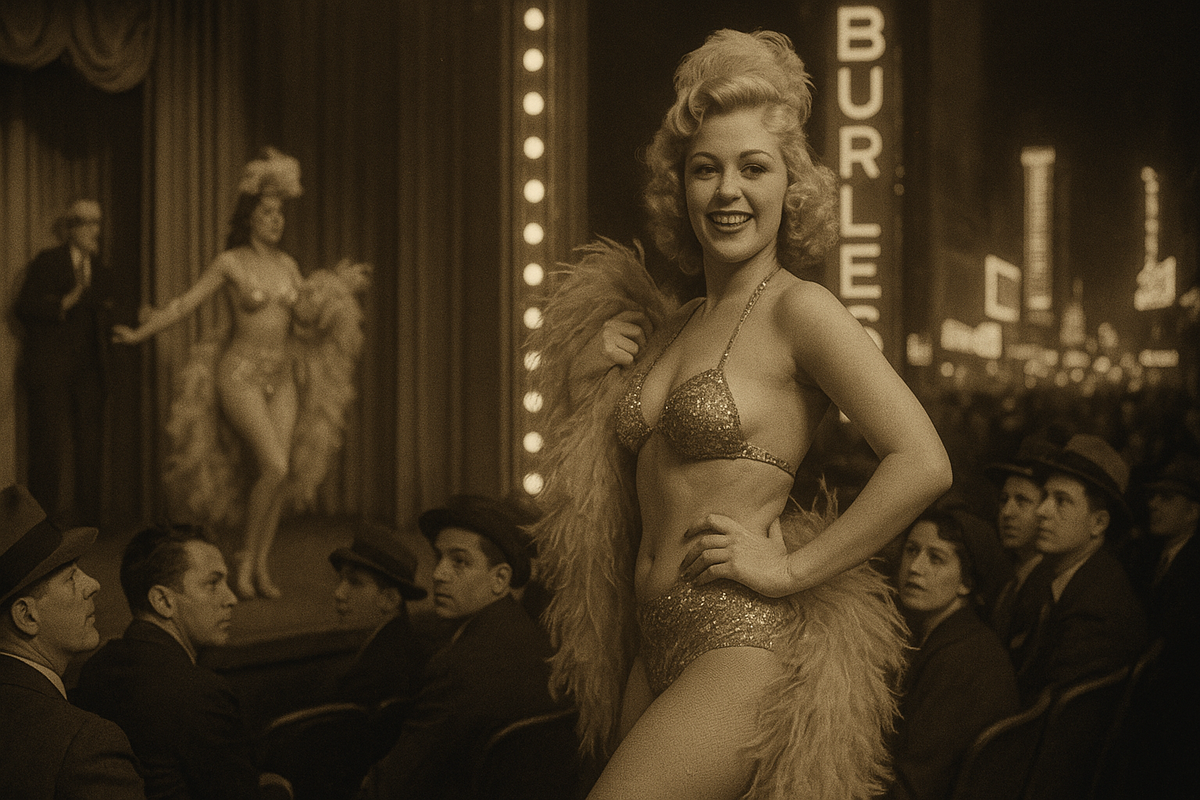
The Night Broadway Fought Back
Inside The New Yorker's 1932 Portrait of Burlesque at War
On May 28, 1932, beneath Julian de Miskey's cover of a woman daydreaming over European travel posters, The New Yorker smuggled something dangerous into America's living rooms: a defense of burlesque.
Not a loud defense. The magazine never shouted. But in its feature "A Tour of Minskyville," it turned its spotlight on the Times Square theaters where reformers saw corruption and audiences saw survival—and refused to choose a side. Instead, it did something more subversive: it made the entire moral panic look faintly ridiculous.
For readers in 1932, this wasn't just entertainment coverage. It was a map of American contradictions, drawn in ink that was half journalism, half satire. And it arrived at the exact moment the country needed to laugh at its own hypocrisy.
When America Was Broken
Spring 1932 remains one of the cruelest seasons in American economic history. Unemployment had clawed past 25%. Banks collapsed weekly. Breadlines snaked through Manhattan neighborhoods while politicians prepared for the November election that would sweep Franklin Roosevelt into power on promises of a New Deal.
Yet every night, the burlesque houses filled.
The Minsky brothers—led by the shrewd Billy Minsky—ran a theater empire that reformers considered a civic menace and audiences considered salvation. For pocket change, working-class New Yorkers could buy two hours of laughter, music, and the kind of risqué comedy that made License Commissioners draft angry letters. Critics charged the shows with corrupting public decency. Defenders called them democratic art for desperate times.
The New Yorker walked into this war zone with a reporter's notebook and a satirist's eye.
Archive Details
Issue Date: May 28, 1932
Cover Artist: Julian de Miskey
Featured Article: "A Tour of Minskyville" (Reporter at Large)
Historical Context: Great Depression, peak unemployment 25%, presidential election year
Cultural Figures: Billy Minsky and the Minsky Brothers theater empire
How to Cover a Scandal Without Taking Sides
By 1932, The New Yorker had already established its signature move: observe modern life with enough irony to expose absurdity, but enough sophistication to avoid cheap moralizing. It didn't traffic in exposés or crusades. It offered something rarer—perspective.
"A Tour of Minskyville" exemplified this approach. The piece described the theaters as both seedy and essential, painted Billy Minsky as both pragmatist and provocateur, and treated reform campaigns as theater of a different kind. The farce wasn't burlesque itself. The farce was the fight over burlesque—civic groups versus showmen, propriety versus survival, all performed nightly under Broadway lights.
The magazine never told readers what to think. It simply showed them the comedy in everyone trying to control what counted as culture.
A Cover That Knew Exactly What It Was Doing
De Miskey's cover deserves closer attention. A stylish woman surrounded by colorful European travel posters—Biarritz, Venice, the Mediterranean. On first glance: aspirational, cosmopolitan, charming.
In the middle of the Depression: quietly brutal.
Most Americans couldn't afford rent, let alone a Mediterranean cruise. The cover wasn't ignorant of this fact. It was aware of it. That awareness created the undertone—a visual wink at the gap between fantasy and reality, between the life The New Yorker depicted and the life its readers actually lived.
Inside, the magazine doubled down on this tension. Advertisements promised transatlantic phone calls ("Betty telephones us from Paris now and then"), Saratoga mineral water, perfumes, European getaways. Meanwhile, essays and cartoons captured a city where people queued for soup.
John Reehill's cartoon showed a doctor scolding a patient: "Are you going to take your medicine, or muss I pank you?" Pure New Yorker—making the everyday absurd through understatement alone.
The luxury ads weren't contradictions. They were part of the story. The New Yorker was documenting how Americans lived in two simultaneous realities: hardship and the performance of normalcy, despair and the machinery of aspiration.
What "Minskyville" Actually Said
The feature didn't just profile theaters. It dissected a cultural battleground.
Burlesque as Democracy
For coins, working men and women bought laughter when laughter was scarce. The shows were crude, yes—but they were accessible. High art might uplift the soul, but it cost too much. Burlesque was the entertainment you could afford on a Thursday when your wages barely covered Friday.
Reformers as Comedy
Civic groups and the License Commissioner waged repeated campaigns to shutter the Minsky theaters, charging them with moral corruption. The article treated these crusades with bemused respect—serious in intent, absurd in execution. Every shutdown threat became a publicity boost.
Minsky as Pragmatist
The piece portrayed Billy Minsky not as villain or hero but as businessman-showman, someone who understood his audience and delivered what they needed: distraction, spectacle, release. He wasn't corrupting America. He was reading it.
Burlesque as Mirror
Ultimately, the feature suggested that these theaters reflected something larger—Depression-era anxieties about class, morality, and who got to decide what constituted art. The battle over burlesque was never really about striptease. It was about control.
The New Yorker captured all of this without once raising its voice.
Why Vintage Magazines Endure
Digital media evaporates. Vintage magazines accumulate weight.
Each issue of The New Yorker functioned as literature, journalism, and art simultaneously. The covers were gallery-worthy. The essays were crafted for permanence. The cartoons distilled American life into single images that still resonate nearly a century later.
The May 28, 1932 issue proved that humor doesn't require optimism. It requires honesty. The New Yorker looked at a country in collapse, at theaters full of desperate people laughing at crude jokes, at reformers crusading against entertainment they couldn't control—and found the story worth telling with intelligence and wit.
These magazines weren't built to be disposable. They were built to be kept, reread, and eventually rediscovered by people who understand that the past isn't dead. It's just waiting in archives, ready to speak again.
Why This Issue Matters to Collectors
Timing
Published at the Depression's lowest point, it documents how New Yorkers balanced catastrophe with spectacle, moral panic with pragmatic survival.
Visual Distinction
De Miskey's travel poster cover ranks among the most striking designs of the early 1930s—colorful, knowing, layered with irony.
Archival Value
"A Tour of Minskyville" offers one of the few contemporary journalistic profiles of burlesque theater before its eventual suppression. Cultural historians cite this feature specifically.
Primary Sources
The original illustrations and ads function as primary sources for understanding Depression-era consumer culture, aspiration, and humor.
Scarcity
Early 1930s New Yorker issues survive in diminishing numbers. High-quality copies command increasing attention from collectors who understand these weren't just periodicals—they were cultural artifacts.
Cultural Weight
Owning this issue means preserving a specific argument: that even when America fractured, satire and sophistication remained tools for understanding—and surviving—the wreckage.
Explore the Collection
If the May 28, 1932 issue intrigues you, the archive runs deeper.
Browse The New Yorker Magazine CollectionFrom the burlesque battles of the 1930s to decades of cultural criticism, satire, and visual art, The New Yorker documented nearly a century of American contradiction with unmatched sophistication.
Holding 1932 in Your Hands
The May 28, 1932 New Yorker remains one of the sharpest portraits of Depression-era culture ever printed. With De Miskey's knowing cover, understated cartoons, glamorous advertisements, and the sardonic feature "A Tour of Minskyville," it captured a city suspended between disaster and defiance, censorship and laughter.
For collectors today, it isn't just a magazine. It's a statement: that even in America's hardest years, people filled theaters, fought over meaning, and refused to stop performing.
Hold this issue and you hold 1932 itself—the humor, the anger, the resilience, and the absurdity of a nation that somehow kept laughing while the world burned.