
The Champion Before the Name
March 1963. America stood at a crossroads it didn't yet recognize. In Birmingham, fire hoses would soon blast protesters into national consciousness. In Washington, a minister's dream would echo from the Lincoln Memorial. And in the pages of Ebony magazine, a 21-year-old fighter with a gold medal and an outsized mouth was announcing himself as something the sporting world had never seen.
His name was Cassius Marcellus Clay Jr., and he was about to vanish.
Within a year, that name would be gone—replaced by Muhammad Ali, a title that would carry the weight of religion, resistance, and revolution. But in March 1963, Ebony captured him in the final moments of his first identity: brash, brilliant, beloved, and still speaking in the voice his mother gave him. The feature, titled "Biggest Mouth in Boxing," preserved something no one knew was disappearing—the Louisville kid before the world changed him, and before he changed the world.
Archive Details
Historical Figure: Cassius Marcellus Clay Jr. (Muhammad Ali)
Issue Date: March 1963
Archive Source: Ebony Magazine
Feature Title: "Biggest Mouth in Boxing"
Journalist: Alex Poinsett
The Magazine That Understood the Moment
Ebony in 1963 wasn't merely documenting Black life in America. It was asserting it, celebrating it, and refusing to let it be filtered through white editorial pages that too often rendered African Americans invisible or inferior. Founded in 1945 by John H. Johnson, the magazine blended Hollywood glamour with serious civil rights reporting, creating a space where Black achievement needed no qualification or apology.
The March issue put singer Shirley Bassey on the cover, celebrating her international stardom. But inside, journalist Alex Poinsett delivered something that would outlast any entertainment profile: a full-spectrum portrait of Clay at the moment before metamorphosis.
The Poetry and the Punch
Poinsett captured what made Clay electric. The young fighter didn't just predict victories—he rhymed them into existence:
"If I say an eagle dips snuff, look under his wing and get the can."
This wasn't showmanship borrowed from wrestling promoters. This was verbal combat refined in Louisville barbershops and Louisville streets, where a Black kid learned early that words could be armor, weapon, and spotlight all at once. Clay understood that in a nation that preferred its Black athletes silent and grateful, noise was power.
At breakfast, he stirred cream into his coffee and cracked: "I don't want to drink it black. Think I'll have my coffee with cream. I want to integrate my coffee."
The joke landed differently in 1963 than it would today. Ebony's readers didn't need footnotes. They lived in the America Clay was mocking—the one where lunch counters still turned away Black customers, where hotels wouldn't rent him rooms, where being the Olympic gold medalist didn't make you welcome everywhere. His humor wasn't entertainment. It was defiance dressed in charm.
The Visual Archive: Beyond the Ring
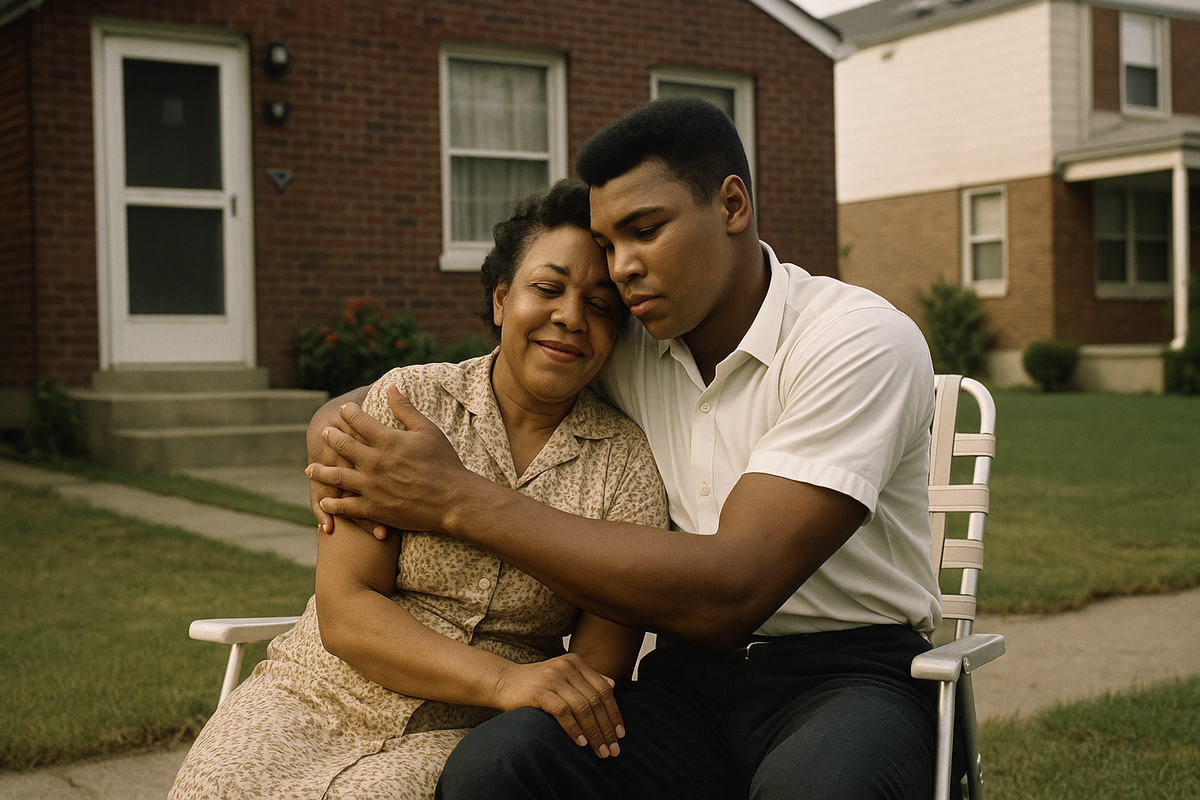
The photographs scattered through the article built a portrait far richer than any sports page could contain. Action shots showed Clay destroying Archie Moore, his fists blurred with speed. But Ebony gave equal weight to other images: Clay in his USA Olympic jacket at the Roman Colosseum, a victor claiming ancient ground. Clay with his parents in front of their $17,000 Louisville home—a detail that spoke to Black middle-class aspiration. Clay embracing his mother, whom he called "my little bird," revealing tenderness beneath the bravado. Clay mobbed by neighborhood children, already a hero on his own block.
These weren't supplementary images. They were the story Ebony chose to tell: that a champion came from somewhere, belonged to someone, and represented a community that had been waiting for exactly this voice.
The Business of Being Cassius Clay
Buried in the profile was a detail that would prove as revolutionary as his footwork: Clay had negotiated an unusual contract through attorney Alberta Jones that guaranteed him control of his earnings. In an era when fighters routinely lost fortunes to managers and promoters, when athletes were treated as commodities rather than partners, Clay was already building the infrastructure of independence.
He spoke of multimillion-dollar projects—housing developments for African Americans, roller rinks, community investment. Critics dismissed this as fantasy. They underestimated him twice: once as a fighter who talked too much, and again as a businessman who understood that wealth meant leverage, and leverage meant freedom.
The Skeptics and the Prophecy
The article captured the split opinion surrounding Clay. Trainers questioned whether he had the knockout power to match his mouth. Promoters debated whether his antics would translate to ticket sales. Sonny Liston, the terrifying heavyweight champion, loomed as the ultimate test—and Clay was already predicting he'd stop Liston in eight rounds.
He was wrong about the rounds. He stopped Liston in seven.
But in March 1963, that fight was still eleven months away. Clay was still unproven against the best. What Ebony captured was the audacity of someone who could see his own future with such clarity that he made doubters seem foolish for doubting.
Why 1963 Mattered
The timing of this issue cannot be overstated. In April, Martin Luther King Jr. would write his Letter from Birmingham Jail, arguing that Black Americans had waited long enough for rights that should never have been delayed. In August, the March on Washington would gather 250,000 people demanding freedom now. The mood in Black America was shifting from patience to insistence, from appeals to demands.
Clay's voice matched that shift. He wasn't asking for respect. He was announcing it. He wasn't requesting a title shot. He was declaring his destiny. For Ebony's readers, this wasn't arrogance—it was alignment. Clay sounded like the future they were fighting for.
Deep Dive: Ten Insights from the Archive
Pre-Ali Identity
The final major profile before Clay became Muhammad Ali, capturing his original voice and Louisville roots.
Poetic Prophecy
Clay's rhyming predictions and verbal brilliance, predicting he'd stop Sonny Liston in eight rounds.
Visual Narrative
Photographs spanning Olympic glory, family life, community hero status, and private moments of tenderness.
Business Acumen
Attorney Alberta Jones negotiated Clay's unusual contract guaranteeing earnings control—revolutionary for athletes.
Racial Commentary
Clay's humor about integrating his coffee revealed awareness of segregation and defiance through wit.
Community Investment
Plans for housing developments, roller rinks, and African American community projects showcased long-term vision.
Family Foundation
Images of Clay with his parents at their $17,000 home and embracing his mother "my little bird."
Media Mastery
Clay understood that in 1963 America, noise was power for a Black athlete demanding to be seen.
Civil Rights Context
Published months before the March on Washington, reflecting Black America's shift from patience to insistence.
Ebony's Mission
Demonstrated the magazine's unique role: elevating sports beyond scores and treating Black celebrities as whole people.
The Collector's Case
Historical Rarity
The pre-Ali snapshot—the last full profile before the name change, before the Nation of Islam, before Vietnam, before exile, before the mythology hardened into legend.
Media Scholarship
Primary source material demonstrating Ebony's unique role in elevating Black sports beyond scores and connecting athletic achievement to cultural struggle.
Boxing History
Contains quotes and images of Ali's early career unavailable elsewhere, including predictions about the Liston fight eleven months before it happened.
Civil Rights Archive
A tangible artifact from the pivot year of the civil rights movement, published between Birmingham and the March on Washington.
Cultural Heritage
Documents how Black media covered Black excellence when mainstream publications ignored or marginalized African American achievement.
Irreplaceable Evidence
As firsthand witnesses pass away and surviving copies dwindle, these issues become increasingly irreplaceable as evidence of vanished moments.
Experience the Archive
The March 1963 Ebony isn't reading material. It's evidence. Evidence of who Cassius Clay was before the world knew who Muhammad Ali would become.
Browse the full collection of original Ebony magazines, spanning from the 1940s through the 1980s, and trace the decades through the pages that refused to let those stories disappear.
Browse Ebony Magazine Collection