
The Plight of the U.S. Patient
When Time Magazine Exposed the Fracture Lines of American Medicine
On February 21, 1969, millions of Americans opened their mailboxes to find something more unsettling than the week's news. Staring back at them from the cover of Time Magazine was a diagnosis they couldn't ignore: their healthcare system—hailed as the world's finest—was failing them.
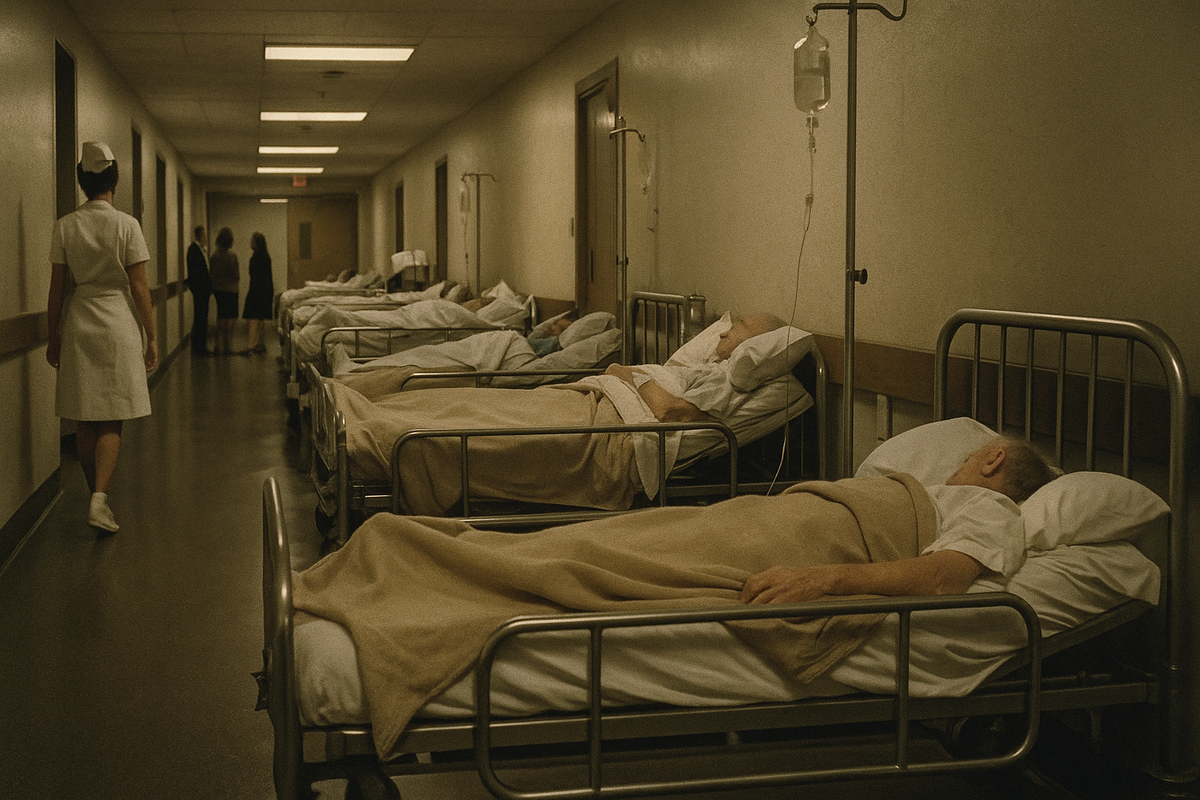
Inside, the magazine had assembled what remains one of the most searing visual investigations of American medicine ever published. The feature, titled "The Plight of the U.S. Patient," didn't offer abstractions or policy debates. It showed the fracture lines. Patients waiting days for care at Cook County Hospital. Hallways at Los Angeles County Hospital transformed into makeshift wards, stretchers lined end to end. And mere pages away: private hospital suites in Evanston, Illinois, where the wealthy recovered in carpeted rooms with attentive nurses and floral arrangements.
For a nation already convulsing over Vietnam, civil rights, and urban poverty, healthcare had arrived as the next battlefield—and Time had brought the war home.
Archive Details
Publication: Time Magazine
Issue Date: February 21, 1969
Feature Title: "The Plight of the U.S. Patient"
Historical Context: Published four years after Medicare and Medicaid legislation
Archive Source: Original Time Collection
The Collision of Progress and Failure
The late 1960s presented American medicine with a paradox it could no longer hide.
Scientific achievement had never been more spectacular. Intensive care units were pulling patients back from death's edge. Kidney dialysis was granting years to those previously condemned. Heart bypass surgery was becoming routine. The technological arsenal of modern medicine seemed unstoppable.
Yet the human experience of American healthcare told a different story entirely. County hospitals buckled under patient loads they were never designed to handle. Emergency rooms turned away the uninsured. Middle-class families watched medical bills devour their savings. The poor died of treatable conditions while waiting for care that never came.
Medicare and Medicaid, signed into law just four years earlier in 1965, had begun extending coverage to the elderly and indigent. But millions remained outside the system, and the programs themselves were too new to have restructured the inequalities built into American medicine over generations.
This was the landscape Time confronted in February 1969—a system capable of medical miracles but incapable of delivering them equitably.
Photojournalism as Witness
Time understood that policy reporting alone wouldn't capture the crisis. The magazine deployed its photographers to document what statistics couldn't convey.
The resulting photo essay remains devastating in its contrasts.
At Cook County Hospital in Chicago, the camera captured patients slumped in waiting room chairs, hours into waits that would stretch into days. At Los Angeles County Hospital, the hallways themselves had become patient wards—stretchers parked along corridors because the beds inside had long since filled. These were not aberrations. They were the daily reality of public healthcare in America's largest cities.
Then came the counterpoint: photographs of private hospital suites that could have been mistaken for hotel rooms. Patients in Evanston rested in upholstered comfort. Nurses attended to their needs with unhurried care. The message required no caption: in American healthcare, your ZIP code and bank balance determined whether you received treatment or merely waiting.
Time amplified these images with three case histories—Jewell Whelan, Leah Edwards, and Charles Anderson—ordinary Americans whose encounters with the medical system revealed the human cost of delay, denial, and debt. Their stories weren't exceptional. That was precisely the point.
The High Cost of Inequality
The magazine's most striking visual may have been its simplest: a bold red chart tracking the rise of healthcare costs. By 1969, medical expenses were outpacing inflation, wage growth, and virtually every other sector of the American economy.
Time identified the forces driving costs upward. New technologies saved lives but carried price tags that strained hospital budgets and insurance systems. The decline of the general practitioner meant patients were increasingly funneled toward expensive specialists. Hospital construction boomed in wealthy suburbs while urban public hospitals operated with equipment from previous decades.
But the magazine also documented what the charts couldn't show: the decline of the family doctor, the physician who knew patients across decades and could provide first-contact care without referral networks and multiple appointments. General practitioners were vanishing from American medicine, replaced by specialists who treated conditions but rarely knew the patient as a whole person.
The implications were clear even in 1969. American healthcare was becoming more technologically sophisticated and more fractured, more capable of spectacular rescues and less able to provide basic, continuous care.
Inside the Feature: Key Revelations
Why This Issue Endures
More than five decades later, the February 21, 1969 issue of Time Magazine retains its power—not as historical curiosity but as prophecy.
Every tension it documented has intensified. The debate over insurance coverage, the crisis of emergency room overcrowding, the medical debt that bankrupts families, the persistent gaps in care between rich and poor—these aren't echoes of 1969. They're continuations of it.
For collectors, this issue represents something beyond standard vintage magazine fare. It captures the precise moment when healthcare inequality became undeniable in mainstream American consciousness. Published just four years after Medicare and Medicaid, it documented the earliest national reckoning with modern medical inequality—before HMOs, before the managed care revolution, before healthcare consumed one-sixth of GDP.
The photography alone would justify its collectible status. The juxtaposition of overcrowded county wards and private luxury suites remains among the most powerful medical photo essays of the 1960s, comparable to the great Life Magazine spreads on war and poverty that defined the era's visual journalism.
But its deepest value lies in testimony. This issue proves that America has understood its healthcare crisis for more than half a century. The knowledge was never lacking. Only the will to act on it.
Collector Significance
Historical Timing
Published just four years after Medicare and Medicaid, it documented the earliest national debate on modern healthcare inequality.
Iconic Photography
The juxtaposition of overcrowded wards and private luxury suites remains among the most powerful medical photo essays of the 1960s.
Cultural Significance
It captures how ordinary Americans experienced illness and care at a moment when social reform was reshaping the nation.
Archive Quality
Like milestone issues covering World War II or the Civil Rights Movement, this issue documents a turning point in American life.
The Lesson That Remains
Hold the February 21, 1969 issue of Time Magazine in your hands and you're holding more than vintage paper and ink. You're holding the moment America first saw itself clearly in the mirror of its medical system—and flinched at the reflection.
The patients waiting in those Cook County corridors are gone now. So are the physicians Time interviewed, and likely most of the readers who first opened this issue in 1969. But the fracture lines they documented remain, widened by time and neglect.
That's what makes this issue more than collectible. It's a record of recognition—proof that we knew, have always known, and still struggle to bridge the gap between the medicine we can imagine and the care we actually deliver.
The past speaks. Sometimes we should listen.
Explore the Archive
From World War II to the Civil Rights era, from the Space Race to the healthcare debate, Time documented the transformations that shaped modern America.
Browse Time Magazine Collection