
When Chicago Became America's Civil Rights Laboratory
Bill Berry, Ebony, and the Battle Nobody Expected
March 1962. Readers across America opened their mailboxes to find something uncomfortable waiting inside their copy of Ebony magazine.
Lerone Bennett Jr.—the publication's senior editor and one of the era's most incisive chroniclers of Black America—had written "North's Hottest Fight for Integration," and it landed like a grenade in living rooms from Harlem to Los Angeles. The message was blunt: If you thought civil rights was a Southern problem, you were dangerously wrong.
Chicago, Bennett reported, was "the most segregated big city in America." And leading the charge against that segregation was a sharp-tongued, strategically brilliant executive named Bill Berry, who had just taken the helm of the Chicago Urban League with a declaration that stunned both allies and adversaries: "If we can win here, we can win everywhere."
He wasn't exaggerating.
Archive Details
Historical Figure: Bill Berry, Executive Director, Chicago Urban League
Issue Date: March 1962
Archive Source: Ebony Magazine
Feature Author: Lerone Bennett Jr.
Article Title: "North's Hottest Fight for Integration"
The Northern Illusion Shatters
By early 1962, the civil rights movement had already scored historic victories in the South. Montgomery's buses were desegregated. Greensboro's lunch counters had opened. The Freedom Riders had exposed the brutality of Jim Crow to the world.
But northern cities had managed to maintain a convenient fiction: that segregation was someone else's sin, confined to Alabama and Mississippi. Chicago shattered that illusion with mathematical precision.
Berry and the Urban League didn't just argue that the city was segregated—they proved it with devastating clarity. While Black children sat three-to-a-desk in crumbling, overcrowded schools, 852 white classrooms stood empty across the city. Each week, 250 housing units flipped from white to Black occupancy as white flight expanded the ghetto's boundaries. Discriminatory hiring practices locked African Americans out of good-paying jobs, regardless of qualifications.
And presiding over the school crisis was Superintendent Benjamin Willis, whose response to overcrowding became infamous: "Willis Wagons," mobile classroom trailers that allowed the board to maintain segregated neighborhood schools rather than integrate vacant white buildings. The League confronted Willis head-on, turning his wagons into a symbol of northern hypocrisy.
Berry's Three-Front War
What made Bill Berry exceptional wasn't just his diagnosis of the problem—it was his refusal to fight on anyone else's terms.
In boardrooms, he pressed executives from Inland Steel and Sears to move beyond token hires. "Our job is to break patterns," he insisted, backing demands with research that made discrimination impossible to deny. In city hall, he challenged housing policies that accelerated ghettoization. In community centers, he mobilized grassroots action, distributing 2 million pamphlets and reports that transformed data into ammunition.
But Berry's most radical position was his independence. He refused to be captured—not by the white establishment hoping to control Black leadership, not by Black militants demanding confrontation over negotiation, not by religious institutions seeking moral authority over strategy. His loyalty was to justice alone, and that made him unpredictable, effective, and occasionally isolated.
Ebony understood this complexity. Bennett's feature didn't sanitize Berry into a convenient hero. It showed him as he was: brilliant and combative, strategic and stubborn, fighting simultaneous battles on multiple fronts while raising an adopted son with his wife Betsy.
Why Ebony Mattered
The March 1962 issue demonstrated exactly why Ebony occupied cultural space no other publication could claim.
While mainstream magazines either ignored Black communities or reduced them to problem statistics, Ebony insisted on full humanity. Bennett's feature ran alongside fashion spreads, entertainment profiles, and lifestyle pieces—a deliberate editorial choice that said: We are fighting for justice AND living full lives while we do it.
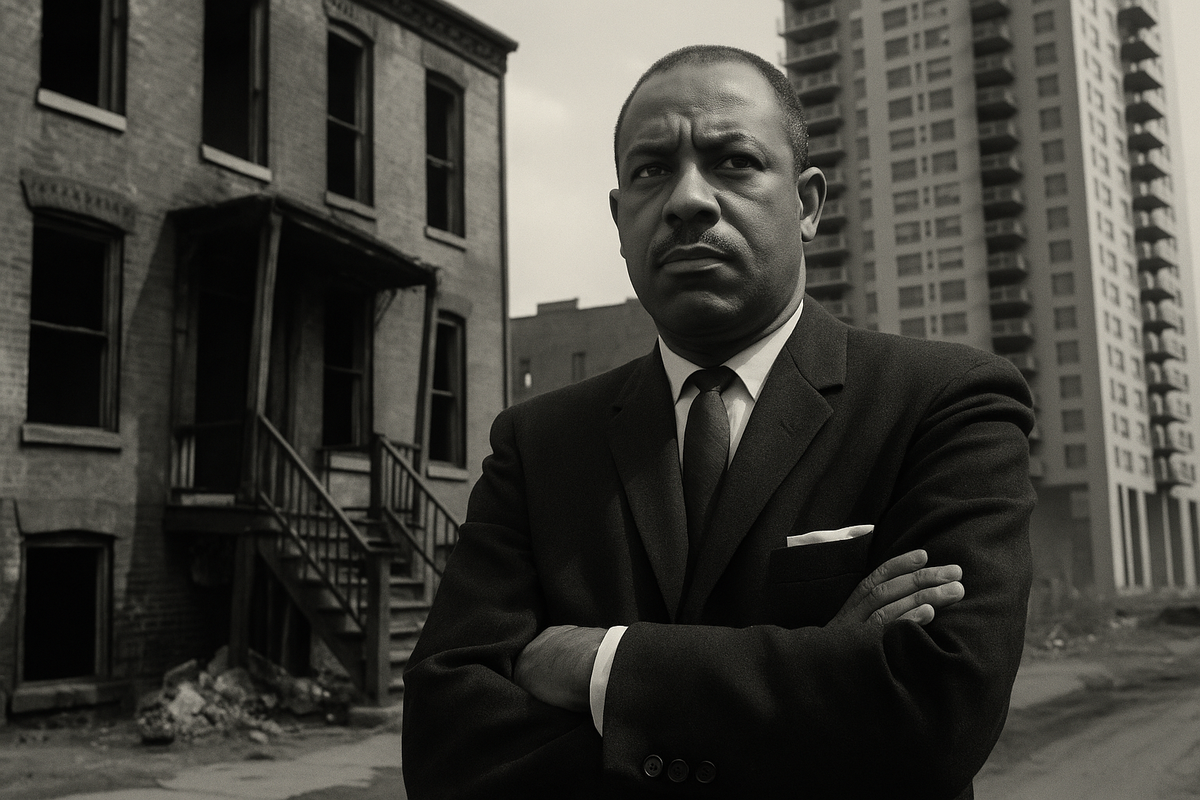
The magazine's photographic documentation was equally strategic. Readers saw Berry standing before crumbling tenements with new housing projects rising behind him—a visual metaphor for broken urban renewal promises. They saw him in close-up, speaking with the blunt authority that made him both respected and feared. They saw boardroom meetings with white executives, evidence that integration battles were being fought in corporate suites as well as streets. And they saw him at home, a reminder that every civil rights leader sacrificed family time for public duty.
These weren't just illustrations. For Ebony's audience, they were proof that the struggle was real, multidimensional, and ongoing.
The Test Case That Defined a Decade
Berry's insistence that Chicago was the ultimate test case proved prophetic. The issues Bennett documented in 1962—school segregation, housing discrimination, employment barriers—would explode into open confrontation by mid-decade. Martin Luther King Jr. would bring the Southern Christian Leadership Conference to Chicago in 1966, facing violence that shocked him more than anything he'd experienced in the South.
But Berry had already mapped the terrain. He'd already identified the enemies: not just individual bigots, but structural systems designed to contain and control. He'd already demonstrated that northern segregation required northern strategies—research departments alongside protest marches, corporate pressure alongside community organizing.
The March 1962 Ebony captured this turning point. It appeared just before the great wave of northern civil rights activism, documenting the moment when the battleground shifted and the strategies evolved.
Key Themes from the March 1962 Issue
Chicago as Test Case
Berry's argument that "If we can win here, we can win everywhere" established Chicago as the proving ground for northern integration strategies that would be replicated nationwide.
The School Crisis
While Black children packed into overcrowded classrooms, 852 white classrooms stood empty. The League's direct confrontation with Superintendent Benjamin Willis exposed the injustice of "Willis Wagons."
Employment Barriers
Berry pushed companies like Inland Steel and Sears to move beyond token hires, insisting "Our job is to break patterns" with research-backed demands.
Housing Segregation
Each week, 250 units flipped from white to Black occupancy as white flight expanded ghettos while city policies offered no real solutions to systemic discrimination.
Research as Activism
The League distributed 2 million pamphlets and reports, proving that data could be weaponized against discrimination in ways protest alone could not achieve.
Berry's Independence
He refused to be captured by the white establishment, Black militants, or religious institutions. His loyalty was to justice alone, making him unpredictable and effective.
Personal Dimensions
Ebony highlighted Berry's family life with his wife Betsy and adopted son Joseph, reminding readers that civil rights leaders were human beings making personal sacrifices.
Visual Documentation
Stark photographs of slums, boardroom negotiations, and family life created a multidimensional portrait of leadership that went beyond traditional hero narratives.
Why This Issue Endures
Historical Timing
Published at the inflection point between Southern protest and Northern confrontation, the March 1962 issue captured the moment when civil rights strategies evolved for urban battlegrounds.
Authorship
Lerone Bennett Jr.'s journalism set the standard for accessible, rigorous reporting. His Ebony features remain models of sophisticated analysis that never condescended to readers.
Leadership Legacy
Bill Berry—less remembered today than King or Malcolm X—emerges from these pages as a leader who understood that integration required dismantling systems, not just changing hearts.
Cultural Witness
Universities, museums, and archives actively seek vintage Ebony issues because they show how African Americans represented themselves when mainstream media looked away.
Physical Permanence
In an era when news evaporates digitally within hours, holding a magazine from 1962 carries different weight—tangible proof that the struggle was documented and preserved.
Primary Source Value
These pages were studied slowly, passed between family members, saved across generations. They functioned as evidence that someone was paying attention to history as it unfolded.
History You Can Hold
The March 1962 Ebony magazine isn't just a collectible—it's evidence that the civil rights movement was always national, always complex, and always fought by people who refused to accept America's promises as substitutes for America's reality.
Bill Berry's fight in Chicago proved integration required more than moral appeals. It required research, pressure, independence, and strategic brilliance. Lerone Bennett Jr.'s journalism ensured that fight wouldn't be forgotten. And Ebony's editorial vision preserved it all—the struggle and the style, the confrontation and the culture, the public battles and the private costs.
For anyone who values authentic historical artifacts, vintage Ebony magazines represent more than nostalgia. They're primary sources that shaped Black consciousness during America's most transformative decades. From civil rights leaders to entertainers, athletes to activists, each issue documented the full spectrum of African American life.
Explore the Archive
Whether you're building a collection, researching a dissertation, or honoring family heritage, these magazines are living documents. Through them, the past doesn't just whisper—it speaks with clarity, urgency, and undiminished power.
Browse Ebony Magazine Collection