
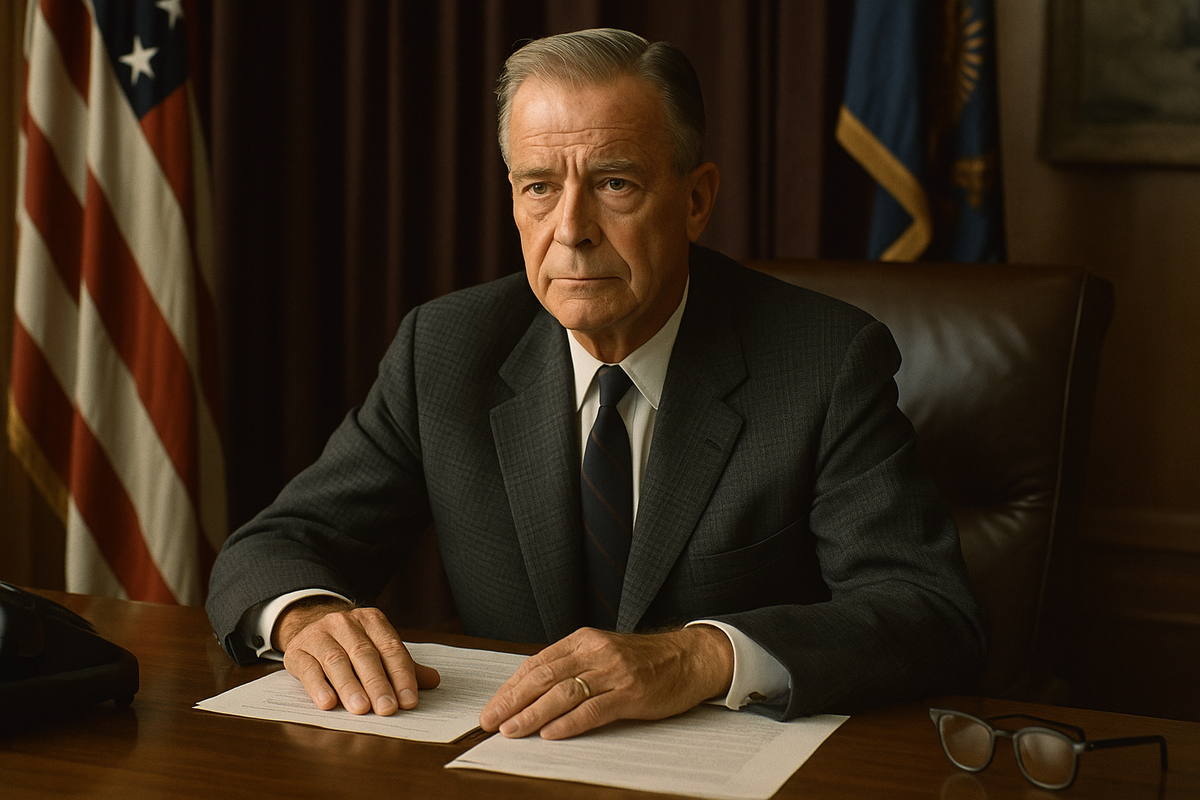
Henry Cabot Lodge, Vietnam, and the Republican Crossroads of 1964
When Time Magazine captured a party's fracture and a nation's Cold War contradictions
When Americans opened the May 15, 1964 issue of Time Magazine, they didn't know they were holding evidence of a political earthquake. On newsstands that week, Henry Cabot Lodge Jr.—a man physically stationed in Saigon, managing U.S. diplomacy during a widening war—was simultaneously being drafted as a Republican presidential contender back home. No official campaign. No stump speeches. Just a groundswell that threatened to upend Barry Goldwater's conservative insurgency.
This wasn't campaign reporting. It was a document of fracture.
The issue arrived at the precise moment when the Republican Party faced an existential choice: rally behind the establishment moderates—Lodge, Nelson Rockefeller, William Scranton—or surrender to Goldwater's conservative revolution. Time didn't just cover that choice. It froze it in ink and imagery, capturing the last breath before the GOP's transformation became irreversible.
Historical Record
Publication: Time Magazine
Issue Date: May 15, 1964
Historical Figure: Henry Cabot Lodge Jr., U.S. Ambassador to South Vietnam
Political Context: Republican Presidential Primaries, 1964
Archive Source: Original Magazines Collection
A Man in Two Worlds
By 1964, Henry Cabot Lodge Jr. had already lived several political lives. Former Senator. Vice-presidential nominee alongside Richard Nixon in 1960. Now, U.S. Ambassador to South Vietnam, stationed in Saigon as the architect—and witness—of American Cold War policy at its most volatile. Lodge had personally navigated the U.S.-backed coup that toppled President Ngo Dinh Diem in 1963, a decision that would haunt American foreign policy for a generation.
And yet, even as Lodge worked from his embassy desk surrounded by American and military flags, draft-Lodge volunteers in New Hampshire were delivering him a stunning primary victory. He wasn't campaigning. He was governing a war zone.
This surreal dual existence made Lodge the perfect symbol for 1964's central tension: a nation whose foreign entanglements were inseparable from its domestic identity crisis. Time understood this. The magazine's coverage didn't treat Lodge as merely another candidate—it presented him as the embodiment of Cold War America's contradictions.
Time as Political Theater
Time Magazine in the 1960s mastered a genre that has all but vanished: the political profile as narrative drama. The May 15 issue deployed that craft at full strength.
Readers weren't given campaign logistics. They were transported—into the backrooms of Republican strategists, onto the streets of Saigon's markets, across college campuses where mock conventions erupted in Goldwater signs and youthful defiance. The writing mixed Lodge's quiet, professorial demeanor with Goldwater's blunt, caustic wit. It juxtaposed Emily Lodge shopping in Saigon with Portland volunteers waving homemade signs for a candidate who refused to acknowledge their existence.
The result was politics as lived experience—immediate, human, tactile.
For families reading Time at the kitchen table, these pages weren't abstractions. They were the only window into a primary fight that would determine whether the Republican Party remained the party of Eisenhower or became something entirely new.
The Visual Argument
The cover alone made a statement. Lodge's face—serious, statesmanlike, unsmiling—projected everything Goldwater's insurgency opposed: restraint, diplomatic gravitas, establishment authority.
Inside, Time's photo spreads built a counter-narrative. "Captain Lodge" in World War II uniform. Lodge at his Saigon desk. Nixon and Lodge together in 1960, a reminder of campaigns past and futures foreclosed. Then, sharply contrasted: Goldwater on the trail, college students holding makeshift convention signs, the visual energy of grassroots conservatism.
These weren't decorative images. They were arguments.
Where newspapers offered only text, Time deployed photography as historical evidence. The layout itself embodied the Republican split: statesmanship versus energy, experience versus insurgency, the old guard versus the future.
What Time Captured
Lodge's Impossible Position
The magazine made explicit what seemed absurd: a sitting ambassador to a war zone being courted for the presidency without lifting a finger to campaign.
Goldwater's Fragility
Despite his frontrunner status, Goldwater appeared perpetually "in the dumps," plagued by gaffes and missteps, even as his grassroots base grew more fervent.
The Campus Revolt
Mock Republican conventions across college campuses revealed a generational fracture. Young activists were choosing sides—moderate establishment or conservative revolution—and the passion was palpable.
The Saigon Backdrop
Photographs of Emily Lodge in Vietnamese markets weren't human-interest filler. They were evidence that U.S. politics and Cold War diplomacy had collapsed into a single, inseparable story.
The Party's Reckoning
Every page of this issue conveyed the same unstated question: What will the Republican Party become?
The answer arrived months later at the Republican National Convention, when Goldwater won the nomination and declared, "Extremism in the defense of liberty is no vice." The establishment had lost. The party Lodge represented was finished.
The Weight of Paper
Time's power came from something digital media cannot replicate: the ability to connect the global and the personal in a single, tangible object. A reader in 1964 could move from college rallies in Virginia to Saigon markets without changing rooms—only pages.
Vintage magazines like this carry a physical authority. They capture the texture of their era: the typography, the advertising, the photographic grain, the editorial voice. They are living historical documents, not digitized approximations.
For historians, collectors, or families preserving memory, these magazines function as witnesses—tangible, archival, irreplaceable.
Why Collectors Covet This Issue
Historical Inflection Point
Published before Goldwater's nomination, this issue captures the GOP at its last moment of uncertainty—when the outcome wasn't yet written.
Cold War Convergence
Few primary sources link domestic presidential politics so directly to active U.S. military involvement abroad. Lodge's simultaneous roles make this a singular artifact.
Visual Documentation
The photography alone—Lodge in Saigon, Goldwater on the trail, college activists in mock conventions—creates an unmatched time capsule of 1964 political culture.
Archival Demand
Presidential election issues, particularly those documenting party realignments, command premium interest among serious collectors and institutional archives.
This isn't reading material. It's evidence—of a party's transformation, a war's escalation, and the moment when American politics and foreign policy fused completely.
Conclusion
The May 15, 1964 issue of Time Magazine captured the Republican Party at a crossroads it would never return from. Through its coverage of Henry Cabot Lodge Jr., Barry Goldwater, and the convulsing primary fight, it documented the collision of tradition and insurgency, diplomacy and politics, foreign wars and domestic transformation.
To hold this issue today is to hold the last evidence of a Republican Party that no longer exists—and the first evidence of the one that replaced it. Thanks to Time's unmatched reporting and visual storytelling, that transformation remains frozen on its pages, waiting to be witnessed again.
For anyone who understands that history isn't just studied—it's held—vintage Time magazines like this are indispensable.
Explore the Archive
Thousands of original Time Magazines spanning the 1920s through the 1970s are available in our collection. You can trace entire decades of political transformation, cultural upheaval, and Cold War tension as they were first reported and photographed.
Whether you're building a serious collection, researching political history, or preserving the memory of someone who lived through these years, these magazines are more than publications. They are artifacts of democracy in motion.
Browse Time Magazine Collection