
Chinese Soldiers, American Eyes, and the Uneasy Lessons of Postwar Asia
When The New Yorker documented Chinese troops aboard an American LST in 1946, it captured the exact moment when wartime alliance turned to postwar misunderstanding
When Americans picked up the May 25, 1946 issue of The New Yorker, they weren't just buying a magazine. They were buying a front-row seat to the unraveling of the postwar world.
Buried inside that issue—past the cartoons and the cocktail party prose—was a dispatch that still cuts: "Reporter in China: Two Weeks' Water Away." The story of Chinese troops aboard an American LST, sailing north just months after Japan's surrender. On the surface, it was reportage. Underneath, it was prophecy.
This wasn't the triumphant homecoming narrative Americans wanted. It was something harder to swallow: a portrait of allies who no longer understood each other, if they ever had.
The Alliance Nobody Wanted to Discuss
Spring 1946. Japan's empire lay in ruins. China's wartime coalition—Chiang Kai-shek's Nationalists and Mao Zedong's Communists—was already fracturing. Civil war wasn't a possibility. It was inevitable.
The 22nd Division of China's New Sixth Army had earned its stripes in Burma, fighting alongside American and British forces to reopen supply routes. Now those same soldiers crowded the decks of LST-1300, ferried north by their American allies. Every movement watched. Every action judged.
The New Yorker sent a reporter to document the voyage. What came back wasn't propaganda. It was discomfort made literary.
Archive Details
Publication: The New Yorker
Issue Date: May 25, 1946
Featured Article: "Reporter in China: Two Weeks' Water Away"
Historical Context: Less than one year after V-J Day, months before the Chinese Civil War
Military Unit: 22nd Division, New Sixth Army (Burma Campaign veterans)
The Magazine That Told Uncomfortable Truths Beautifully
By 1946, The New Yorker had perfected a dangerous alchemy: marrying wit to witness. Where newspapers gave you headlines, The New Yorker gave you the texture of history—the smell of diesel, the sound of hobnailed boots sliding across steel decks, the silence when an interpreter fails.
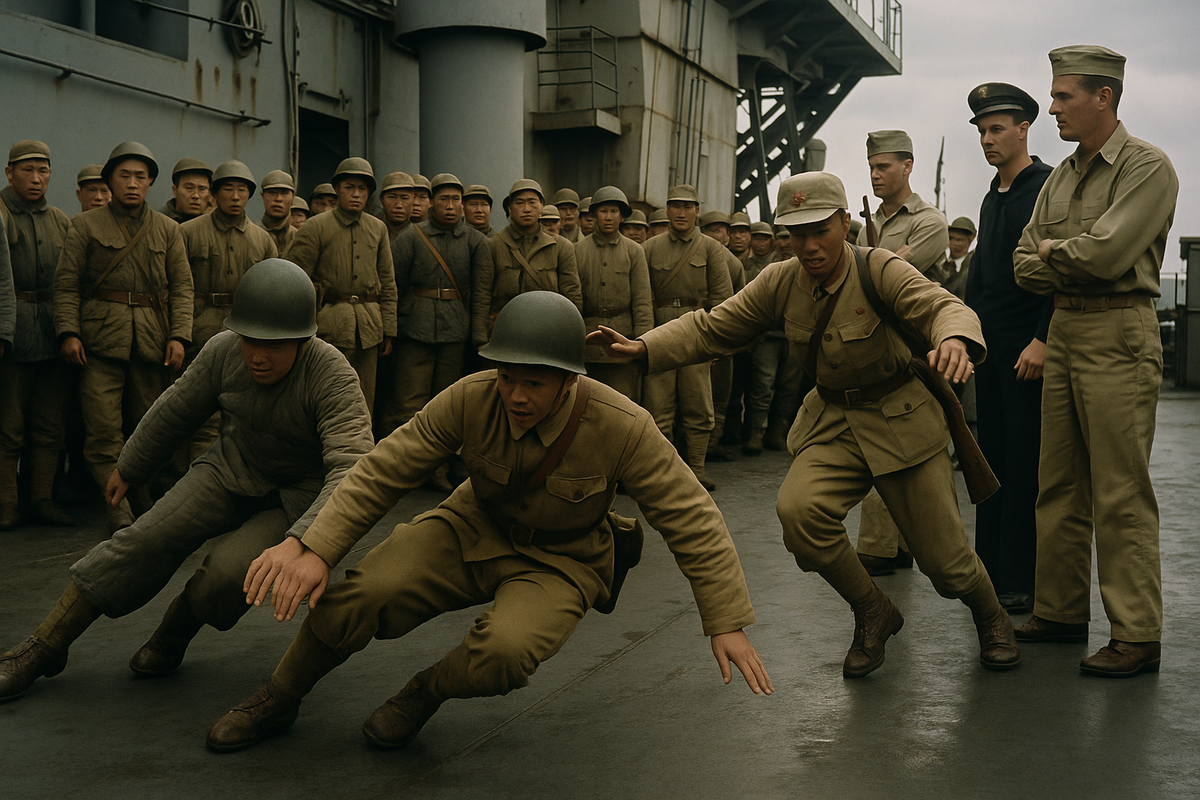
The May 25 issue delivered that contract in full. "Two Weeks' Water Away" opened with near-slapstick: Chinese soldiers in heavy boots, skating helplessly across the pitching deck, laughing to mask humiliation. American officers watching, grimacing, cataloging failures of discipline.
No policy analysis. No diplomatic spin. Just the raw friction of cultures forced into proximity by war, now drifting apart in peace.
This was The New Yorker at its most essential—transforming a military transport into a metaphor for everything America didn't yet understand about its role in the world.
What the Cover Hid
The cover art: whimsical, bright, innocent. A tree filled with colorful birds, onlookers gazing up in wonder. Classic New Yorker misdirection.
Inside, the reporting turned sharp. "Two Weeks' Water Away" wasn't about troop movements. It was about perception—how Americans saw their Chinese allies, and how those allies absorbed the weight of American judgment.
The details landed like small humiliations: Chinese soldiers in patchwork uniforms—American helmets, British jackets, Japanese coats, Chinese quilts. Gear that told the story of a war won by scavenging. An army held together by improvisation, now being measured against West Point standards.
Major Chow, a Chinese officer, summoned by American superiors for a lecture on naval discipline. His retreat to his bunk afterward, wordless. The article didn't editorialize. It didn't need to.
Lieutenant Jackson, a Texan interpreter, became the fulcrum of the piece—a man trying to translate not just words but worlds. His struggle revealed the truth: some distances can't be bridged by good intentions.
Five Moments That Still Sting
The Sliding Soldiers
Hobnailed boots on wet steel. Laughter covering shame. American officers reading chaos where there was simply unfamiliarity. The misreading of cultural cues as military failure.
Major Chow's Silence
Called before American command. Lectured. Dismissed. The quiet dignity of a man swallowing indignity for the sake of alliance. A preview of every unequal partnership to come.
Jackson's Impossible Job
The interpreter as tragic figure. Fluent in language, helpless before culture. Every translation a small betrayal of nuance.
The Patchwork Uniform
American helmets on Chinese heads. British boots, Japanese overcoats, homemade quilts. The visual vocabulary of resourcefulness misread as disorder. A metaphor for China's wartime experience—surviving by synthesis.
Voices at Sunset
Soldiers singing together. Joking about "boat dizziness." Moments of humanity breaking through the reportage. Reminders that history is made by individuals, not abstractions.
These weren't just anecdotes. They were warnings that went unheeded.
Why This Issue Matters Now
For collectors, the May 25, 1946 New Yorker occupies rare territory.
Historical Inflection Point – Published less than a year after V-J Day, before the Chinese Civil War erupted, before the Cold War calcified. A snapshot of the exact moment when everything could have gone differently.
Unique Cultural Journalism – Firsthand reporting on U.S.–China relations before ideology hardened into doctrine. These perspectives don't exist in government archives. They exist here.
Editorial Contrast – That playful cover against the weight of the reporting inside. The magazine's identity preserved in a single object.
Research Primary Source – For scholars studying American perceptions of Asia, media representation of allies, or the cultural roots of Cold War misunderstanding, this issue is foundational.
Owning this isn't nostalgia. It's owning evidence—of how nations see each other, of how misunderstanding becomes policy, of how journalism can capture what diplomacy obscures.
Why These Issues Endure
Wartime and postwar New Yorkers survive because they refuse to simplify. Every page contains contradictions: victory and anxiety, humor and dread, optimism shadowed by doubt.
Daily newspapers dissolve into history. These magazines remain intact—cartoons, essays, advertisements, all of it. The mundane and the momentous preserved together, because that's how people actually experienced 1946.
You can't skim them. You have to read them at the speed they were written. That slowness is the point.
Collector Significance
Historical Timing
Appearing less than a year after World War II, it captures the fragile aftermath of victory and the uncertain future of China.
Unique Reporting
The "Reporter in China" article is a rare piece of cultural journalism on U.S.–China relations, written before the outbreak of the Chinese Civil War.
Iconic Cover Art
The whimsical bird illustration contrasts strikingly with the sober reportage inside, showcasing the magazine's unique editorial balance.
Scholarly Value
For historians and cultural scholars, this issue provides firsthand insight into how Americans viewed their wartime allies in the uneasy transition to peace.
Your Access Point
Thousands of original New Yorker issues—1920s through the postwar era—are available now. Not reprints. Not digital facsimiles. The actual artifacts.
Explore the Archive
Whether you're completing a research project, building an institutional archive, or simply want to hold a piece of 1946 in your hands exactly as it was printed, these issues deliver what screenshots and PDFs cannot: the physical presence of history.
Browse The New Yorker Magazine CollectionThe Deck of the LST-1300
The May 25, 1946 New Yorker remains one of the sharpest cultural documents of the postwar moment. "Reporter in China: Two Weeks' Water Away" captured something American foreign policy would spend decades failing to understand: that alliances built in war don't survive peace without humility.
Reading it now is like standing on that steel deck—watching American officers and Chinese soldiers try to bridge a gap that language, good faith, and shared enemies couldn't close. The New Yorker preserved the moment not with judgments but with details. Those details still speak.
For anyone who values history that doesn't flatten into lessons, vintage New Yorker issues like this aren't collectibles. They're arguments with the present, written in the past tense.