
The Magazine That Made America Question Everything
Life's Aldous Huxley Issue, September 20, 1948
Picture this: A Broadway starlet smiles from the cover. Inside, a philosopher warns that your new refrigerator might be destroying your soul.
When Americans opened the September 20, 1948 issue of Life Magazine, they expected the usual—celebrity profiles, product ads, maybe a photo essay on European reconstruction. What they got instead was a cultural detonation. Aldous Huxley, sixteen years after publishing Brave New World, had returned with a reckoning: his dystopia wasn't science fiction anymore. It was Tuesday.
For the millions of middle-class families reading Life that week, Huxley's essay landed like ice water. The atomic bomb was three years old. The Berlin Blockade was four months old. Their new Frigidaires and Philco television sets—symbols of the American Dream—were suddenly implicated in something darker. Huxley didn't just critique the future. He held up a mirror to 1948 and asked: When did we agree to this trade?
This issue remains one of the most intellectually provocative magazines Life ever published. And today, it's one of the most sought-after.
Archive Details
Historical Figure: Aldous Huxley
Issue Date: September 20, 1948
Archive Source: Life Magazine
Cover Subject: Joan Diener, Broadway actress
Cultural Context: Early Cold War, dawn of the atomic age
A Nation at the Crossroads
The late 1940s weren't just postwar—they were post-certainty.
World War II had ended three years earlier, but its shockwaves still governed everything. The United States was riding an economic boom: suburban tracts sprouting like weeds, cars rolling off Detroit assembly lines, Levittown redefining what "home" meant. Consumer culture was being born in real time, lubricated by advertising that promised fulfillment through purchase.
But underneath the prosperity sat dread. The Cold War had crystallized. The Berlin Blockade—Stalin's attempt to starve West Berlin into submission—had begun in June. NATO was months away from formation. And somewhere in the New Mexico desert, the blueprints for hydrogen bombs were already being drafted.
Into this fragile optimism, Life dropped Huxley's essay like a lead weight.
The magazine's editorial team understood what they had: not just literary criticism, but a diagnostic tool for the American condition. Huxley's themes weren't abstract—they were ripped from the headlines Life itself printed.
Technology worship? The magazine's own pages advertised "push-button living" as salvation.
Pharmaceutical dependency? Ads for vitamins, tonics, and "nerve pills" crowded every issue.
Manufactured happiness? Madison Avenue had turned it into a business model.
Huxley's essay sat in deliberate tension with its surroundings. The irony wasn't accidental—it was curatorial genius.
Photojournalism as Prophecy
Life didn't explain Huxley's warnings. It illustrated them.
This is where the issue transcends text and becomes visual argument. The editors deployed Life's unmatched photojournalism arsenal to make Huxley's dystopia tangible:
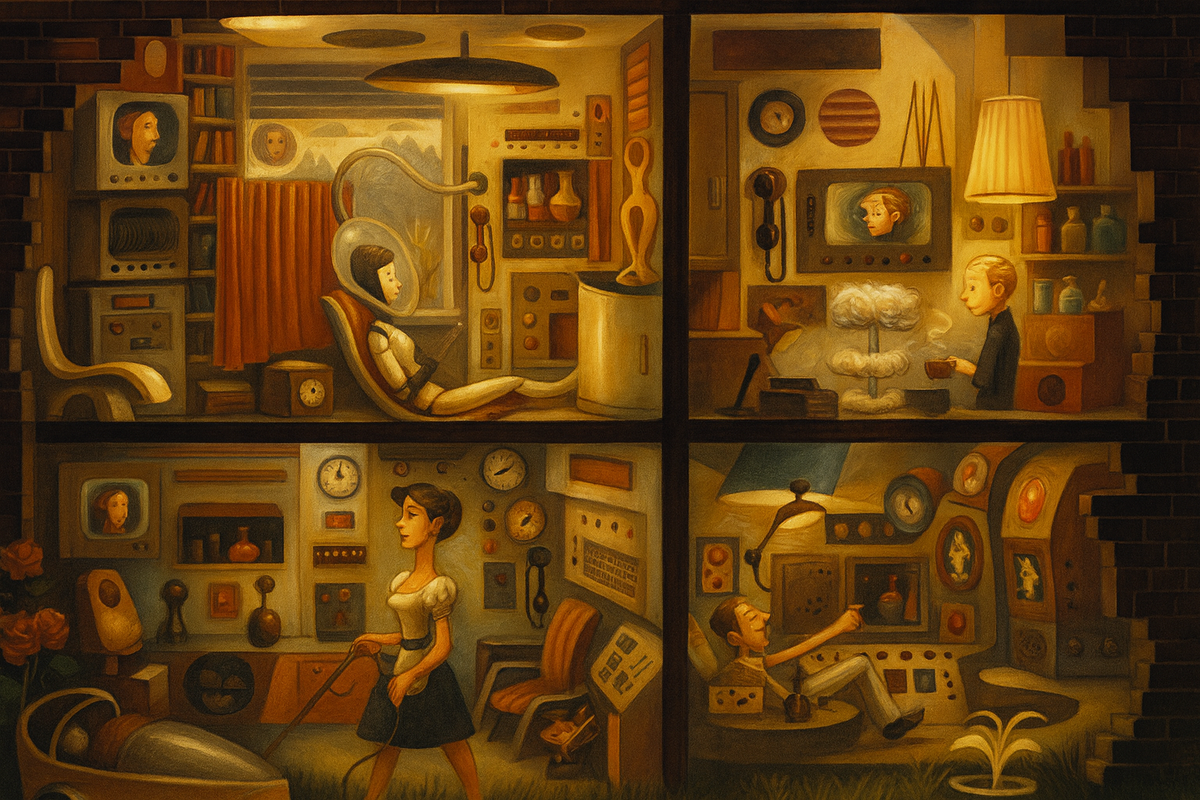
The World of Tomorrow: A multi-panel cartoon rendered a push-button home of the future—atomic chemistry sets for children, wall-sized televisions, kitchens operated by remote control. The illustration walked the line between satire and advertisement. Readers couldn't tell if they were supposed to laugh or start saving.
Sleep-Learning in Practice: A photograph showed a real experiment—a sleeping subject beside a record player, attempting to absorb information during slumber. For anyone who'd read Brave New World, the parallel was immediate: hypnopaedia, the conditioning of children while they slept. What Huxley imagined in 1932 was now peer-reviewed research in 1948.
The Pharmaceutical Array: A clinical photograph displayed rows of vitamins, hormones, and mood stabilizers. Huxley had invented soma—the drug that pacified his fictional citizens. Life's photo spread suggested the real version was already in production, available at your local pharmacy.
Helicopters Over Water: U.S. Navy helicopters in formation. In Brave New World, helicopters were the signature technology of the World State. In 1948, they were standard military issue. Fantasy had become logistics.
The magazine's visual language did what Huxley's prose alone couldn't: it made the argument inescapable. You couldn't skim past a photograph the way you might skim past a paragraph. The images forced confrontation.
This wasn't journalism—it was montage. Eisenstein would have approved.
The Cover's Calculated Dissonance
The issue's cover featured Joan Diener, captured backstage during Broadway rehearsals. She's glamorous, mid-century American, wholesome in the way Life covers always were.
Turn the page, and you're in a different magazine entirely.
The whiplash was intentional. Life's editors understood contrast as a storytelling device. The cover promised entertainment; the interior delivered existential crisis. That tension—between the aspirational image and the philosophical undertow—defined the magazine's cultural power in the late 1940s.
Other publications might have led with Huxley on the cover, making the issue's intellectual heft obvious. Life trusted its readers to discover it. The surprise amplified the impact.
Huxley's Diagnosis: Ten Warnings That Still Echo
The essay itself is dense, but its arguments cut clean. Huxley wasn't interested in nuance—he was interested in wake-up calls. Here are the core warnings embedded in his 1948 reflection:
These weren't predictions. They were X-rays.
The Enduring Architecture of Life
What made Life magazines from the 1930s through the 1950s culturally indispensable was their hybrid form. They weren't just photo magazines—they were visual arguments. They weren't just journalism—they were designed experiences.
Life believed the photograph was the language of modern life. But the magazine also understood that images need context, and context needs narrative structure. The result was a publication that could translate complex ideas into forms accessible to millions without condescension.
The September 20, 1948 issue demonstrates this architecture at its peak. Huxley's philosophical essay, which in another venue might have reached academics and literati, became a mass-market conversation because Life knew how to frame it. The photos didn't just illustrate the text—they extended the argument into visual space.
This is why Life issues from this era remain collectible. They weren't disposable. They were curated cultural interventions.
Why This Issue Commands Collector Attention
Cultural Timing
It appeared at the exact inflection point when American confidence and American anxiety were in open combat. The Cold War was hardening. Consumerism was accelerating. Huxley's essay gave readers a vocabulary for the unease they already felt.
Huxley's Reach
This was a rare instance of a major literary intellectual addressing mainstream America through the country's most popular visual magazine. Huxley wasn't preaching to the converted—he was speaking to Levittown.
Photojournalistic Power
The images in this issue—sleep-learning, pharmaceuticals, futuristic homes—remain visually potent. They don't feel dated. They feel prescient.
Tangible Historical Artifact
Owning this issue means holding the same pages that sparked kitchen-table debates in 1948. It's not a reprint. It's not digitized. It's the original object that entered American homes seventy-seven years ago.
For collectors of Cold War ephemera, mid-century cultural history, or vintage photojournalism, this issue checks every box. It's intellectually significant, visually arresting, and historically specific.
Explore the Archive
If this issue resonates—or if you're drawn to other moments when America argued with itself in print—original Life magazines offer unmediated access to those debates.
World War II. The space race. Civil rights. Vietnam. The women's movement. Every major 20th-century upheaval was documented by Life as it unfolded, in real time, with the visual power that only Life could marshal.
Browse Life Magazine CollectionEach issue is a time capsule—a window into the fears, hopes, and contradictions of the moment it was published.
Conclusion: The Magazine That Refused to Look Away
The September 20, 1948 issue of Life Magazine endures because it captured a specific American paradox: a nation celebrating its prosperity while quietly terrified of its implications.
Aldous Huxley's essay wasn't a literary exercise. It was a mirror held up to postwar America, reflecting back an image most readers had been avoiding. The refrigerators, the televisions, the pills, the helicopters—they were supposed to be progress. Huxley asked: At what cost?
More than seven decades later, the question hasn't aged a day.
For collectors, this issue represents more than historical significance. It's a document of the moment when mainstream America was forced to reckon with the idea that technological advancement and human flourishing might not be the same project.
And thanks to Life's photojournalism, that reckoning remains vivid on the page—still asking us to look, and to answer.