
The Last Christmas Before the Crash
Inside Electronic Games' December 1982 Console Wars Issue
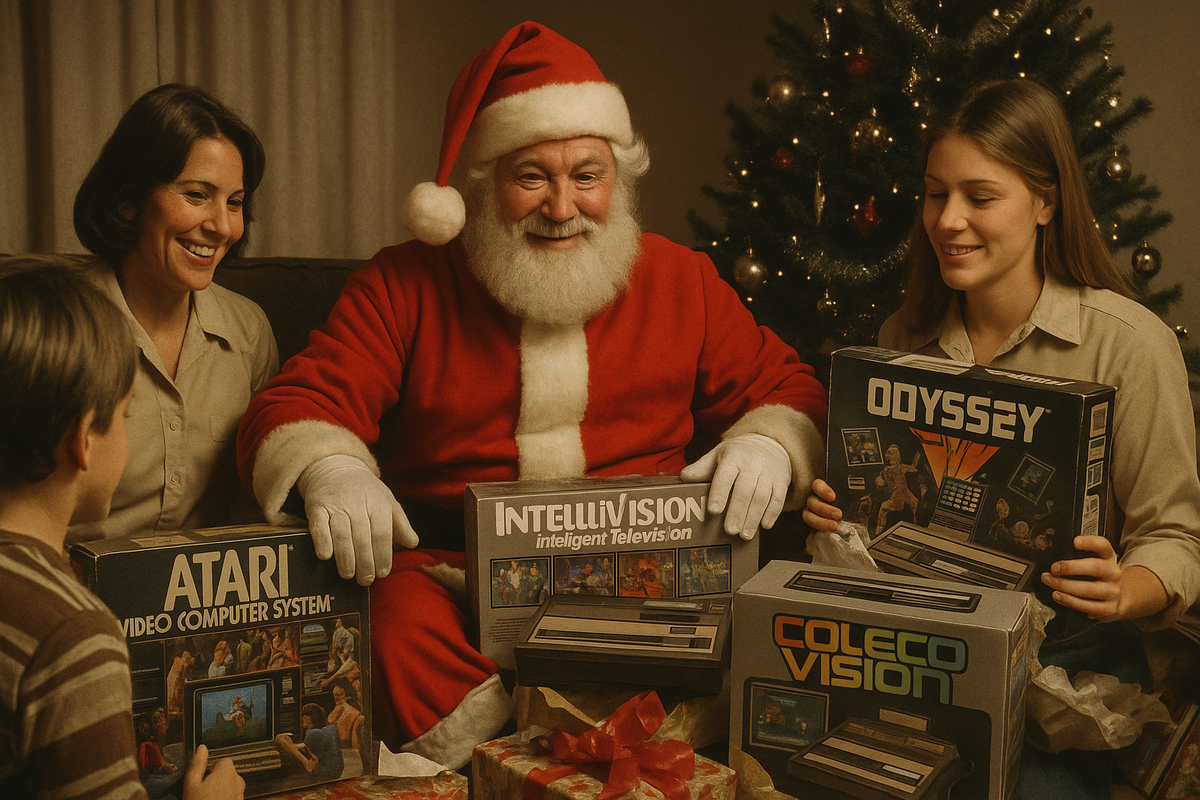
Santa Claus smiled from the cover of Electronic Games Magazine in December 1982, his red coat open to reveal a T-shirt bearing the magazine's logo. He wasn't delivering toys. He was presiding over a battlefield.
Inside that issue, four consoles fought for supremacy beneath America's Christmas trees: Atari's unshakable VCS, Mattel's graphically superior Intellivision, Magnavox's eccentric Odyssey², and the upstart ColecoVision—armed with the most coveted arcade game of the year. For readers flipping through "The Players Guide to Programmable Video Game Systems," this wasn't just buying advice. It was intelligence from the front lines of the first true console war.
They had no idea they were reading a eulogy.
Within twelve months, the video game industry would collapse. Warehouses would overflow with unsold cartridges. Atari would bury E.T. in a New Mexico landfill. The optimism radiating from this issue—the confidence, the expansion, the billion-dollar projections—would curdle into the crash of 1983. But in that moment, in December 1982, the future looked limitless.
This makes the issue more than a collector's item. It's a preserved moment of hubris and hope, frozen just before the fall.
Archive Details
Publication: Electronic Games Magazine
Issue Date: December 1982
Featured Article: "The Players Guide to Programmable Video Game Systems"
Historical Context: Published at peak of video game boom, months before the 1983 crash
Cover Theme: Santa Claus revealing Electronic Games logo T-shirt
The Market at Maximum Velocity
The numbers told one story: arcades were printing money, consoles had penetrated millions of homes, and advertising budgets rivaled Mattel's toy empire. Lines wrapped around Donkey Kong cabinets. Pac-Man had become a cultural icon. Parents queued outside electronics stores, convinced that programmable video game systems were the defining gift of the 1980s.
The cultural shift told another: video games had escaped the basement. They were no longer hobbyist curiosities or teenage obsessions. They were family entertainment, legitimate technology, and—crucially for manufacturers—a goldmine.
Electronic Games Magazine understood this transformation better than most. Launched as the first dedicated gaming publication, it treated the medium with the seriousness of film criticism and the accessibility of consumer reporting. Other magazines reviewed games as toys. Electronic Games reviewed them as culture.
The December 1982 issue elevated this mission. Its holiday buyer's guide didn't just compare specifications—it positioned video games as central to American tradition. For the first time, consoles competed alongside bicycles and dolls in the pantheon of must-have Christmas gifts.
The magazine's editorial authority shaped perception. When families debated Atari versus Coleco, Electronic Games became the arbiter. Its assessments carried weight precisely because they combined technical knowledge with genuine enthusiasm. The writing never condescended, never drowned readers in jargon. It spoke to both the parent calculating value and the kid memorizing sprite counts.
The Contenders: A Console-by-Console Breakdown
ColecoVision: The Newcomer with Arcade Credentials
Coleco's strategy was brilliant in its simplicity: bundle the system with Donkey Kong. Not a clone, not an approximation—the actual arcade hit, playable at home. For a market obsessed with "arcade-quality graphics," this was checkmate.
Electronic Games recognized the significance immediately. The coverage positioned ColecoVision as more than another console—it was a generational leap. Launch titles like Zaxxon, Cosmic Avenger, and Venture reinforced the promise: what you saw in the arcade, you could now own.
The system's versatility mattered too. Controllers that worked. Expansion modules on the horizon. A company willing to compete on graphics and gameplay simultaneously. In the winter of 1982, ColecoVision represented ambition, and the magazine captured that energy.
Atari VCS: The Incumbent Defending Territory
Atari's advantage was ubiquity. Millions of consoles already occupied American living rooms. The largest game library. Brand recognition that transcended gaming. When parents thought "video games," they thought Atari.
The magazine documented this dominance while acknowledging the system's age. Accessories like the Supercharger extended its capabilities. Major licenses—Pac-Man, Donkey Kong—kept it relevant. But the VCS was fighting on two fronts: against newer hardware and against its own success. The installed base was simultaneously its greatest asset and its Achilles' heel.
Electronic Games treated the VCS with the respect a market leader deserved, but the subtext was clear: evolution or obsolescence.
Intellivision: The Technically Superior Alternative
Mattel positioned the Intellivision as the thinking player's console. Better graphics. Sports simulations with depth. Games like Major League Baseball and NFL Football that promised realism over arcade flash.
The magazine's coverage highlighted this differentiation. Where Atari aimed for mass appeal and ColecoVision chased arcade perfection, Intellivision carved out the niche of "serious" gaming. The controversial keypad controllers—awkward but functional—became a mark of sophistication rather than a design flaw.
This was peak Mattel confidence, captured in print. The company's famous television ads positioned it as superior to Atari, and Electronic Games reflected that narrative. For collectors, this section documents the exact moment before Mattel's momentum stalled.
Odyssey²: The Maverick Play
Magnavox's console never threatened the top tier, but it refused to play by conventional rules. A built-in keyboard. The Voice module. Hybrid games that merged video gameplay with board game mechanics. K.C. Munchkin as a Pac-Man alternative that actually innovated.
The Odyssey² coverage in this issue matters because it preserves the system's eccentric creativity. Not every console tried to out-Atari Atari. Some experimented. Some failed. But they expanded what the medium could be.
For historians of gaming's evolutionary dead-ends, this documentation is invaluable.
The Holiday Gift Guide: Gaming Becomes Tradition
The most culturally significant section wasn't the console comparisons—it was the gift guide itself. Cartridges, accessories, and systems presented with the same consumer logic as department store catalogs. Video games had crossed the threshold from novelty to tradition.
This represented a seismic shift. Gaming wasn't something you explained or justified. It was something you wrapped and placed beneath the tree. Electronic Games validated this transformation by treating it as normal, expected, inevitable.
For an entire generation, this issue shaped what Christmas morning looked like. The games they unwrapped, the systems they fought over, the memories they formed—all influenced by this single magazine's recommendations.
The Magazine as Historical Document
Decades later, the December 1982 Electronic Games endures because it captured something ephemeral: the feeling of unlimited possibility. The writing buzzes with energy. The coverage assumes continued growth. The advertising promises innovation.
All of it would collapse within a year. Atari would hemorrhage money. Retailers would refuse to stock games. The industry would contract so violently that many predicted its permanent death.
This issue exists in the space between triumph and catastrophe. It's a time capsule from the moment before everyone realized the market had fractured. That tension—between documented optimism and known outcome—gives the magazine its power.
Like examining photographs from the Titanic's maiden voyage, there's poignancy in seeing confidence that was about to be shattered. The difference is that video gaming survived its iceberg. It rebuilt. But it never quite recaptured the innocent exuberance of Christmas 1982.
Why This Issue Commands Collector Attention
Historical Timing
Published at the absolute peak of the boom, months before the industry collapsed. It captures optimism that would never return in the same form.
Comprehensive Console Documentation
No other publication of the era offered this direct, authoritative comparison between all major systems. It's a snapshot of the complete market at a pivotal moment.
ColecoVision's Defining Moment
The coverage documents the system's launch strategy and arcade promises before reality complicated the narrative. It's the "before" picture.
The Santa Cover
Holiday-themed gaming covers are always prized, but this one symbolizes the medium's mainstreaming. It's visually iconic and culturally significant.
Nostalgia Preservation
For readers who lived through this era, the issue doesn't just document history—it resurrects the exact emotional texture of Christmas 1982.
Cultural Artifact
Owning this magazine means possessing more than paper and ink. It means holding the final moment of collective belief before the crash shattered the industry's confidence.
Acquire Gaming History
The December 1982 issue of Electronic Games Magazine belongs in serious collections. It documents the console wars, ColecoVision's launch, and the moment video games became American tradition—all before the crash rewrote the industry's trajectory.
Browse Electronic Games Magazine CollectionWhether you're building an archive, researching gaming's cultural evolution, or reclaiming childhood memories, these magazines offer something digital scans cannot: the physical artifact of history, preserved exactly as readers held it in 1982.
Santa's smile on that December cover promised a future that would arrive differently than anyone expected. The consoles profiled—Atari, Intellivision, ColecoVision, Odyssey²—would all face reckoning. The market's explosive growth would reverse catastrophically. The optimism would evaporate.
But on Christmas morning 1982, none of that mattered. Kids unwrapped Donkey Kong. Families gathered around television sets. Video games weren't just entertainment—they were the future.
Electronic Games Magazine captured that moment perfectly. The issue remains valuable not despite the coming crash, but because of it. It's a monument to belief, preserved in print, from the last Christmas before everything changed.