
Joan Baez, Folk Music, and the Voice of a New Generation
How Time Magazine captured a cultural revolution in the making
November 23, 1962. Across America, subscribers pulled a magazine from their mailboxes that would never look quite the same again. There, staring back in stark black-and-white, was a 21-year-old woman with a guitar—not a Hollywood starlet, not a politician, not a titan of industry. Joan Baez. A folk singer. On the cover of Time.
If you understood what that meant in 1962, you understood that something fundamental was shifting in American culture.
This wasn't just celebrity coverage. Time had chosen to tell its millions of readers that the future of American music—and perhaps American conscience—belonged to the coffeehouses, not the concert halls. To the activists, not the entertainers. To a generation that was about to stop asking permission.
Archive Details
Featured Artist: Joan Baez
Issue Date: November 23, 1962
Archive Source: Time Magazine
Historical Context: Cuban Missile Crisis aftermath, Civil Rights Movement peak, Folk Revival era
The World That Opened This Magazine
The readers who opened that November issue were living through the aftermath of the Cuban Missile Crisis—just one month earlier, the world had stood at the edge of nuclear annihilation. The Civil Rights Movement was no longer a regional disturbance but a national reckoning, with sit-ins, Freedom Rides, and legal battles tearing down the architecture of segregation. President Kennedy occupied the White House. The Beatles hadn't yet arrived. Vietnam was still a small advisory mission.
Folk music wasn't background noise in this moment—it was a language. Where rock and roll offered rebellion through volume and attitude, folk offered rebellion through clarity. The songs were spare, direct, unadorned. They spoke of freedom, justice, and peace with a moral urgency that matched the times. Pete Seeger had been blacklisted for his politics. Bob Dylan was just emerging from the Greenwich Village scene. And Joan Baez was already selling out concerts and turning down venues that wouldn't integrate their audiences.
When Time profiled Baez that November, it wasn't covering entertainment. It was documenting a cultural inflection point.
How Time Told the Story
By 1962, Time had mastered the art of cultural translation. The magazine didn't just report—it interpreted. It told Americans what mattered and why. The Baez feature exemplified this approach: sharp prose, striking photography, and an editorial voice that framed her not merely as a talented singer but as a generational symbol.
The article traced her Quaker upbringing, her brief time at Boston University, and her ascent from Cambridge coffeehouses to the Newport Folk Festival stage. But Time went deeper. It emphasized her refusal to perform for segregated audiences—a stance that cost her Southern bookings and money, but won her credibility with the students and activists who would define the decade. The piece captured her impact on college campuses, where young people heard in her crystalline voice both beauty and defiance.
For families reading this issue over breakfast tables or in living rooms, Time wasn't just offering biography. It was explaining why their children were suddenly listening to music about workers' rights and "Blowin' in the Wind." It was translating a youth movement to a skeptical mainstream.
The Visual Testament
The cover itself was a statement. Baez appeared without makeup, without glamour, without the gloss of commercial pop. Guitar in hand, she looked like exactly what she was: a serious artist with something to say. The photography was intimate, unvarnished—authenticity made visible.
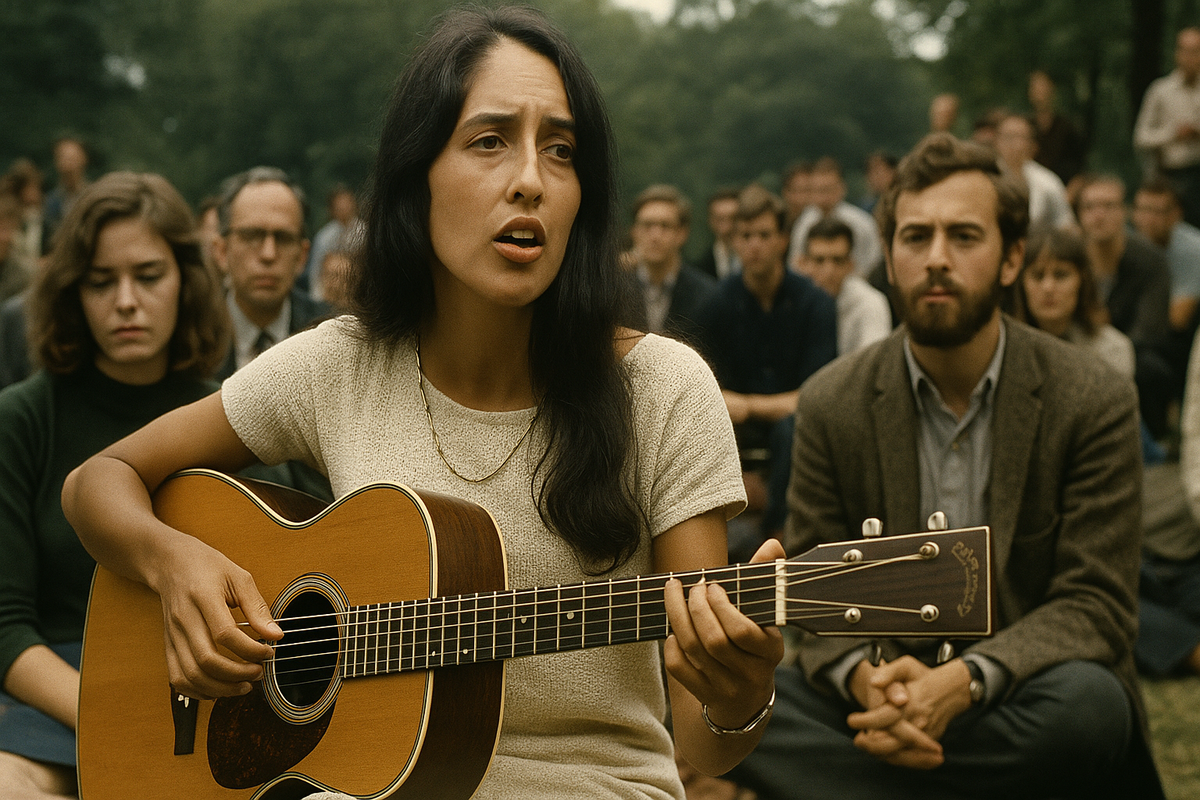
Inside, Time's photo editors built a visual narrative. Concert shots captured Baez in outdoor settings, surrounded by audiences sitting on grass, leaning in. Candid images showed her deep in performance, eyes closed, lost in song. These weren't publicity stills. They were documentation of a movement happening in real time, in college quads and folk festivals, far from the machinery of mainstream entertainment.
The editorial voice struck a careful balance. Time praised Baez's vocal purity and artistic integrity while noting her political commitments. The magazine contrasted folk music's authenticity with the manufactured quality of commercial pop, positioning Baez and her peers as representatives of something more genuine, more connected to American tradition. This was Time at its best—not just covering culture, but shaping how millions understood it.
What Time Captured
The Folk Revival's Breakthrough
The article chronicled folk music's leap from niche festivals to national consciousness, carried by Baez and a handful of peers who made traditional music feel urgent and contemporary.
Courage in Action
Time didn't soft-pedal Baez's moral stance. Her refusal to perform for segregated audiences in 1962 was radical, risky, and real. The magazine made this central to her story.
Authenticity as Currency
Unlike the pop stars dominating radio, Baez drew on tradition, simplicity, and directness. For students questioning authority and convention, this mattered deeply. Time recognized that her appeal wasn't despite her seriousness—it was because of it.
Generational Voice
The piece positioned Baez not just as a performer but as a spokesperson for young Americans rethinking politics, culture, and their place in the world. She wasn't selling records. She was articulating values.
The Politics of Song
Time understood that folk music and the civil rights struggle were inseparable in 1962. The songs Baez sang weren't nostalgia—they were calls to action.
More than six decades later, the November 23, 1962 issue of Time Magazine commands attention from serious collectors for reasons that go beyond nostalgia.
Why Collectors Seek This Issue
Cultural Watershed
This issue documents the folk revival at its peak and captures Joan Baez at the beginning of a career that would span generations. It's a snapshot of the moment before Dylan went electric, before folk rock, before everything changed again.
Civil Rights Era Artifact
The coverage of Baez's political commitments makes this magazine inseparable from the broader social upheavals of the early 1960s. It's a document of how art and activism converged.
Iconic Photography
Time covers featuring musicians are rarer than those featuring politicians or business leaders. A folk singer on the cover in 1962 was both unusual and significant, making this issue visually distinctive in the magazine's archive.
Historical Witness
Collectors value this issue not as a retrospective but as a contemporary account—how Time's editors and readers understood these changes as they happened, without the benefit of hindsight.
For collectors, historians, and anyone preserving the artifacts of American cultural history, this issue offers something tangible: the texture of a moment when music became inseparable from moral purpose.
The Enduring Value of Primary Sources
Vintage Time issues survive as more than information sources. They preserve mood, priority, perspective. Reading this 1962 issue today delivers something no history book can: the feel of that cultural moment, the language its observers used, the assumptions they carried.
For historians and collectors, these magazines are invaluable because they show not how we remember the past, but how people lived it. They are first drafts of history, captured in photographs and prose before anyone knew how the story would end.
Explore the Archive
Thousands of original Time magazines spanning World War II through the cultural revolutions of the 1960s and beyond are available in our collection. From political upheavals to artistic breakthroughs, Time chronicled the events and figures that shaped the 20th century.
Browse Time Magazine CollectionA Magazine That Captured a Turning Point
The November 23, 1962 issue of Time Magazine remains one of the defining cultural documents of the early 1960s. Its Joan Baez cover story captured not just a singer, but a movement—the rise of folk music, the awakening of youth culture, and the fusion of art and politics that would come to define the decade.
Holding this issue today means stepping back into 1962—a year of nuclear brinkmanship, civil rights battles, and a nation on the edge of transformation. Thanks to Time's reporters and photographers, that moment is preserved with remarkable clarity, more than sixty years later.
For anyone who values cultural history, this magazine is more than a collectible. It's proof that voices like Joan Baez's didn't just make music—they helped shape the conscience of a nation, one song at a time.