
The Magazine That Tried to Kill Comics
Inside the 1953 Attack That Changed American Culture
November 1953. While most Americans thumbed through Ladies' Home Journal for recipes and fashion advice, they stumbled into a cultural ambush.
There, between the Jell-O advertisements and advice columns, psychiatrist Dr. Fredric Wertham launched an assault that would cripple an entire industry, empower Senate subcommittees, and create a censorship regime that would strangle American comics for the next four decades.
The article was titled "What Parents Don't Know About Comic Books." But what parents really didn't know was that they were holding the opening salvo of a moral panic—one that would end with publishers burning inventory, artists losing careers, and an entire art form forced into submission.
This wasn't just journalism. It was a declaration of war.
Historical Context
Featured Figure: Dr. Fredric Wertham, German-born psychiatrist and anti-comics crusader
Issue Date: November 1953
Article Title: "What Parents Don't Know About Comic Books"
Publication: Ladies' Home Journal
Historical Impact: Preceded Senate hearings and creation of the Comics Code Authority (1954)
The Target: An Industry Selling 90 Million Comics a Month
By 1953, comic books had become an economic and cultural juggernaut. Ninety million copies sold monthly. Kids traded them like currency. Newsstands couldn't stock them fast enough.
But the industry had evolved beyond the patriotic superhero fare of the war years. Publishers now trafficked in crime, horror, and romance. Titles like Crime Does Not Pay, The Haunt of Fear, and Guilty dominated racks with lurid covers and stories that made parents recoil.
To children, these comics were electric—forbidden fruit wrapped in four-color printing. To postwar parents already anxious about rising juvenile delinquency rates, they were a ticking time bomb in every child's bedroom.
Enter Fredric Wertham, a German-born psychiatrist who had worked with juvenile offenders and arrived at a diagnosis: violent media was creating violent children. Comics weren't just entertainment—they were instruction manuals for crime.
When Ladies' Home Journal gave him a platform in November 1953, Wertham had already been building his case. Within a year, he would publish Seduction of the Innocent and testify before the U.S. Senate Subcommittee on Juvenile Delinquency. The result: the Comics Code Authority, a censorship body that would sanitize American comics into bland irrelevance for generations.
This article was the match that lit the fuse.
Why Ladies' Home Journal Was the Perfect Weapon
Ladies' Home Journal wasn't just another magazine—it was the voice in millions of American living rooms. Its readership was overwhelmingly female, overwhelmingly mothers, and overwhelmingly trusted.
The magazine positioned itself as the guardian of American domesticity, blending practical advice with cultural authority. It told women how to cook, how to parent, how to decorate—and now, what threats lurked in their children's hands.
By publishing Wertham's piece, the Journal wasn't reporting news. It was sounding an alarm directly into the ears of the nation's primary gatekeepers: mothers.
The message was clear: You think you know what your children are reading. You don't.
The Indictment: Wertham's Case Against Comics
Wertham's article didn't argue—it prosecuted. His claims were surgical, specific, and designed to terrify:
Comics glamorized criminals. Villains weren't punished—they were charismatic, successful, admired. Crime paid in four-color panels.
Comics were instruction manuals. Panels showed readers how to pick locks, break into homes, commit assaults. Step-by-step tutorials disguised as entertainment.
Violence against women was endemic. Page after page depicted women strangled, beaten, terrorized. Sexual aggression normalized as narrative.
Repetition was psychological programming. Children reread comics obsessively, embedding violent imagery through repetition.
Even "innocent" comics were guilty. Superman and Batman? Also culpable. Wertham dismissed the entire medium as irredeemable.
Parents were blind. The title itself was an accusation: What Parents Don't Know. You've failed. Your vigilance has failed.
The article didn't present a debate. It presented a verdict.
The Visual Evidence: Photographs That Weaponized Innocence
Ladies' Home Journal understood that text alone wouldn't be enough. The layout transformed Wertham's arguments into visceral alarm.
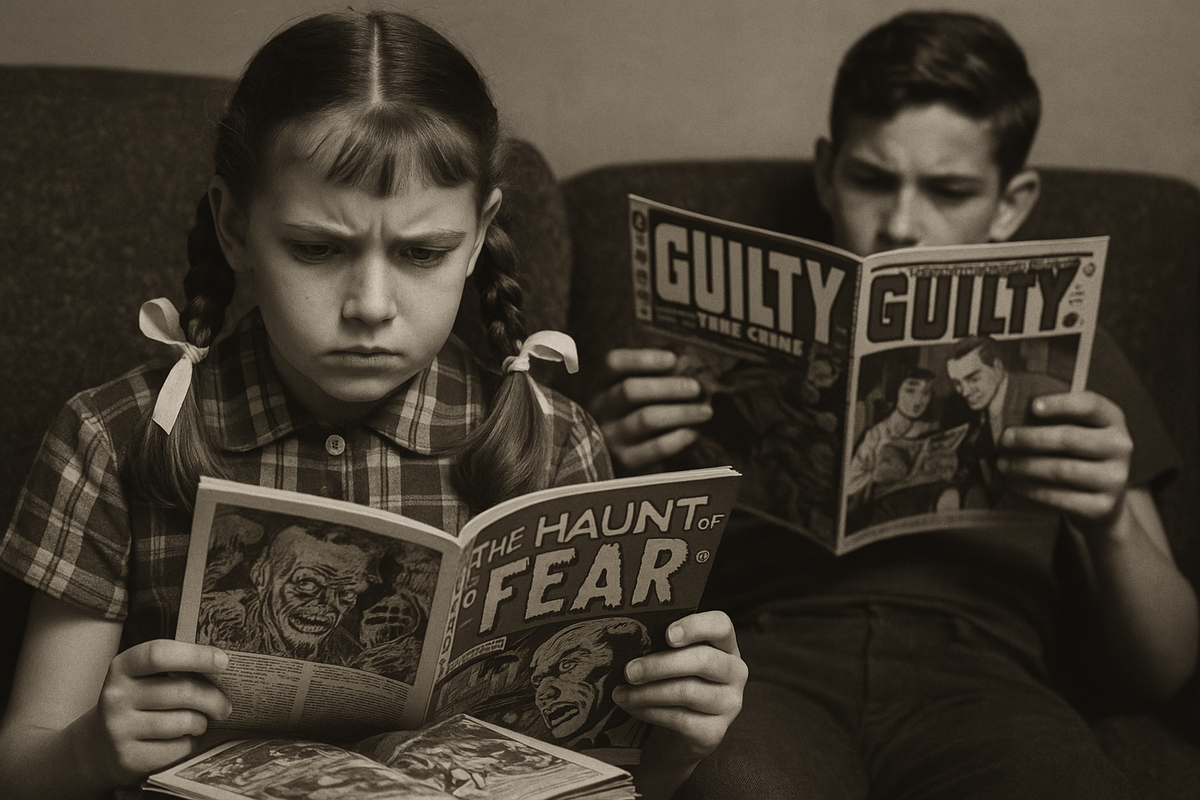
One photograph shows a young girl in pigtails, face absorbed in The Haunt of Fear. Another comic—equally violent—sits in her lap. Her expression is innocent. The juxtaposition is devastating.
A boy stares at a copy of Guilty, oblivious to the camera, lost in whatever depravity fills its pages.
The magazine reproduced actual comic panels: women attacked, gangsters threatening victims, a diagram labeling vulnerable human body parts for maximum damage. Captions screamed in all caps: "LOUSY!!! FILTHY!!!"
This wasn't journalism—it was evidence at trial. The children were exhibits. The comics were weapons. And mothers, reading in their living rooms, were the jury.
What the Article Really Revealed: A Nation Afraid of Itself
Strip away the rhetoric about comics, and Wertham's article exposes something deeper: Cold War America's terror about its own children.
The Soviet threat loomed abroad, but what if the real corruption was happening at home? What if American youth—raised on prosperity and permissiveness—were morally weaker than their Depression-era parents?
Comic books became a proxy for every anxiety the 1950s couldn't articulate: changing gender roles, youth independence, the erosion of parental authority, the fear that mass media could reach children before parents could intercept it.
Ladies' Home Journal gave those fears a name and a target. It empowered mothers to act as cultural police. It transformed private parenting into a civic duty.
The article was, ultimately, about control—who had it, who was losing it, and what had to be destroyed to regain it.
Cold War Anxiety
The fight for democracy abroad required moral strength at home—comics threatened that foundation.
Maternal Gatekeeping
Women's magazines empowered mothers as the cultural guardians of American households.
Media Panic Pattern
The 1953 comics scare established a template repeated with rock music, TV, video games, and social media.
Censorship Legacy
The Comics Code Authority's restrictions wouldn't be broken until the independent publishers of the 1980s-90s.
The Aftermath: An Industry on Its Knees
The Ladies' Home Journal article was the beginning, not the end. Wertham's 1954 Senate testimony sparked public hearings, publisher boycotts, and an industry-wide panic. To avoid government censorship, comic publishers created the Comics Code Authority—a self-imposed straitjacket.
The Code banned graphic violence, sexual content, disrespect for authority, and even the word "crime" in titles. Horror and crime comics were effectively outlawed. Publishers went bankrupt. Artists abandoned the medium.
American comics wouldn't recover their creative freedom until the 1980s underground movement and the 1990s independent publishers finally broke the Code's grip.
All of it traces back to November 1953. To a magazine. To a warning. To mothers who believed what they read.
Why This Issue Matters to Collectors Today
The November 1953 Ladies' Home Journal is more than a magazine—it's a primary source document in the history of American censorship.
Historic Rarity
One of the first mass-market publications of anti-comics rhetoric before Seduction of the Innocent.
Visual Documentation
Reproduced comic panels that are otherwise lost to history, now preserved in a mainstream magazine.
Cultural Significance
A window into how women's magazines shaped national debates and family policy.
Research Value
Essential for anyone studying media censorship, comic book history, or 1950s cultural politics.
To own this issue is to own the moment American culture declared war on its own popular art.
Vintage Magazines: Time Capsules of Cultural Warfare
This November 1953 issue isn't an outlier—it's emblematic of how magazines functioned as battlegrounds for American values. From wartime propaganda to feminist movements, from Cold War paranoia to generational conflict, these publications captured the tensions that defined their eras.
Ladies' Home Journal preserved not just Wertham's arguments but the visual grammar of 1950s fear: earnest children, alarming imagery, authoritative voices warning mothers to act.
For historians, it's invaluable. For collectors, it's irreplaceable.
Explore the Archive: Original Issues, Original History
The battle over comic books is just one story waiting in our archive. Decades of cultural debates, fashion revolutions, political upheavals, and everyday life preserved in original print.
Browse Ladies' Home Journal Magazine CollectionFrom the Great Depression to the Space Age, from suffrage to suburbs—every issue is an original artifact that shaped American consciousness.
The Legacy: A Moral Panic That Never Really Ended
The November 1953 Ladies' Home Journal stands as proof that entertainment has always been a battleground. The targets change—comics in the '50s, rock music in the '60s, video games in the '90s, social media today—but the script remains the same.
Someone warns that youth are being corrupted. Parents panic. Authorities intervene. Creative expression gets strangled.
Wertham's article wasn't an anomaly. It was a template.
And thanks to Ladies' Home Journal, that template is preserved in perfect, devastating detail—waiting for anyone willing to read it and recognize the cycle before it repeats again.
The magazine that tried to kill comics didn't succeed. But it came close enough to matter.
And that makes this issue essential reading for anyone who cares about culture, censorship, and the eternal war between generations over what stories children deserve to hear.