
The Saturday Evening Post, July 1, 1944: When Commando Kelly Brought the War Home
How a Pittsburgh sergeant's Medal of Honor confession became the most honest wartime narrative America had ever read
Charles E. Kelly didn't want to be a hero.
By the time The Saturday Evening Post published "One Man's War" in its July 1, 1944 issue, the Pittsburgh sergeant had already survived the inferno at Salerno, single-handedly repelled waves of German infantry, earned the Medal of Honor, and become one of the most decorated enlisted men in the European Theater. What he couldn't survive was the weight of what he'd done to earn it.
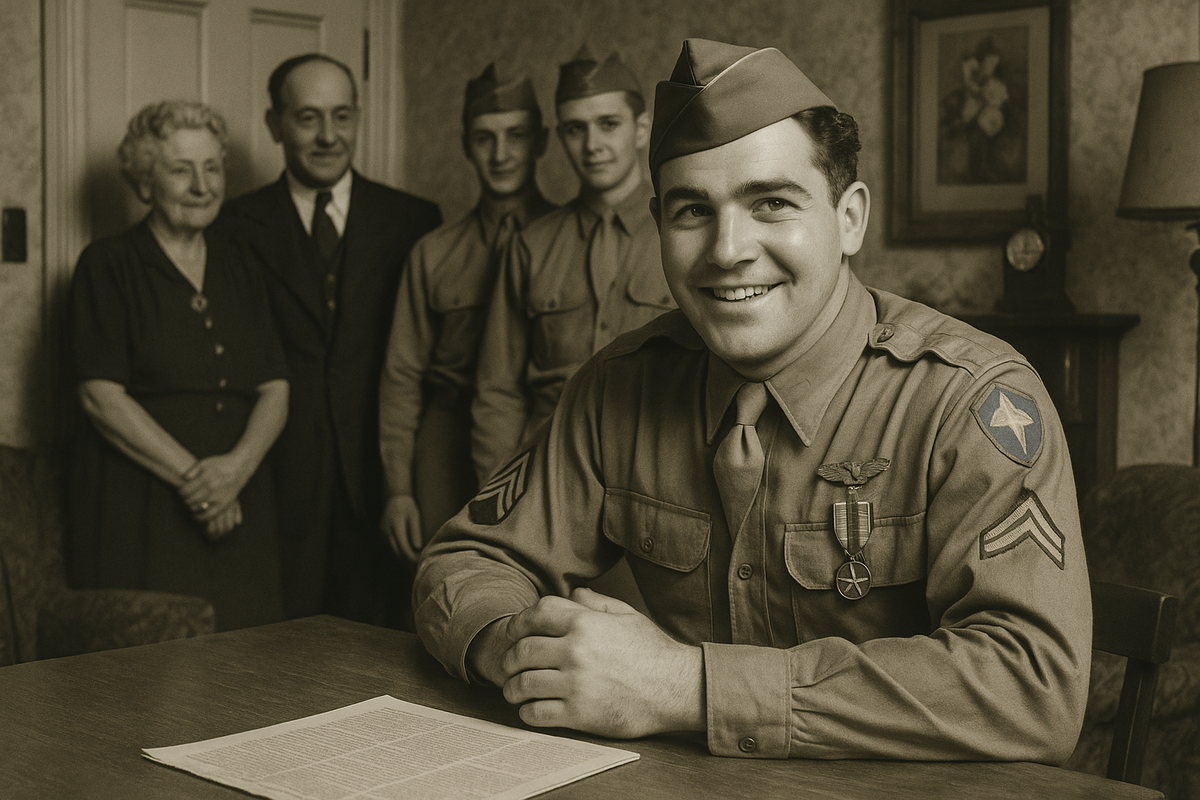
Americans who opened their mail that summer found Kelly staring back at them—not with the triumphant grin of propaganda posters, but with something harder to reconcile. This was a working-class kid from Pennsylvania who'd thrown grenades into machine-gun nests until his hands bled, who'd held a defensive position alone while his unit retreated, and who now sat in his family's Pittsburgh home trying to explain why he felt more haunted than heroic.
The timing was no accident. D-Day had shattered the Atlantic Wall just three weeks earlier. Every household in America was waiting for telegrams, scanning casualty lists, praying their sons would come home whole. The Post gave them Kelly instead: proof that ordinary men could perform extraordinary acts, but also a window into the brutal arithmetic of survival that no one wanted to calculate too closely.
This wasn't battlefield reporting. This was confession.
Archive Details
Historical Figure: Sgt. Charles E. "Commando" Kelly
Issue Date: July 1, 1944
Archive Source: The Saturday Evening Post
Feature Article: "One Man's War" by Pete Martin
Military Recognition: Medal of Honor (Battle of Salerno, 1943), Silver Star
The Strategic Moment
June 1944 marked the hinge point of the war. Allied forces were fighting through the hedgerows of Normandy. The Red Army was preparing its summer offensive. In the Pacific, American Marines were island-hopping toward Japan through a meatgrinder of coral and blood.
Against this backdrop, the Post's editors made a calculated decision: publish Kelly's story now, while the nation's attention was riveted on France, to remind readers what the fight had already cost in Italy—and what it would continue to demand.
Kelly's Medal of Honor stemmed from the Battle of Salerno in September 1943, where Allied forces fought a desperate eight-day struggle to secure their beachhead against German counterattacks. When his position came under sustained assault, Kelly remained at his post after others fell back, using hand grenades and rifle fire to break multiple German advances. His actions saved his company and became legend within the 36th Infantry Division.
But by July 1944, the propaganda value of Kelly's heroics had matured into something more valuable: a case study in what combat actually did to the men who fought it. Reporter Pete Martin's interview captured not just Kelly's tactical decisions at Salerno, but his moral reckoning with them—the grenades that killed German soldiers whose faces he never saw, the machine-gun fire that stopped men who were also someone's sons.
The Post understood that American readers in 1944 needed both inspiration and preparation. Kelly provided both.
The Saturday Evening Post's War
By 1944, the Post had become America's mirror—circulation hovering near three million, Norman Rockwell covers adorning living rooms and barbershops from coast to coast. Founded in 1821, the magazine had evolved from Benjamin Franklin's original gazette into the defining voice of middle-class American life.
What made the Post essential during wartime wasn't its battlefield coverage—newspapers and newsreels handled that. The Post specialized in something more intimate: the connection between the front lines and the home front, between national sacrifice and neighborhood pride, between the abstract concept of "the war effort" and the Kelly family of Pittsburgh, who had multiple sons in uniform and a photograph on the mantle of Charles receiving his medal from General Mark Clark.
The July 1 issue embodied this approach. Readers found Kelly's first-person combat narrative alongside Rockwell's latest cover, short fiction, cultural commentary, and advertisements that ranged from war bonds to soap. The magazine didn't segregate war content into a special section—it wove combat and domesticity together because that's exactly how Americans were living in 1944.
The visual storytelling matched the editorial ambition. Kelly appeared in full uniform, the weight of experience visible in his expression. His family surrounded him in another photograph—a Pittsburgh working-class household that could have been any household, except for the service stars in the window. Neighbors crowded the street outside the Kelly home, their faces reflecting both pride and anxiety. The award ceremony with General Clark provided the official validation, but it was the neighborhood scenes that made the story resonate.
This wasn't journalism in the detached sense. It was witness testimony, packaged for mass consumption.
What Kelly Told Them
"One Man's War" succeeded because Pete Martin let Kelly speak in his own voice—unpolished, direct, conflicted. The article's power came from what it included and what it refused to sanitize.
Kelly described the mechanics of killing: the trajectory of a grenade, the sound of a machine gun chewing through wooden beams, the moment when you stop thinking and just throw another explosive because the alternative is watching your friends die. He explained how fear and adrenaline collapsed time, how you could fight for hours and remember only fragments, how courage looked nothing like the movies suggested.
He also admitted uncertainty. Kelly questioned whether he'd done enough, whether the Germans he'd killed had families like his, whether the medal meant he was brave or just lucky enough to survive when others hadn't. The Post published these doubts without editorial commentary, trusting readers to wrestle with them.
The article traced Kelly's arc from Pittsburgh steelworker to combat soldier, from anonymous private to national symbol. But it also insisted that heroism didn't erase humanity—that the same man who saved his company at Salerno came home struggling with what that salvation had required.
Three awards anchored Kelly's military record: the Medal of Honor for his actions at Salerno, the Silver Star for a separate engagement, and the combat decorations that marked him as one of the most recognized enlisted men in the war. The Post documented all of them, but gave equal weight to Kelly's family—his brothers in service, his parents' pride mixed with fear, the community that claimed him as their own.
This balance—between individual heroism and collective sacrifice—defined the Post's wartime coverage. Kelly's story mattered not just because he'd fought well, but because his experience represented thousands of other young men who'd done the same without recognition.
The Rockwell Frame
Norman Rockwell's cover for the July 1, 1944 issue didn't depict combat. It didn't need to. Rockwell specialized in the emotional architecture of American life—the moments that defined why men like Kelly fought in the first place.
Inside, Rockwell's aesthetic sensibility infused the Kelly feature even where his brush hadn't touched it. The photographs of Kelly's neighborhood, his family, the ceremony with General Clark—all carried that same commitment to rendering American life with clarity and affection. The Post's visual language insisted that the war wasn't happening "over there" in some abstract sense. It was happening to Pittsburgh, to the Kelly family, to the neighbors on the street.
This approach transformed war coverage into something more durable than news. The Post created artifacts—issues that families saved, reread, and preserved as evidence of what they'd lived through.
Why It Endures
The Saturday Evening Post's wartime issues survive as more than collectibles. They function as time machines.
Every page carries the texture of its moment: the advertisements for war bonds and Victory gardens, the short fiction that distracted readers from casualty lists, the editorials that navigated between patriotism and honest reckoning. These weren't designed as historical documents—they were weekly magazines, consumed and discarded. That so many survived speaks to their emotional weight.
Families kept them. They folded issues carefully and stored them in attics, marking the weeks when sons were overseas, when telegrams arrived, when the war finally ended. The magazines became proxies for memory—physical objects that anchored stories too complex for simple telling.
Today, holding an original issue means touching 1944 directly. The paper stock rationed during wartime, the ink slightly faded, the pages that someone turned while waiting for news from Europe—these aren't replicas or digital scans. They're the actual artifacts that sat on American coffee tables while history was still undecided.
Collector Significance
Historical Convergence
Published three weeks after D-Day, this issue captures the war at its most uncertain point—victory probable but far from guaranteed, casualties mounting, the final cost still unknown.
Primary Source Rarity
Few Medal of Honor recipients published first-person combat accounts while the war was still being fought. Kelly's narrative offers unfiltered testimony from inside the experience.
Rockwell Provenance
Norman Rockwell covers command premium prices across all eras of the Post. Wartime Rockwell issues carry additional weight.
Cultural Documentation
The Kelly feature didn't just report news—it preserved a specific moment in American consciousness, when heroism and trauma were being negotiated in real time.
Condition Scarcity
Wartime paper rationing and the hard use these magazines endured means high-grade copies are increasingly difficult to locate.
Cross-Collector Appeal
Military historians seek this issue for Kelly's testimony. Rockwell collectors want the cover. Students of American culture value the complete package.
Explore The Archive
Our collection includes thousands of original Saturday Evening Post issues spanning the 1930s through the 1970s. Each decade tells its own story—Depression-era resilience, wartime sacrifice, postwar prosperity, the cultural upheavals of the 1960s—all documented in real time by the magazine that served as America's visual and narrative diary.
Browse The Saturday Evening Post Magazine CollectionConclusion
The July 1, 1944 issue of The Saturday Evening Post represents a collision of forces—military heroism, visual storytelling, cultural documentation, and the raw testimony of a young man trying to explain what killing does to the killer.
Charles Kelly didn't resolve those tensions. Neither did the Post. What they created instead was a record: proof that Americans in 1944 were asking hard questions about the cost of victory, even as they remained committed to achieving it.
For modern collectors, this issue offers more than nostalgia. It provides evidence of how a nation talked to itself during its most consequential crisis—honestly, painfully, with recognition that heroism and trauma weren't opposites but two sides of the same coin.
Kelly went to war an ordinary Pittsburgh kid. He came home a symbol. The Saturday Evening Post captured him in between, still processing what that transformation had required. That's what makes this issue invaluable—not the medal, but the man behind it, speaking directly across eight decades about what war asks and what it takes.