
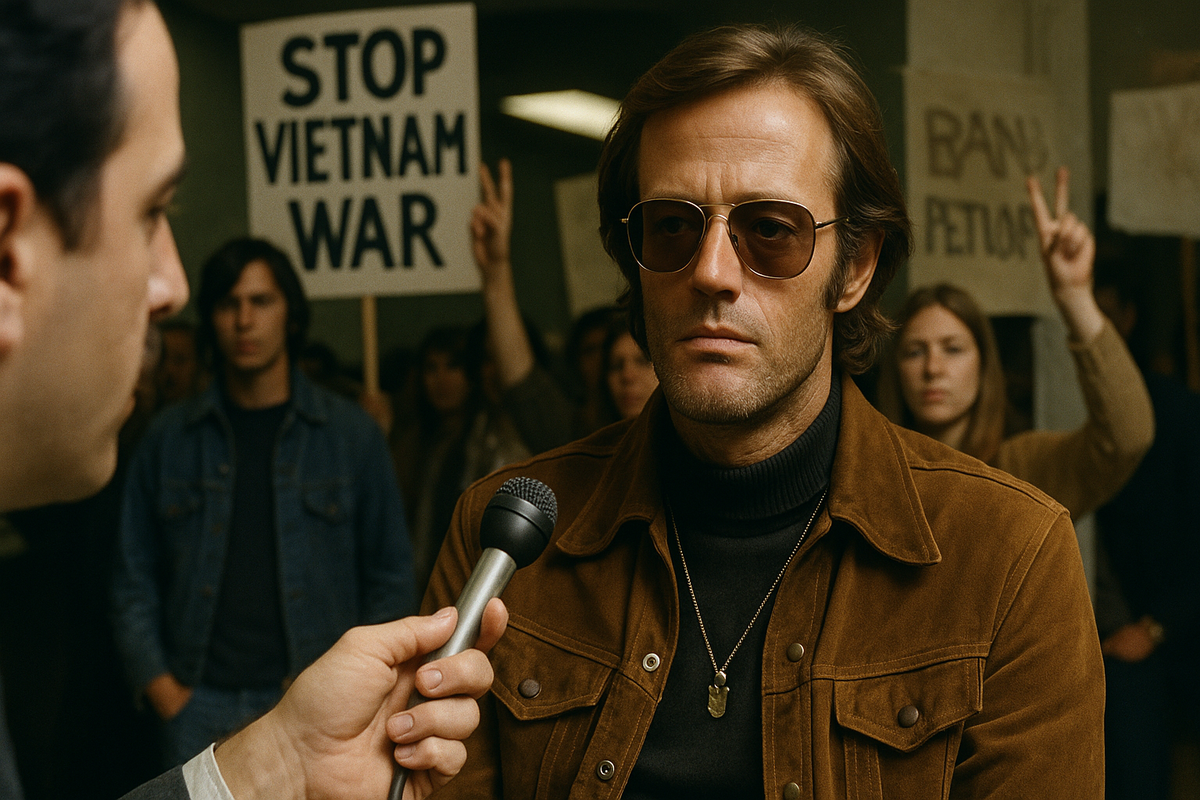
When Peter Fonda Told America to Go to Hell
The September 1970 Playboy Interview That Defined a Generation
Five months after National Guardsmen shot four students dead at Kent State, readers opened their September 1970 issue of Playboy Magazine to find Peter Fonda—Easy Rider's architect of rebellion—telling them exactly what the establishment didn't want to hear.
The cover model flashed a peace sign. Inside, Fonda declared war.
This wasn't celebrity puff journalism. It was a reckoning.
Archive Details
Historical Figure: Peter Fonda, Actor & Director
Issue Date: September 1970
Archive Source: Playboy Magazine
Historical Context: Published five months after Kent State shootings, amid peak Vietnam War protests
A Nation Coming Apart
By September 1970, America had fractured along fault lines that seemed irreparable. Vietnam consumed its fifty-eighth thousand American lives while tearing apart living rooms from coast to coast. The Kent State massacre in May had transformed college campuses into battlegrounds. The sexual revolution collided with women's liberation, the civil rights movement pushed against centuries of resistance, and the generation gap yawned into an abyss.
Playboy understood its moment. The magazine had spent the 1960s building a reputation that transcended its centerfolds—its interviews with Malcolm X, Jimmy Carter, Joan Baez, and Muhammad Ali had become primary sources for understanding American transformation. The Playboy Interview wasn't entertainment; it was documentation.
When the magazine turned its attention to Peter Fonda, it captured lightning in a bottle.
The Interview as Manifesto
Fonda arrived at the conversation carrying the credibility of Easy Rider, the 1969 film that had grossed $60 million on a $400,000 budget and redefined what American cinema could say. He wasn't promoting a project. He was testifying.
The interview sprawled across dozens of pages, but its themes struck with the force of hammer blows:
Vietnam and the Machinery of Obedience
Fonda condemned the war without equivocation, voicing the fury of a generation that refused to mistake obedience for patriotism. His words articulated what thousands were shouting in the streets: the system demanded compliance at the price of conscience, and conscience was no longer for sale.
Hollywood's Spiritual Bankruptcy
He dissected the film industry's obsession with commercial formulas and creative cowardice, contrasting it with Easy Rider's raw authenticity. For Fonda, Hollywood wasn't just artistically bankrupt—it was morally complicit in maintaining the very conformity his generation was rejecting.
Consciousness as Revolution
Fonda discussed LSD and marijuana not as recreational escapes but as tools for dismantling conditioned thought. In his framework, drugs weren't the counterculture's weakness but its methodology—a way to shatter inherited assumptions and explore alternative states of being.
The Unbridgeable Divide
His reflections on the generation gap captured something deeper than parental disappointment. He spoke to an entire cohort that felt existentially alienated from the values, wars, and hypocrisies of their parents' America.
Authenticity as Imperative – Threading through every theme was Fonda's demand for honesty—not as an abstract virtue but as a survival strategy. To live authentically in 1970 meant rejecting the masks that mainstream society required, even when that rejection cost everything.
For readers, the interview functioned less as a profile than as a philosophical statement. Fonda wasn't explaining himself; he was explaining them.
The Cover's Calculated Rebellion
The September 1970 cover marked a deliberate departure from Playboy's traditional glamour photography. The model's casual sweater, the hippie-inspired styling, and especially the prominent peace gesture announced the magazine's allegiance. This wasn't Playboy observing the counterculture—it was Playboy joining it.
The peace sign wasn't decoration. It was declaration.
The cover worked in tandem with the Fonda interview to position Playboy as something rare in 1970: a mainstream publication willing to platform radical critique without sanitizing it. While other entertainment magazines reduced celebrities to gossip and publicity, Playboy gave Fonda space to attack Hollywood, question authority, and advocate resistance.
The issue didn't just reflect its moment—it shaped it.
The Legacy of Playboy's Interview Series
The Playboy Interviews of the 1960s and 1970s represent some of the most significant journalism produced during those decades. By providing public figures with long-form space to develop complex arguments—space that network television and daily newspapers couldn't or wouldn't provide—the magazine created an archive of American thought at its most turbulent.
These interviews endure because they captured people speaking with unusual candor about ideas that mattered. They are historical records of how Americans argued with themselves about who they were and who they wanted to become.
Why This Issue Matters to Collectors
Historical Inflection Point
Published in the immediate aftermath of Kent State and amid the largest anti-war mobilizations in American history, the issue captures the counterculture at its apex of influence and fury.
Primary Source Documentation
Fonda's interview remains one of the most comprehensive articulations of counterculture philosophy from someone who lived it, not just observed it. His words document internal logic that later historical accounts often oversimplify or misrepresent.
Visual Iconography
The peace sign cover has become one of the defining images of Playboy's engagement with 1970s protest culture, reproduced in documentaries, exhibitions, and scholarly works on the period.
Contextual Richness
Beyond Fonda, the issue contains articles on abortion rights, shifting sexual norms, and campus activism—creating a comprehensive snapshot of every major social transformation happening simultaneously in 1970.
Enduring Relevance
The tensions Fonda articulated—between individual conscience and institutional authority, between authenticity and conformity, between profit and artistic integrity—remain unresolved in contemporary American life.
Cultural Time Capsule
Owning this issue means possessing a cultural document from a year when America's future hung in the balance—evidence of a moment when the nation questioned every assumption about itself.
Access the Archive
Original Playboy magazines from the 1960s and 1970s remain among the richest primary sources for understanding twentieth-century American culture. Each issue preserves not just articles and interviews but advertisements, editorial decisions, and design choices that collectively document how Americans lived and thought.
Browse Playboy Magazine CollectionA Time Capsule That Still Speaks
The September 1970 Playboy Magazine isn't simply a vintage collectible. It's evidence.
Evidence of a moment when America questioned every assumption about itself. Evidence of a generation that refused inherited answers. Evidence that magazines once served as forums for ideas too complex, too challenging, and too necessary for the limited bandwidth of broadcast media.
The cover's peace sign speaks to rebellion. The Fonda interview speaks to search for meaning. The pages collectively remind us that periods of social fracture produce their most important documents not in retrospect but in real time—written by people who don't yet know how the story ends.
For anyone who values cultural history not as nostalgia but as testimony, the September 1970 issue of Playboy remains essential reading. Not because it provides answers, but because it asked the right questions—questions America is still trying to answer.