
The Secret Diary Inside Teen Magazine
When Creedence Clearwater Revival Opened the Doors to Cosmo's Factory
March 1971. Vietnam still raged. Campus protests hadn't stopped—they'd hardened. And somewhere between the political fury and the fading psychedelia, America's teenagers were trying to figure out who they were supposed to become.
They found part of the answer in a magazine.
That month, Teen Magazine published something extraordinary: "A Solo Flight to Creedence Country," a photo-essay that did what few publications dared—it cracked open the rehearsal room doors at Cosmo's Factory and let readers walk inside. No velvet ropes. No publicist scripts. Just Creedence Clearwater Revival, unguarded and unfiltered, in the California headquarters where they were reshaping American rock.
For the teenage girls clutching that issue, this wasn't celebrity journalism. It was a backstage pass to the band that had become the soundtrack of their generation.
The Band That Refused to Be Psychedelic
By 1971, CCR had already conquered the charts with a sound that stood defiantly apart from the era's sonic experiments. While other bands drowned in reverb and studio effects, Creedence delivered stripped-down, swamp-soaked rock that hit like a freight train. "Fortunate Son." "Proud Mary." "Bad Moon Rising." These weren't songs—they were cultural statements, rallying cries that spoke to working-class frustration and wartime cynicism without pretense or poetry-class metaphors.
John Fogerty's gravelly howl carried both rage and rhythm. The band's music was roots-driven, blue-collar, and brutally direct. And unlike the sprawling jam bands of the time, CCR songs got in, made their point, and got out—usually in under three minutes.
This was the band Teen Magazine invited its readers to meet.
Archive Details
Featured Artists: Creedence Clearwater Revival (John Fogerty, Tom Fogerty, Stu Cook, Doug Clifford)
Issue Date: March 1971
Feature Title: "A Solo Flight to Creedence Country"
Location: Cosmo's Factory, California
Archive Source: Teen Magazine
Inside Teen: Where Youth Culture Lived
Teen Magazine occupied a singular space in early-'70s publishing. It wasn't Seventeen, with its haute-fashion aspirations. It wasn't Tiger Beat, with its wall-to-wall pin-ups of safe, scrubbed teen idols. Teen understood that its readers wanted more than beauty tips and horoscopes—they wanted access to the artists who shaped their world.
The March 1971 CCR feature proved it.
Written in a playful diary format—"Are your bags packed? Fasten your seatbelts and let's go!"—the piece transported readers straight into Cosmo's Factory. The story unfolded like a weekend adventure: a fan, somehow granted entry, watches the band rehearse, jokes with them between takes, and sees the creative engine up close.
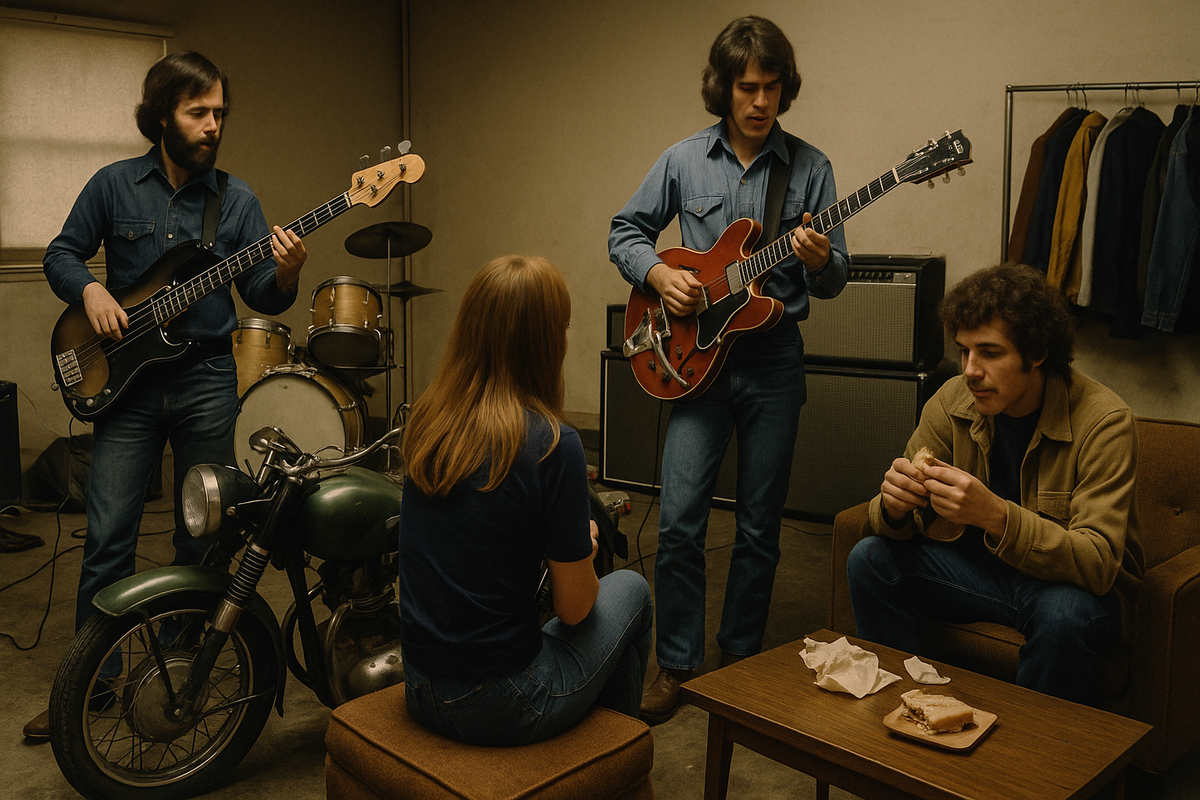
The photos told the real story. Black-and-white shots captured CCR in their element—rehearsing, laughing, sprawled on worn furniture. No stage makeup. No manufactured glamour. Just four guys in a lived-in rehearsal space that doubled as office and jam studio, surrounded by instruments and motorcycles. Doug Clifford and Stu Cook radiated easy humor. Tom Fogerty offered grounded reflections. And John Fogerty—always the engine—emerged as the band's serious creative force, relentlessly pushing CCR forward.
This wasn't idol worship. It was intimacy.
What Made This Feature Radical
Most rock coverage in 1971 fell into two categories: high-minded criticism in Rolling Stone or glossy promo shots in fan magazines. Teen did neither.
Instead, the magazine gave readers something more valuable: authenticity. The article showed CCR eating, working, and cracking jokes—not posing for album covers or delivering carefully rehearsed sound bites. Cosmo's Factory wasn't presented as some mythical temple of rock—it was a cozy, cluttered workspace where creativity happened in real time.
For teenage readers, this mattered. The feature said: These rock gods are people. They rehearse. They joke around. They work hard. They're not untouchable.
And crucially, Teen didn't condescend. The diary-style narration made readers feel like insiders, not observers. You weren't reading about CCR—you were riding motorcycles with them, sitting in on rehearsals, part of the circle.
The Mirror and the Time Capsule
Teenagers in 1971 saw themselves in Teen's pages. The magazine validated their concerns, entertained their fantasies, and gave them heroes who felt real. Features like "A Solo Flight to Creedence Country" showed that Teen understood its mission: not to talk down to readers, but to connect them with the cultural forces shaping their lives.
For readers then, Teen Magazine was identity. For collectors now, it's evidence.
Why This Issue Still Matters
For collectors of vintage youth media, this isn't just a magazine. It's a primary source document—proof of how music, identity, and teenage dreams collided in the space between the 1960s and whatever came next.
Where This Fits in Music History
The March 1971 Teen feature on Creedence Clearwater Revival stands as one of the most fascinating intersections of youth media and rock journalism from the era. It captured a major American band not as untouchable legends, but as working musicians with dirt under their nails and sweat on their instruments.
Holding this issue today means holding proof that youth culture mattered—that the music, dreams, voices, and style of 1971 teenagers weren't frivolous, but foundational.
For Creedence fans, this is a rare glimpse of the band through their youngest audience's eyes. For cultural historians, it's vital evidence of how youth media shaped identity. For collectors, it's treasure.
Because some artifacts don't just capture a moment—they let you walk back into it.
Explore More Original Magazines
Discover our curated collection of authentic vintage magazines from the 20th century
Browse Teen Magazine Collection